First-piece release, digital from second zero
In a plant that makes laminated windshields, every model start-up is released with a handwritten first-piece sheet: sag and curvature measured on the checking fixture, position of the printed black band, homologation mark, assembly thickness. That sheet decides whether the batch can run, yet today it sits in a folder next to the furnace until someone transcribes it. With iLEAN Connect, the inspector takes a photo right after signing and the release already exists in the central system, linked to the model, the shift and the tooling, with no change to the routine.
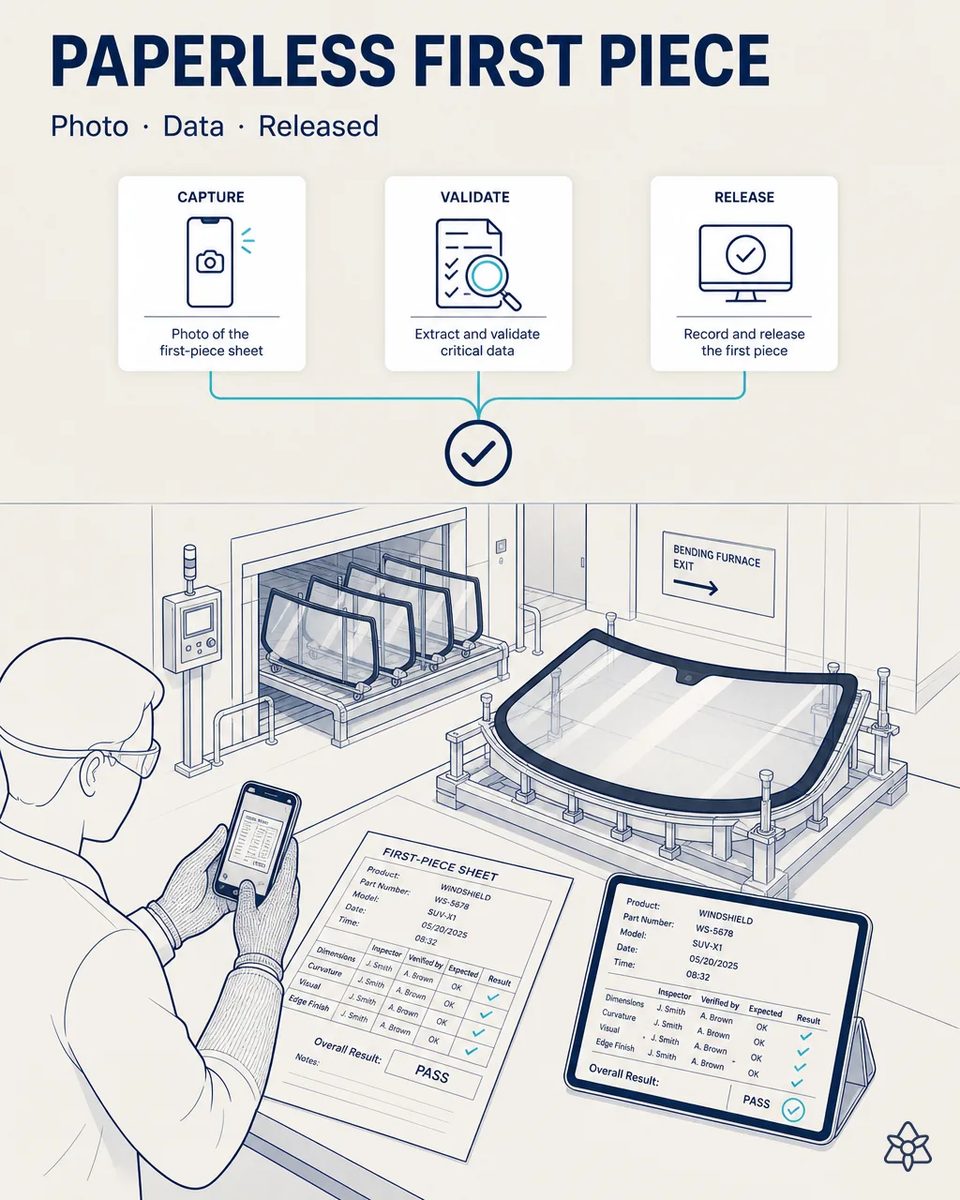
The sheet that releases the windshield model sits in a folder by the bending furnace.
The first-piece sheet and the rack traveler are the documents that prove a model started within specification. They are filled in by hand at the line, between the bending furnace and the inspection table, and can go a full shift without being digitized. When the OEM opens a claim and asks for the start-up evidence, someone has to find the right sheet among dozens. Notes in the margin, such as a mold adjustment or a remark about the flat glass lot, are valuable information that never reaches process engineering or supplier quality, because nobody transcribes margins.
- Every model start-up is released on a handwritten first-piece sheet: sag and curvature on the checking fixture, position of the printed black band, homologation mark and assembly thickness.
- It is filled in between the bending furnace and the inspection table, together with the rack traveler, and can go a full shift without being digitized. On night shifts and weekends the gap is longer still.
- When the OEM opens a claim and asks for the start-up evidence of a model, somebody has to find the right sheet among dozens — often from a shift that is no longer on site.
- The margin notes — a bending mold adjustment, a remark on the flat glass lot — never reach process engineering or supplier quality, because nobody transcribes margins.
Connect in photo mode — the inspector signs the sheet and photographs it.
Connect in photo mode. The inspector photographs the sheet with a phone or an industrial tablet; an anchored LLM recognizes the form layout, extracts the fields (model, tooling, measurements, signatures, remarks) and stores them in the iLEAN central memory, linked to the active production order. Any out-of-tolerance value is highlighted so the person in charge confirms it before it crosses into the system. Zero change of habit: the paper still exists, and now the data does too.
Nothing on the line changes: the sheet is still filled in by hand at the fixture and still signed. What changes is that, seconds after the signature, the release exists in the central system linked to the model, the tooling and the production order. It is usually the first case approved because it asks nobody to do anything new. And it is the case that makes every later claim cheaper to answer, because the start-up evidence is already there.
Windshield first-piece release on paper versus captured
| Aspect | Today, on paper | With iLEAN Connect |
|---|---|---|
| Release to record | 4-8 hours, sometimes a full shift | Seconds after the signature |
| Sag and curvature on the fixture | Handwritten, filed by date | Queryable by model and tooling |
| Black band and homologation mark | A tick on the sheet | Field linked to the model start-up |
| Bending mold adjustment in the margin | Lost | Extracted and sent to process engineering |
| Start-up evidence for an OEM claim | Hunting through folders | One query by model, shift or rack |
| Out-of-tolerance sag value | Seen when someone retypes it | Highlighted for confirmation |
From 4-8 hours between release and record to seconds. From hunting for paper during a claim to an instant query by model, shift or rack.
Impact estimate per model start-up — to be validated with your numbers.
The block below is an estimate to be validated against your plant's actual data. We put it forward so the committee has an order of magnitude; we refine it during the assessment.
- Estimated payback 4-9 months, depending on the number of model start-ups per shift. The more models a line runs, the faster it pays.
- Transcription time returned to the quality team, which today retypes sheets instead of analyzing them.
- From 4-8 hours between release and record to seconds, including the start-ups of the night shift.
- Faster claim response: the start-up evidence of a windshield model is found by query, not by searching a shelf.
Estimated payback of 4 to 9 months depending on the number of model start-ups per shift; transcription time returned to the quality team and faster claim response. Estimate to be validated.
And the fair question from the production manager
"What if it misreads a sag value or a band position?" — reading the fields of a first-piece sheet whose layout is always the same is an anchored task, where the best models drop below 1.5% error [1]. And there is a second net: any value outside the model's tolerance is highlighted, and the inspector confirms it on the tablet before it crosses into the system. The paper original stays in the folder, so there is always a source to check against.
[1] OpenAI paper "Why Language Models Hallucinate", 2025 — on the reliability of AI in anchored tasks.
What people ask about photographing the windshield first-piece sheet
Do we have to redesign the windshield first-piece sheet?
No. Vision recognizes the layout you already use, with its checking fixture measurements, black band position and homologation mark. If the sheet changes revision, the new layout is learned from a few examples. Inspectors keep the same pen, the same fixture and the same signature box.
Does it read the inspector's handwritten margin notes?
Yes, and they are often the most useful part: a bending mold adjustment or a remark on the flat glass lot. They are extracted as remarks and routed to process engineering or supplier quality. Today those notes die in the folder; with the photo they become a remark tied to the model and the flat glass lot.
Is the release linked to the bending tooling used?
Yes. The record is tied to the active production order, the model and the tooling, so a later query by mold returns every start-up made with it. That matters when a bending mold is reworked and you need to know which windshields came off it before and after.
What happens with the rack traveler that goes with the first parts?
It can be photographed in the same gesture. Linking the traveler to the release is what lets you follow a rack from the furnace exit to final inspection. Without it, the rack and its release are two pieces of paper that only a person can match.
Does it need MES integration before we can try it?
No. The case works from the first model start-up against iLEAN's central memory, and the push to the MES is connected once the value has been shown. Most plants prefer it that way: first the evidence on the floor, then the integration project.
More cases from this series
- Always audit-readyiLEAN gathers and sorts by requirement the quality evidence for every windshield: IATF and customer…
- Zero escaped defects: from receiving to the shipping rackFour iLEAN verification rings, from receiving to shipment, so that no defective windshield reaches the…
- The autoclave is the same machine, but now it talksA camera reads the autoclave panel and links the pressure and temperature curve to each windshield load,…
- Raw material receiving, traced with one photoA photo of the supplier's packing slip, labels and certificate: iLEAN records lot and expiry in the ERP…
- What the supervisor sees on the floor, recorded while walkingThe quality supervisor dictates findings by voice while walking the plant; iLEAN structures them and…
- Lab tests in the ERP, with no retypingiLEAN reads lab and incoming-inspection spreadsheets and, after human validation, posts them to the ERP.…
Tell us how many model start-ups you release per shift and where the sheets end up.
We work on your plant's real data, not ours. Assessment with no commitment.
Request estimated ROI within 48h ‹ See all cases of automotive glass See automotive