Always audit-ready
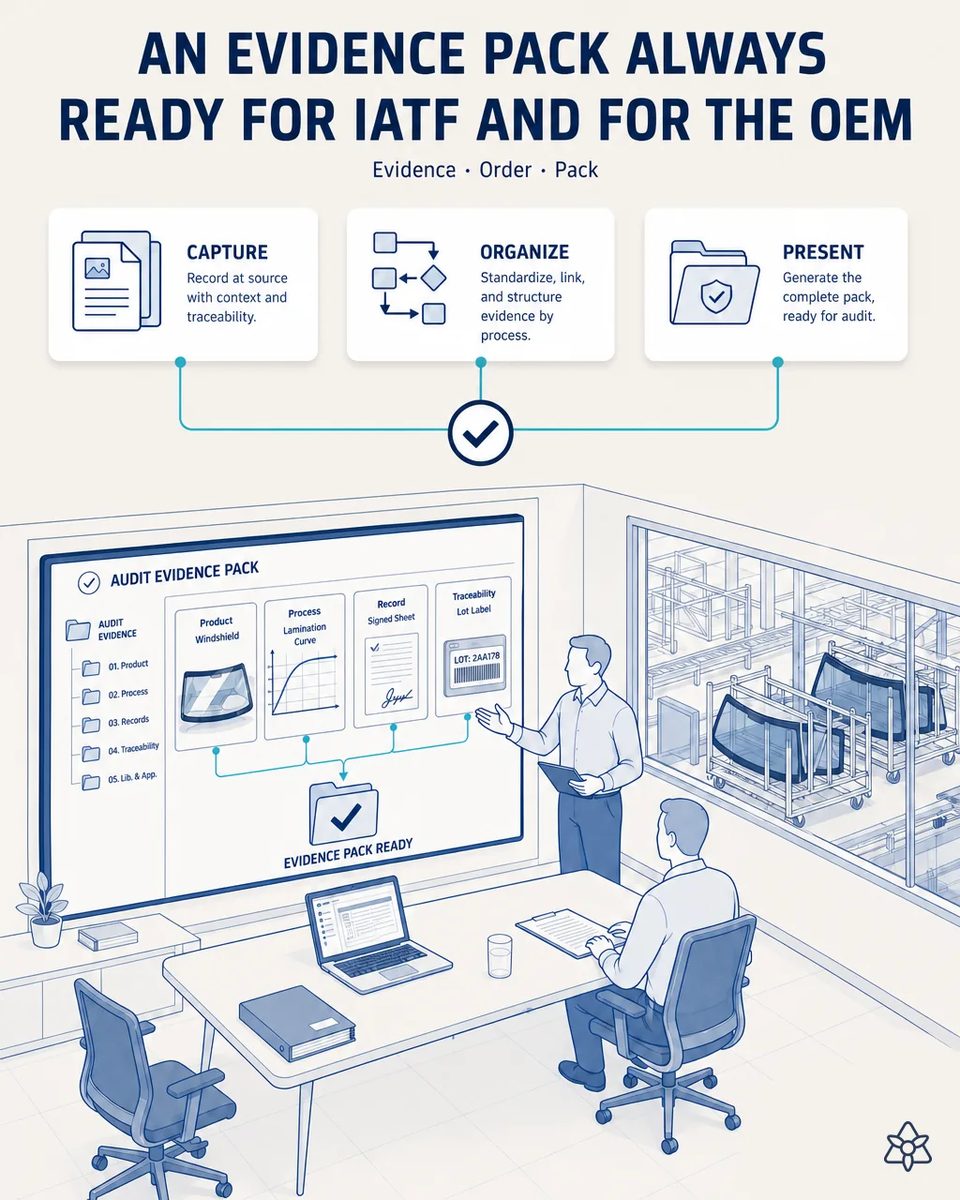
Before an IATF 16949 audit, an OEM process audit or the response to a formal claim, the quality team spends days rebuilding evidence: who released, with which measurements, which autoclave cycle, which PVB lot, which test. With iLEAN, that evidence was already generated at every step. Agents sort it by requirement and by part and assemble the pack: the auditor asks about a model and a period, and the person in charge shows it on screen within minutes. It also works upstream: the same pack supports a claim against a supplier.
The windshield plant generates its evidence — scattered in four places.
The plant does generate the evidence, but scattered: paper next to the furnace, Excel in the lab, records on the inspection computer, emails with the supplier. Pulling it together is manual work repeated for every audit, every claim and every 8D analysis. When a piece of the puzzle is missing, the auditor raises a finding, not because the process was wrong but because it could not be shown to be right.
- Before an IATF 16949 audit, an OEM process audit or a formal claim, the quality team spends days rebuilding who released, with which measurements, which autoclave cycle, which PVB lot, which test.
- The evidence exists, but on paper next to the furnace, in Excel in the lab, on the inspection computer and in emails with the supplier. Each source has its own owner and its own format.
- Pulling it together is manual work repeated for every audit, every claim and every 8D. With several OEMs auditing, the same evidence is rebuilt several times a year.
- When a piece is missing, the auditor raises a finding — not because the process was wrong, but because it could not be shown to be right.
Edge and Connect capture; Agents sort by clause and by customer requirement.
Edge and Connect capture; Agents organize. Every critical event, whether release, model changeover, autoclave cycle, test or receipt, leaves its evidence with timestamp, signature and measurement. An agent classifies it by clause of the standard and by customer-specific requirement, detects gaps before the auditor sees them and prepares drafts: the pack for a period, the traceability summary for a windshield, the facts section of an 8D. Every draft is reviewed and signed by a person.
Every critical event — release, changeover, autoclave cycle, test, receipt — already left its evidence with timestamp, signature and measurement. The agent's job is to sort it by requirement, find the gaps before the auditor does and prepare drafts a person reviews and signs. The auditor asks about a model and a period, and the answer is on screen within minutes. The same pack serves the IATF certification body, each OEM process audit and the response to a formal claim.
Rebuilding windshield evidence versus having the pack ready
| Aspect | Today | With iLEAN Agents |
|---|---|---|
| Pack for a model and period | Days of preparation | Available in minutes |
| Autoclave cycle of a load | Hunted in a paper log | Already attached to the windshield |
| Missing evidence | Found by the auditor | Detected and closed beforehand |
| 8D facts section | Written from scratch | Draft with traceability gathered |
| Customer-specific requirements | Prepared again per OEM | Same evidence, indexed per customer |
| Claim against a supplier | Evidence assembled by hand | The same pack, used upstream |
From days of preparation before each audit to a pack available in minutes. From findings for missing evidence to gaps detected and closed beforehand. From an 8D written from scratch to a draft with facts and traceability already gathered.
Impact estimate per audit and claim — to be validated with your numbers.
The block below is an estimate to be validated against your plant's actual data. We put it forward so the committee has an order of magnitude; we refine it during the assessment.
- Estimated payback 6-12 months, depending on audit and claim frequency. Plants with several OEMs and frequent claims see the shortest payback.
- Days of quality team work released at every audit, OEM claim and 8D. That time goes back to improvement work instead of document hunting.
- Lower risk of documentation findings, because gaps are detected when they occur, not on the auditor's day. A finding avoided is also a corrective action plan nobody has to write.
- And the same evidence supports claims against flat glass or PVB suppliers. The pack works upstream as well as downstream.
Estimated payback of 6 to 12 months depending on audit and claim frequency; days of quality team work released at every event and lower risk of documentation findings. Estimate to be validated.
And the fair question from the production manager
"Is the AI writing my audit evidence?" — no: it only sorts evidence that was captured, signed and timestamped at source. Classifying a record by IATF clause or customer requirement is an anchored task, where the best models drop below 1.5% error [1], and every pack, traceability summary or 8D draft is reviewed and signed by a person before anyone outside sees it. Nothing is generated that was not captured at source. If a piece of evidence is missing, the pack shows the gap instead of filling it. That honesty is exactly what an auditor values.
[1] OpenAI paper "Why Language Models Hallucinate", 2025 — on the reliability of AI in anchored tasks.
What people ask about the windshield audit evidence pack
Does one pack serve both the IATF auditor and the OEM?
The evidence is the same; what changes is the scheme it is indexed against. The agent sorts it by clause of the standard and by each customer's specific requirements. That is the work repeated today for every auditor that walks in.
Can it produce the traceability summary of a single windshield?
Yes: release, autoclave cycle, PVB and flat glass lots, tests and inspection result, assembled for that part as a draft to review. It is the document asked for first when an OEM opens a claim.
How does it detect a gap before the audit?
It knows which evidence each critical event should leave. When a release has no signature or a cycle has no curve, it flags it at the time it should have been generated. The gap is closed while the people involved still remember what happened.
Does it write the 8D for us?
It prepares the facts and traceability section as a draft. Root cause analysis and actions remain the team's work, and a person signs. What the team saves is the days spent gathering facts.
Does it work with records from before iLEAN?
The pack builds from day one forward. Older records stay where they are, and bringing them in is optional. Within a few months, the audited period is fully covered. From then on, every audit starts from a pack that already exists. Preparation becomes review, not reconstruction.
More cases from this series
- Zero escaped defects: from receiving to the shipping rackFour iLEAN verification rings, from receiving to shipment, so that no defective windshield reaches the…
- The autoclave is the same machine, but now it talksA camera reads the autoclave panel and links the pressure and temperature curve to each windshield load,…
- First-piece release, digital from second zeroHow a photo of the first-piece sheet puts the model release into the central system instantly in…
- Raw material receiving, traced with one photoA photo of the supplier's packing slip, labels and certificate: iLEAN records lot and expiry in the ERP…
- What the supervisor sees on the floor, recorded while walkingThe quality supervisor dictates findings by voice while walking the plant; iLEAN structures them and…
- Lab tests in the ERP, with no retypingiLEAN reads lab and incoming-inspection spreadsheets and, after human validation, posts them to the ERP.…
Tell us how many days your team spends preparing each IATF or OEM audit.
We work on your plant's real data, not ours. Assessment with no commitment.
Request estimated ROI within 48h ‹ See all cases of automotive glass See automotive