What the supervisor sees on the floor, recorded while walking
The quality supervisor in a windshield plant spends the shift walking between cutting, printing, furnaces, the clean room and final inspection, wearing cut-resistant gloves and often holding a part. They see things nobody else sees: a flat glass rack with damaged separators, a roller leaving a mark, a new operator who needs support. They cannot type, so almost all of it is lost when the shift ends. With iLEAN Connect in voice mode, they say it as they walk and the system turns it into a structured finding, linked to line and lot, and answers within seconds.
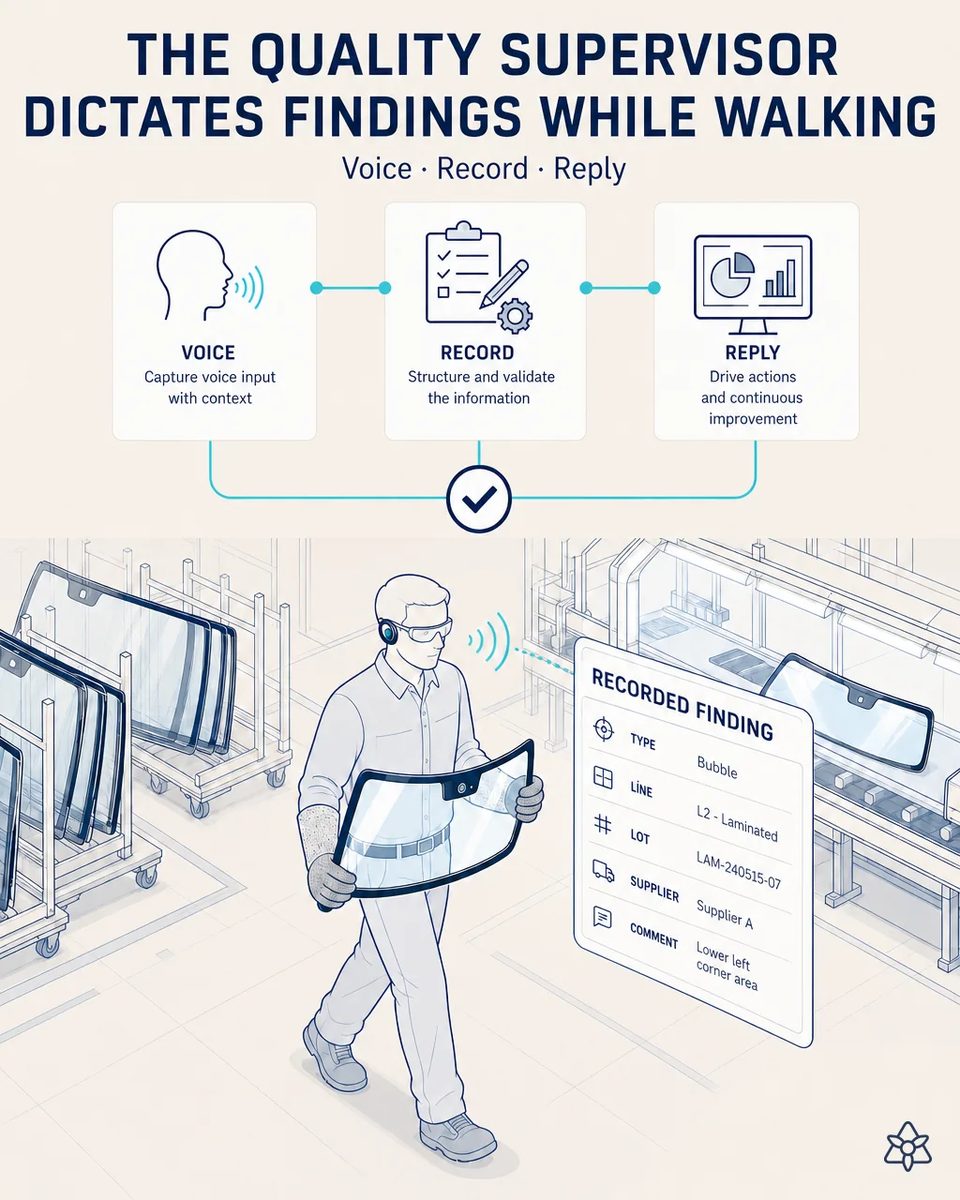
What the quality supervisor sees between the furnace and the clean room is lost by shift end.
The most useful knowledge in the plant lives in the heads of the people who walk the floor. Gloves, sleeves and the glass itself make it impractical to pull out a phone or walk to a terminal, so the finding is written from memory at the end of the shift, if at all. As a result, patterns take weeks to surface: three supervisors separately notice that a certain supplier delivers racks with damaged separators, but nobody connects it until it shows up as scratches at final inspection.
- The quality supervisor walks between cutting, printing, the bending furnaces, the clean room and final inspection, wearing cut-resistant gloves and often holding a part.
- They see what nobody else sees: a flat glass rack with damaged separators, a roller leaving a mark, a new operator who needs support at the PVB lay-up. None of it fits in a checklist, and all of it matters.
- Gloves, sleeves and the glass itself make it impractical to pull out a phone or walk to a terminal, so the finding is written from memory at shift end, if at all.
- Patterns take weeks to surface: three supervisors separately notice damaged separators from one supplier, and nobody connects it until it shows up as scratches at final inspection.
Connect in voice mode — an earpiece, a wake word and the finding structured on the move.
Connect in voice mode with a Bluetooth earpiece and a wake word. The supervisor says, for example: 'note that the flat glass rack from the latest shipment has damaged separators, I want a photo and a heads-up to receiving'. An anchored LLM structures the dictation as a finding, links it to the active line, shift, lot and supplier, and stores it in central memory. Where relevant it answers through the earpiece: 'receiving confirms, they are quarantining the rack and expect you in ten minutes'. The person leads; the system takes notes and coordinates.
The supervisor keeps leading: they decide what to say and when. iLEAN takes the note, links it to the active line, shift, lot and supplier, and coordinates the follow-up — a photo request, a heads-up to receiving — answering through the same earpiece. It is the difference between a finding that dies at shift end and one that reaches receiving in minutes. Over months, that record becomes the plant's quality memory, searchable by line, lot and supplier.
The quality round from memory versus the dictated round
| Aspect | Today | With iLEAN Connect |
|---|---|---|
| Finding on the floor | Written at shift end, if at all | Recorded as it is seen |
| Damaged rack separators | A comment in the handover | Finding linked to supplier and shipment |
| Roller leaving a mark | Remembered by one person | Linked to line and furnace |
| Pattern across supervisors | Weeks to surface | Visible within days |
| Heads-up to receiving | A walk or a phone call | Sent from the earpiece |
| Supplier claim | Based on memory | Backed by dated findings |
From findings lost at the end of the shift to a real-time record linked to lot and supplier. From patterns that take weeks to surface to patterns visible within days.
Impact estimate for the quality round — to be validated with the quality manager.
The block below is an estimate to be validated against your plant's actual data. We put it forward so the committee has an order of magnitude; we refine it during the assessment.
- Indicative payback 6-12 months, though it is hard to monetize upfront. We would rather say so than inflate a number.
- Its real value is as the foundation of continuous improvement: findings that exist as data instead of in someone's head.
- Better-supported supplier claims, because damaged separators or contaminated racks are recorded with date, shipment and lot. A claim built on dated findings from three supervisors is hard for a supplier to dispute.
- Patterns across shifts and supervisors become visible within days instead of weeks. The separator problem is seen in the first week, not after the scratches appear.
Hard to monetize upfront, but it is the foundation of continuous improvement and of well-supported supplier claims. Indicative payback of 6 to 12 months. Estimate to be validated with the quality manager.
And the fair question from the production manager
"Is this a way of recording my people?" — no: iLEAN listens only after the supervisor's wake word, and only to what they choose to dictate. There is no continuous listening and operators are not recorded. Turning a dictation into a finding with line, lot and supplier is an anchored task, where the best models drop below 1.5% error [1], and the supervisor can correct it before it is stored. What is not dictated does not exist for the system. The supervisor stays in command of what is recorded.
[1] OpenAI paper "Why Language Models Hallucinate", 2025 — on the reliability of AI in anchored tasks.
What people ask about dictating glass quality findings hands-free
Does it work with cut-resistant gloves and a part in hand?
That is the design condition. Nothing has to be touched: the wake word opens the dictation and the earpiece answers, so both hands stay on the glass. For someone carrying a windshield, that is the only workable interface.
Can it hear over furnace fans and conveyors?
Recognition is prepared for industrial noise and for trade vocabulary: PVB, separators, sag, black band, autoclave load. It is tested on your floor before deployment. Clean-room and furnace areas are checked separately, because their noise is different.
How does it know which lot or supplier a finding refers to?
From the active line and shift, and from what the supervisor says. If the lot is ambiguous, it asks back through the earpiece instead of guessing. A finding with the wrong lot is worse than no finding, so it prefers to ask.
Can a dictation trigger an action in another area?
Yes: a heads-up to receiving, a photo request or a quarantine proposal. The other area confirms, and the supervisor hears the answer in the earpiece. The loop closes without anyone leaving their area.
Does it replace the shift handover meeting?
No, it feeds it. The handover starts from a written list of the shift's findings instead of from what each person remembers. The incoming shift sees the open findings and who is following each one.
More cases from this series
- Always audit-readyiLEAN gathers and sorts by requirement the quality evidence for every windshield: IATF and customer…
- Zero escaped defects: from receiving to the shipping rackFour iLEAN verification rings, from receiving to shipment, so that no defective windshield reaches the…
- The autoclave is the same machine, but now it talksA camera reads the autoclave panel and links the pressure and temperature curve to each windshield load,…
- First-piece release, digital from second zeroHow a photo of the first-piece sheet puts the model release into the central system instantly in…
- Raw material receiving, traced with one photoA photo of the supplier's packing slip, labels and certificate: iLEAN records lot and expiry in the ERP…
- Lab tests in the ERP, with no retypingiLEAN reads lab and incoming-inspection spreadsheets and, after human validation, posts them to the ERP.…
Tell us how your quality supervisors record what they see on the floor today.
We work on your plant's real data, not ours. Assessment with no commitment.
Request estimated ROI within 48h ‹ See all cases of automotive glass See automotive