Lab tests in the ERP, with no retyping
In a laminated windshield plant, the lab and incoming inspection live in Excel: adhesion test, boil test, light transmission, optical distortion, PVB moisture, dimensions of incoming flat glass. These are the live quality data, yet the ERP needs someone to retype them. iLEAN Connect observes the shared folder, reads each file when it is saved, interprets it with an anchored LLM and, after the person in charge validates, inserts it into the ERP quality module. The lab keeps working the same way and double entry disappears.
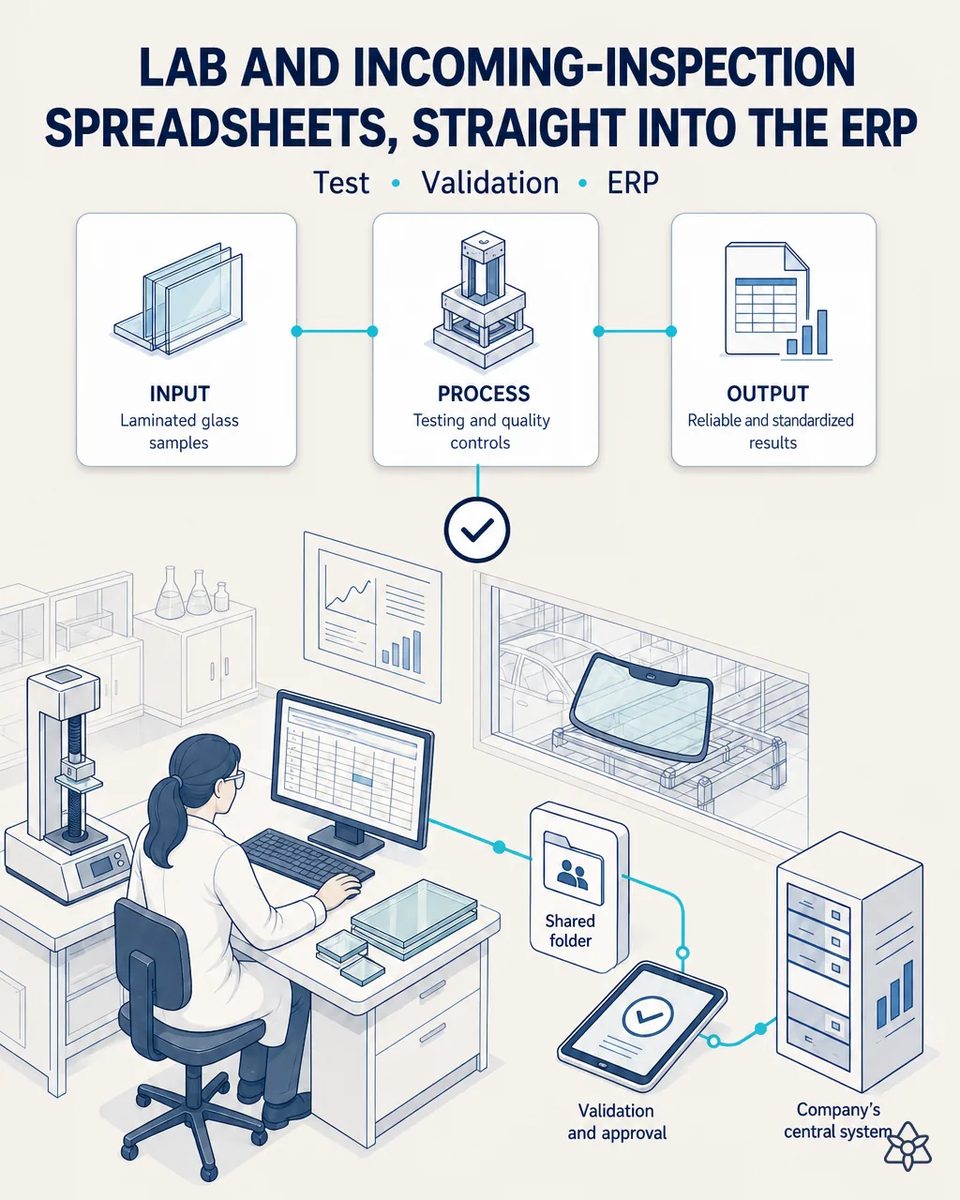
Laminated glass test results live in two worlds that never match.
There are two parallel worlds: the real spreadsheet, where the analyst logs each test, and the official ERP record, fed by transcription, late and with errors. When a supplier disputes a rejection or an auditor asks for the trend of a test, the two have to be reconciled. On top of that, every person who logs into the ERP only to key in results needs a quality module license. It is a recurring cost that buys nothing but typing.
- The lab and incoming inspection live in Excel: adhesion test, boil test, light transmission, optical distortion, PVB moisture and dimensions of incoming flat glass. Each analyst has refined their own sheet over years.
- The official ERP record is fed by transcription, late and with errors. Between the test and the record, days or weeks can pass. In that window, a bad lot can be released on data nobody has seen officially.
- When a supplier disputes a flat glass rejection or an auditor asks for the trend of a test, the spreadsheet and the ERP have to be reconciled by hand.
- And every person who logs into the ERP only to key in results needs a quality module license: a recurring cost that buys nothing but typing.
Connect in inward-listening mode — it watches the shared folder, not the analysts.
Connect in inward-listening mode: it observes the shared folder, not the people, detects the change when the file is saved, interprets the sheets even when the layout varies from one analyst to another, and leaves the results in central memory linked to lot, supplier and model. The person in charge validates on the tablet and Connect posts to the ERP through its API. If a value breaks a trend, it is highlighted before crossing. CFO angle, direct savings in ERP licenses: if four or five people in the lab and receiving log into the ERP only to enter results, that is four or five quality module licenses. With Connect, only the person who validates needs one: from N licenses to 1. Typical reduction of 50-80% in licenses for that module, a recurring annual saving that depends on the ERP vendor's price list.
The lab keeps its spreadsheets, its layouts and its way of working. Connect detects each save, interprets the sheet even when the layout varies from one analyst to another, and after validation posts to the ERP through its API. Double entry disappears, and so do the licenses that only existed for it. For the auditor asking for the trend of a test, there is finally one source.
The laminated glass lab in Excel versus the lab posted to the ERP
| Aspect | Today | With iLEAN Connect |
|---|---|---|
| Test to official record | Days or weeks | Seconds after validation |
| Boil and adhesion results | Retyped by hand | Read from the saved file |
| Analyst-specific layouts | A barrier to automation | Interpreted as they are |
| Value breaking a trend | Seen in the monthly review | Highlighted before crossing |
| Disputed flat glass rejection | Excel and ERP reconciled by hand | One source, linked to the lot |
| Quality module licenses for glass lab staff | One per person keying results | One per validator |
From days or weeks between test and official record to seconds. From monthly hours of transcription to zero. From reconciling Excel and ERP in front of an auditor to a single source.
Impact estimate for the glass lab — to be validated against your actual ERP invoice.
The block below is an estimate to be validated against your plant's actual data. We put it forward so the committee has an order of magnitude; we refine it during the assessment.
- Estimated payback 4-9 months, plus the recurring annual saving in quality module licenses.
- If four or five people in the lab and receiving log in only to enter results, only the validator needs a license: typical reduction of 50-80% in that module, depending on the vendor's price list.
- Monthly transcription hours go to zero, and the official record arrives in seconds instead of days. The analysts spend that time on tests, not on typing.
- And supplier disputes and audits are answered from one source instead of two that have to be reconciled. There is no longer a version of the truth that lives only on someone's desktop.
Estimated payback of 4 to 9 months, plus the recurring annual saving in quality module licenses. Estimate to be validated against the actual ERP invoice.
And the fair question from the production manager
"Every analyst builds the sheet differently — will it read them right?" — interpreting a test spreadsheet whose fields and units are known, even with layout variations, is an anchored task, where the best models drop below 1.5% error [1]. And a light transmission or PVB moisture value that breaks its trend is highlighted, so the validator sees it before it reaches the ERP. The analyst's original file is never modified. If the validator corrects a value, both versions are kept with their author.
[1] OpenAI paper "Why Language Models Hallucinate", 2025 — on the reliability of AI in anchored tasks.
What people ask about posting laminated glass lab results to the ERP
Do the analysts have to change their test spreadsheets?
No. Connect interprets each sheet as it is, including layouts that vary from one analyst to another. The lab keeps working the same way. No template project, no new form to fill in.
Which laminated glass tests does it cover?
The ones the lab already logs: adhesion, boil test, light transmission, optical distortion, PVB moisture and incoming flat glass dimensions. Each is linked to its lot, supplier and model. New tests can be added when the lab adds them, without changing the flow.
How does the result reach the ERP?
Through the ERP's API, after the person in charge validates on the tablet. Nobody types into the quality module anymore. If the API is not available, the push is agreed with your ERP team before starting.
How is the license saving calculated?
By counting who logs into the quality module only to enter results. With Connect, only the validator needs a license, and the saving is checked against your actual ERP invoice. It is a recurring saving, so it keeps paying after the payback.
Does it help when a supplier contests a rejection?
Yes: the incoming inspection result is linked to the flat glass or PVB lot and its certificate, so the discussion starts from one record instead of two. And the trend of that supplier's results is already in the ERP when the discussion starts.
More cases from this series
- Always audit-readyiLEAN gathers and sorts by requirement the quality evidence for every windshield: IATF and customer…
- Zero escaped defects: from receiving to the shipping rackFour iLEAN verification rings, from receiving to shipment, so that no defective windshield reaches the…
- The autoclave is the same machine, but now it talksA camera reads the autoclave panel and links the pressure and temperature curve to each windshield load,…
- First-piece release, digital from second zeroHow a photo of the first-piece sheet puts the model release into the central system instantly in…
- Raw material receiving, traced with one photoA photo of the supplier's packing slip, labels and certificate: iLEAN records lot and expiry in the ERP…
- What the supervisor sees on the floor, recorded while walkingThe quality supervisor dictates findings by voice while walking the plant; iLEAN structures them and…
Tell us how many people log into your ERP only to type glass lab results.
We work on your plant's real data, not ours. Assessment with no commitment.
Request estimated ROI within 48h ‹ See all cases of automotive glass See automotive