Raw material receiving, traced with one photo
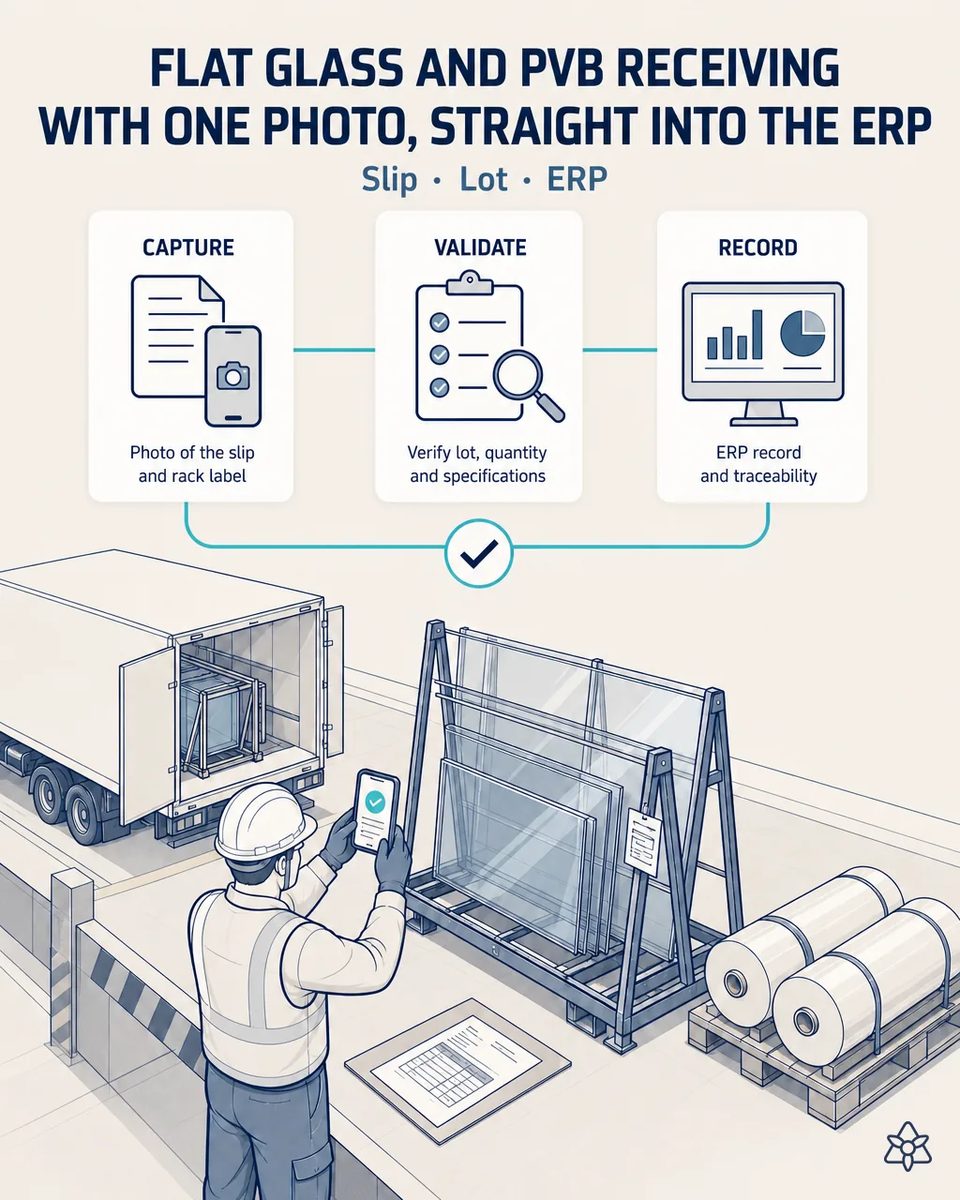
The truck arrives with racks of flat glass or refrigerated PVB rolls. The receiving lead is holding the packing slip, the labels of each rack or roll and the lot's certificate of quality, and has to key everything into the ERP line by line while the carrier waits. With iLEAN Connect, they take photos with a phone: the system extracts supplier, material, glass thickness and tint, lot, quantity, manufacturing date and PVB expiry, compares it with the purchase order and, after one validation tap, inserts it into the ERP. Receiving stops being a bottleneck and traceability is complete from the start.
The first link of windshield traceability is keyed in a rush.
Raw material receiving is the first link in a windshield's traceability, and it is where the rush is greatest. With the truck waiting, lots are keyed in by hand, sometimes summarized, sometimes at the end of the shift. A PVB lot entered wrong, or a roll whose expiry nobody recorded, does not hurt that day: it hurts weeks later, when a containment has to be scoped and nobody knows which windshields it went into. The supplier's certificate of quality usually ends up in a folder, never compared with the specification. For supplier quality it is a missed opportunity: the data to rate the supplier arrives with every shipment and goes unused.
- The truck arrives with racks of flat glass or refrigerated PVB rolls, and the receiving lead has to key packing slip, labels and certificate into the ERP line by line while the carrier waits. Every minute at the dock is a minute the carrier may charge for.
- With the rush, lots are entered summarized or at the end of the shift.
- A PVB lot entered wrong, or a roll whose expiry nobody recorded, does not hurt that day: it hurts weeks later, when a containment has to be scoped and nobody knows which windshields it went into. The containment then has to be widened to everything that could have used it.
- The supplier's certificate of quality ends up in a folder, never compared with the specification, and the data to rate the supplier goes unused.
Connect in photo mode with ERP output — packing slip, labels and certificate in three photos.
Connect in photo mode with ERP output. The receiving lead photographs the packing slip, the labels and the certificate. iLEAN vision recognizes each supplier's format without asking them to change it, reads barcodes, QR codes or plain text, and builds the complete receipt. It compares against the purchase order and the specification (thickness, tint, remaining PVB shelf life) and highlights differences. The lead validates with one tap and Connect posts to the ERP through its API. The certificate stays linked to the lot and feeds the supplier rating. CFO angle, direct savings in ERP licenses: the receiving and warehouse module usually needs two or three active licenses per shift just to enter receipts. With Connect, one person validates with a tap: from N licenses to 1. Typical reduction of 50-70% in licenses for that module, plus the elimination of carrier detention charges.
Suppliers are not asked to change their format: vision recognizes each one as it is. Thickness, tint, lot, manufacturing date and PVB expiry are compared with the purchase order and the specification before the lead validates with one tap. Receiving stops being a bottleneck and traceability starts at the dock. It is also where every later containment is scoped, so errors here cost the most. Getting the lot right at the dock is cheaper than any containment downstream.
Flat glass and PVB receiving keyed versus photographed
| Aspect | Today | With iLEAN Connect |
|---|---|---|
| Data entry per truck | 30-45 minutes | About 5 minutes |
| PVB roll expiry | Sometimes not recorded | Read and checked against shelf life |
| Glass thickness and tint | Assumed from the order | Compared with the specification |
| Certificate of quality | Filed in a folder | Linked to the lot, feeding the supplier rating |
| Lot-to-windshield traceability | Broken at receiving | Complete from the dock |
| Carrier detention | Charged when unloading drags | Eliminated |
From 30-45 minutes of data entry per truck to about 5 minutes. From summarized or late lot entry to lot-to-windshield traceability from receiving. From filed certificates to certificates checked against specification.
Impact estimate at the receiving dock — to be validated with your actual shipment volume.
The block below is an estimate to be validated against your plant's actual data. We put it forward so the committee has an order of magnitude; we refine it during the assessment.
- Estimated payback 3-8 months, plus recurring annual savings in licenses and detention. Both savings repeat every year after the payback.
- From 30-45 minutes of data entry per truck to about 5.
- The receiving and warehouse module goes from two or three active licenses per shift to one validator: typical reduction of 50-70% in that module.
- And every flat glass or PVB lot can be followed to the windshields it went into, which is what scopes a containment. Scoping by lot instead of by month is where most of the hidden value sits.
Estimated payback of 3 to 8 months, plus recurring annual savings in licenses and detention. Estimate to be validated with actual shipment volume.
And the fair question from the production manager
"Every supplier prints its labels differently — will it get them right?" — reading supplier, lot, thickness, tint and expiry from a packing slip, a rack label or a roll label is an anchored task, where the best models drop below 1.5% error [1]. Barcodes and QR codes are read directly, any difference against the purchase order is highlighted, and nothing reaches the ERP before the lead's tap. The photos stay attached to the receipt as evidence. If a lot is later disputed, the original label is one click away.
[1] OpenAI paper "Why Language Models Hallucinate", 2025 — on the reliability of AI in anchored tasks.
What people ask about receiving flat glass and PVB with a photo
Do suppliers have to adopt a standard label or packing slip?
No. Vision recognizes each supplier's format as it is and reads barcodes, QR codes or plain text. Nothing is asked of the supplier. A new supplier format is learned from a few receipts.
Does it check the remaining shelf life of PVB rolls?
Yes. Manufacturing date and expiry are read from the roll label and compared with the minimum shelf life you define, and a short-dated roll is highlighted before it is accepted. A roll accepted with little life left is a clean-room problem weeks later.
Does it compare the certificate with our specification?
Yes: thickness, tint and the values the certificate carries are checked against the specification, and the certificate stays linked to the lot for the supplier rating. Every shipment adds a data point to that rating without extra work.
What happens if the quantity does not match the purchase order?
The difference is highlighted on the validation card. The receiving lead decides whether to accept, accept partially or open a claim. Whatever they decide is what reaches the ERP, with their signature.
Does the carrier still have to wait?
Much less: data entry goes from 30-45 minutes per truck to about 5, which is what removes detention charges. And the dock is free sooner for the next truck.
More cases from this series
- Always audit-readyiLEAN gathers and sorts by requirement the quality evidence for every windshield: IATF and customer…
- Zero escaped defects: from receiving to the shipping rackFour iLEAN verification rings, from receiving to shipment, so that no defective windshield reaches the…
- The autoclave is the same machine, but now it talksA camera reads the autoclave panel and links the pressure and temperature curve to each windshield load,…
- First-piece release, digital from second zeroHow a photo of the first-piece sheet puts the model release into the central system instantly in…
- What the supervisor sees on the floor, recorded while walkingThe quality supervisor dictates findings by voice while walking the plant; iLEAN structures them and…
- Lab tests in the ERP, with no retypingiLEAN reads lab and incoming-inspection spreadsheets and, after human validation, posts them to the ERP.…
Tell us how long a flat glass truck waits at your dock while it is keyed in.
We work on your plant's real data, not ours. Assessment with no commitment.
Request estimated ROI within 48h ‹ See all cases of automotive glass See automotive