Zero escaped defects: from receiving to the shipping rack
The capital pain of an automotive glass plant is the defect that escapes: a windshield with contamination, a scratch, a bubble, distortion or the wrong configuration that reaches the OEM's line. Every escape costs sorting at the customer's site, chargebacks, points on the supplier scorecard and, at worst, a campaign. The iLEAN system coordinates the eleven previous pieces into four verification rings that cross-check each other: raw material, process, product and shipment. If the four do not match for a rack, the rack is not released, and an agent hands the person in charge the reason and the proposed containment.
Windshield escapes rarely come from a missing control.
Automotive glass defects have many entry doors: the supplier's flat glass, the PVB, clean-room cleanliness, the autoclave cycle, a model changeover, a wrong component. Each area controls its own door, but nobody crosses all the signals part by part and in real time. That is why escapes are rarely due to a missing control; they happen because one control's information did not reach the next in time. And when it happens, scoping which racks are affected takes days, so containment is done by excess.
- The capital pain is the defect that escapes: contamination, a scratch, a bubble, distortion or the wrong configuration reaching the OEM's line.
- Each escape costs sorting at the customer's site, chargebacks, points on the supplier scorecard and, at worst, a campaign. And the scorecard remembers long after the sorting ends.
- The defects have many entry doors — flat glass, PVB, clean-room cleanliness, the autoclave cycle, a changeover, a wrong component — and each area controls its own, but nobody crosses all the signals part by part.
- When something escapes, scoping which racks are affected takes days, so containment is done by excess. Every rack that might be affected is held, sorted and inspected again.
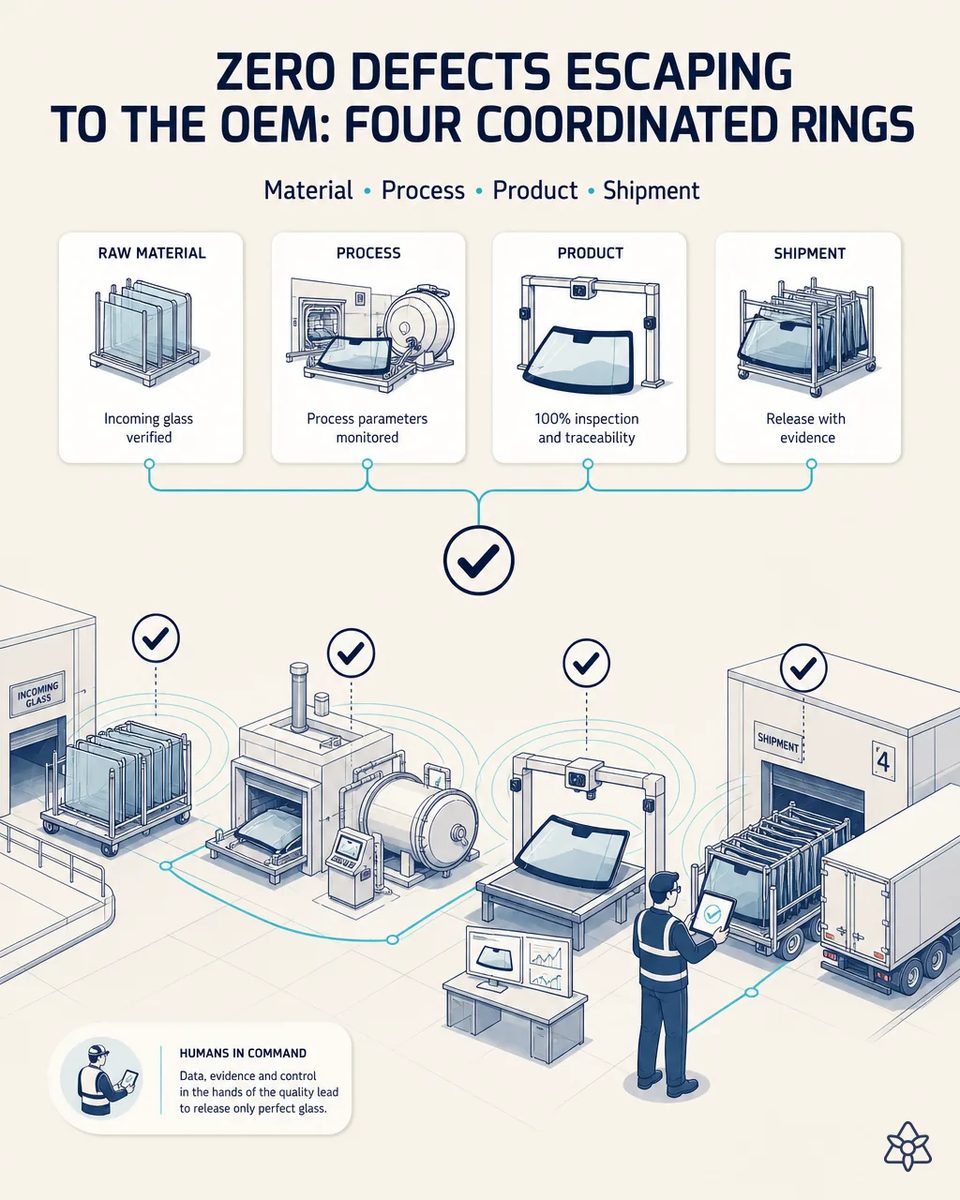
Four coordinated rings — no new pieces, everything above orchestrated.
Four coordinated rings, with no new pieces: everything already described, orchestrated. Ring 1, raw material: photo receiving, certificates checked and supplier alerts turned into containment (cases 3, 6 and 7). Ring 2, process: first-piece release, autoclave curve per load and model changeover validated by cameras (cases 1, 2 and 10). Ring 3, product: Edge vision for contamination and scratches plus optical inspection stitched to the MES (cases 8 and 9). Ring 4, shipment: evidence pack per rack (case 11). JIDOKA AI holds the rack if a ring does not close; SMED AI speeds up changeovers so control does not cost productivity; and every hold is resolved by a person with the agent's proposal in front of them.
Escapes happen because one control's information did not reach the next in time. The rings fix exactly that: JIDOKA AI holds the rack if any ring does not close, SMED AI keeps changeovers fast so control does not cost output, and every hold is resolved by a person with the agent's proposal in front of them. The rings do not add new controls; they make the existing ones talk to each other. That is why the first rings can be running long before the last case is deployed.
The four windshield rings and what each one closes
| Ring | Which cases it draws on | What it closes |
|---|---|---|
| Ring 1 · Flat glass and PVB in | Supplier alert (3) + lab (6) + receiving (7) | Suspect flat glass or PVB stopped before cutting |
| Ring 2 · Furnace and autoclave | First piece (1) + autoclave (2) + changeover (10) | Start-up, cycle and configuration with evidence |
| Ring 3 · Finished windshield | Optical inspection (8) + contamination vision (9) | Defects found before they leave |
| Ring 4 · Shipping rack | Evidence pack (11) | Each rack verified before release |
| Across all rings | Supervisor voice (4) + verification tablet (5) | Findings captured and every record signed |
| When rings disagree | JIDOKA AI + the person in charge | The rack waits, with reason and containment proposed |
From area-by-area controls that never cross to four rings verified per rack before shipping. From days of containment by excess to exposure scoped by lot in minutes. From defects found by the OEM to defects found before they leave.
Impact estimate against claims and sorting — to be validated with claim history and the scorecard.
The block below is an estimate to be validated against your plant's actual data. We put it forward so the committee has an order of magnitude; we refine it during the assessment.
- Estimated reduction of 50% or more in defects escaping to the OEM and in external sorting hours.
- Estimated payback 6-12 months against the annual cost of claims, sorting and chargebacks.
- Containment scope goes from days of excess to exposure scoped by lot in minutes.
- And the supplier scorecard is protected, which is what weighs on the award of future windshield programs.
Estimated reduction of 50% or more in defects escaping to the customer and in external sorting hours; estimated payback of 6 to 12 months against the annual cost of claims, sorting and chargebacks. Estimate to be validated with claim history and the customer scorecard.
And the fair question from the production manager
"Do we have to deploy all eleven cases before this pays?" — no. The rings are built in layers and each case pays on its own. Cross-checking signals between rings is an anchored task, where the best models drop below 1.5% error [1], and JIDOKA AI holds a rack only on a verifiable discrepancy between sources; when the doubt is the model's, a person decides. With receiving and the first-piece sheet you already have half of ring 1 and part of ring 2. Each step adds coverage without waiting for the full system.
[1] OpenAI paper "Why Language Models Hallucinate", 2025 — on the reliability of AI in anchored tasks.
What people ask about the four-ring zero-escape system for windshields
Where does a windshield plant usually start?
With the case with fewest dependencies and the shortest deployment, often the first-piece sheet or receiving. Each layer pays on its own while the rings take shape. The order is decided with your claim history in hand.
What does crossing the rings add to controls we already have?
Exactly what escapes today: a lot flagged by the supplier, a cycle at the edge and a borderline particle can each pass their own control, and the rack that combines them should not ship. No single area sees that combination today.
Can JIDOKA AI release or hold a rack on its own?
It holds the rack when a ring does not close, on a verifiable discrepancy. Releasing it again is always a person's decision, with the reason and the proposed containment in front of them. That keeps the line moving without shipping on doubt.
How fast can affected racks be scoped after an escape?
In minutes, by lot: with raw material, cycle and inspection linked per rack, the exposure is bounded instead of contained by excess. Fewer racks sorted, less time at the customer's site.
Can the return be estimated from our windshield claim history?
Yes: with your claim history, external sorting hours, chargebacks and the customer scorecard, the return per layer is estimated before choosing the order. That makes the first layer an easy decision rather than a leap.
More cases from this series
- Always audit-readyiLEAN gathers and sorts by requirement the quality evidence for every windshield: IATF and customer…
- The autoclave is the same machine, but now it talksA camera reads the autoclave panel and links the pressure and temperature curve to each windshield load,…
- First-piece release, digital from second zeroHow a photo of the first-piece sheet puts the model release into the central system instantly in…
- Raw material receiving, traced with one photoA photo of the supplier's packing slip, labels and certificate: iLEAN records lot and expiry in the ERP…
- What the supervisor sees on the floor, recorded while walkingThe quality supervisor dictates findings by voice while walking the plant; iLEAN structures them and…
- Lab tests in the ERP, with no retypingiLEAN reads lab and incoming-inspection spreadsheets and, after human validation, posts them to the ERP.…
Tell us what your last escaped windshield defect cost you at the OEM.
We work on your plant's real data, not ours. Assessment with no commitment.
Request estimated ROI within 48h ‹ See all cases of automotive glass See automotive