Contamination and scratches, caught before lamination
In a laminated windshield, a particle or scratch that is not seen in time is trapped forever between two glass plies. At line rate, on a transparent curved surface, the human eye tires: what it catches at the start of the shift slips through at the end. iLEAN Edge places cameras with controlled lighting at the points where action is still possible, after washing and before PVB assembly, and at final inspection. The neural network, trained on the plant's own parts, infers in milliseconds, marks the defect position and raises the flag before added value is lost.
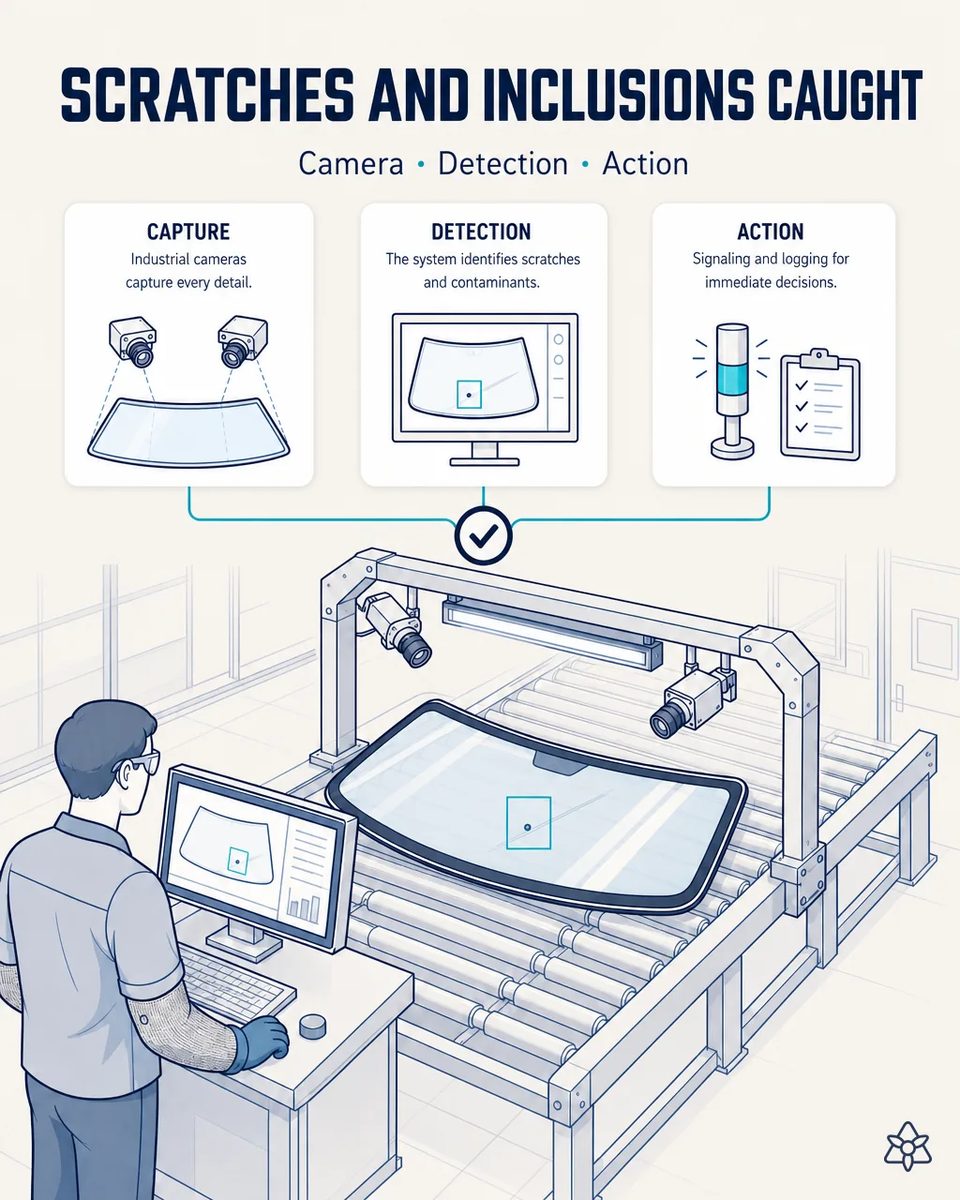
A particle missed before lay-up stays trapped in the laminate for good.
Contamination (particles, fibers, separator residue) and scratches are the classic defects of automotive glass. Catching them after the autoclave means scrapping a complete assembly with all its added value; missing them means a claim from the OEM. One-hundred-percent human visual inspection of transparent glass at line rate is not sustainable across a full shift. And when the defect comes from incoming flat glass, it is discovered late, mixed in with process defects, and is hard to attribute to the supplier.
- Contamination — particles, fibers, separator residue — and scratches are the classic defects of automotive glass. They come from the flat glass itself, from handling and racks, and from the washing and lay-up steps.
- Caught after the autoclave, they mean scrapping a complete assembly with all its added value; missed, they mean a claim from the OEM. Neither outcome is cheap, and the second also costs points on the supplier scorecard.
- One-hundred-percent human inspection of transparent, curved glass at line rate is not sustainable across a shift: what the eye catches at the start slips through at the end. That is not a training problem; it is how human attention works on a transparent surface.
- And when the defect comes from incoming flat glass, it is found late, mixed with process defects, and is hard to attribute to the supplier. Without position and lot, the supplier can always argue it happened in your plant.
Edge — local neural-network vision after washing and before PVB assembly.
Edge: neural-network vision running locally, with no images sent to the cloud, capable of dozens of detections per second. It is trained with real samples from the plant, so it pays to collect enough parts with each defect type, and it grows by defect family: contamination first, then scratches, then others. Each detection gives type and position, is shown to the operator on screen and is recorded with the glass lot. The operator decides rework, quarantine or scrap; the system does not tire and does not stop looking.
The camera goes where action is still possible: after washing and before the clean room, and again at final inspection. A defect found there costs a rework or a single glass; found after the autoclave, it costs the whole laminated assembly. That difference in added value is what pays for the cameras. And every detection carries the glass lot, so the line learns where its defects come from.
Human inspection of transparent glass versus Edge vision
| Aspect | Human visual inspection | With iLEAN Edge |
|---|---|---|
| Coverage across the shift | Falls with fatigue | Constant, one hundred percent |
| Where the particle is found | After the autoclave | Before PVB assembly |
| Cost of a caught defect | A full laminated assembly | One glass or a rework |
| Defect position | Described from memory | Marked on screen and recorded |
| Origin of the defect | Unclear | Attributed to process or flat glass lot |
| Inspection images | — | Processed locally, never sent to the cloud |
From detection that depends on fatigue to constant one-hundred-percent inspection. From defects found after the autoclave to defects found before assembly. From defects with no clear origin to defects attributed to process or supplier lot.
Impact estimate for contamination and scratch scrap — to be validated with your numbers.
The block below is an estimate to be validated against your plant's actual data. We put it forward so the committee has an order of magnitude; we refine it during the assessment.
- Estimated reduction of 30% or more in scrap from contamination and scratches. Measured on the covered defect families, not on total scrap.
- Estimated payback 5-12 months, depending on current scrap from these defects. Plants with high contamination scrap after the autoclave see the shortest payback.
- Fewer OEM claims for defects trapped inside the laminate. Each one avoided also protects the plant's standing with that customer.
- And defects attributed to a flat glass lot, which turns a suspicion about the supplier into a supported claim.
Estimated payback of 5 to 12 months depending on current scrap from contamination and scratches; estimated reduction of 30% or more in scrap from these defects and fewer customer claims. Estimate to be validated.
And the fair question from the production manager
"Transparent, curved glass — won't it flag reflections as defects?" — that is why lighting is controlled and the network is trained on your own parts, not a generic model. Locating a defect type within a known glass zone is close to an anchored task, where the best models drop below 1.5% error [1]; and the operator still decides rework, quarantine or scrap, with every decision feeding back into training. False alarms drop as the model learns your glass. Thresholds are agreed with quality, not imposed by the system. Borderline particles are escalated to a person instead of being rejected silently.
[1] OpenAI paper "Why Language Models Hallucinate", 2025 — on the reliability of AI in anchored tasks.
What people ask about detecting contamination and scratches on windshield glass
Where are the cameras placed on a windshield line?
Where action is still possible: after washing and before PVB assembly in the clean room, and at final inspection. The first point is the one that saves the laminated assembly. Final inspection then confirms what got through and closes the loop.
How many defective parts do we need to train it?
Enough of each defect type, collected from your own line. That is why it grows by family: contamination first, then scratches, then others. Real parts from your line are what make the difference against a generic model.
Are images sent outside the plant?
No. Inference runs locally on the line, with dozens of detections per second, and no image goes to the cloud. The line does not depend on the plant network or an internet connection to keep inspecting.
Does it stop the line when it finds a particle?
It flags the part with type and position on screen. The operator decides rework, quarantine or scrap; the system keeps looking at every part. Rules for automatic diversion can be added later, if quality decides so.
Can it tell a supplier defect from a process defect?
Each detection is recorded with the flat glass lot, so a defect pattern that follows one lot across shifts points to the supplier rather than the line. That is what turns a suspicion about incoming glass into a claim with data.
More cases from this series
- Always audit-readyiLEAN gathers and sorts by requirement the quality evidence for every windshield: IATF and customer…
- Zero escaped defects: from receiving to the shipping rackFour iLEAN verification rings, from receiving to shipment, so that no defective windshield reaches the…
- The autoclave is the same machine, but now it talksA camera reads the autoclave panel and links the pressure and temperature curve to each windshield load,…
- First-piece release, digital from second zeroHow a photo of the first-piece sheet puts the model release into the central system instantly in…
- Raw material receiving, traced with one photoA photo of the supplier's packing slip, labels and certificate: iLEAN records lot and expiry in the ERP…
- What the supervisor sees on the floor, recorded while walkingThe quality supervisor dictates findings by voice while walking the plant; iLEAN structures them and…
Tell us how many laminated assemblies you scrap each month for contamination or scratches.
We work on your plant's real data, not ours. Assessment with no commitment.
Request estimated ROI within 48h ‹ See all cases of automotive glass See automotive