The AI captures; a person validates in two taps
What sets iLEAN apart from an autonomous agent that writes into systems on its own is this: nothing it captures enters the ERP or MES before a person has seen it. In an automotive glass plant that takes the form of an industrial tablet at receiving, in the lab and at final inspection. The disposition of a flat glass lot, the result of an adhesion test or the release of a rack appear as a two-second visual summary, and the person in charge confirms with two taps. Seconds of latency, minimal training and a clean master record.
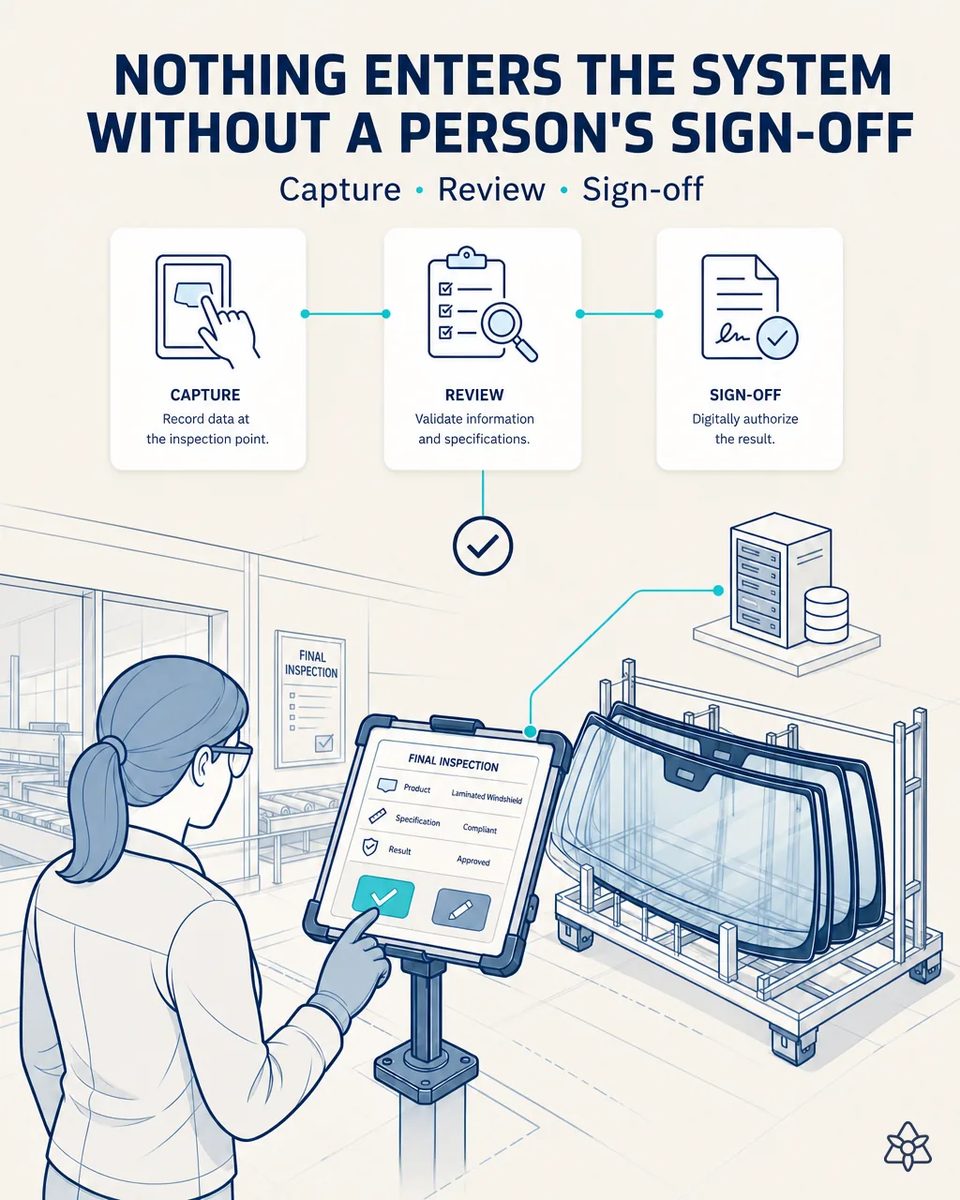
Under IATF 16949, nobody signs off on AI writing quality records on its own.
The most common cultural brake on digitalization in a plant under IATF 16949 is a reasonable one: 'if the AI writes into the system by itself and gets it wrong, who cleans up and who answers to the customer?'. At the same time, nobody on the floor wants to type more. Without a fast human gate, only two bad options remain: unvalidated data contaminating quality records, or data that is never captured out of distrust.
- The most common brake on digitalization in a windshield plant is a reasonable one: if the AI writes into the system by itself and gets it wrong, who cleans up and who answers to the OEM? Quality managers ask it in the first meeting, and they are right to.
- At the same time, nobody at receiving, in the lab or at final inspection wants to type more than they already do. Any solution that adds data entry fails within weeks.
- Without a fast human gate, only two bad options remain: unvalidated data contaminating quality records, or data that is never captured out of distrust.
- And in an IATF audit, a record without a responsible person is a record open to challenge.
Connect with early human verification — a summary card and two taps.
Connect in early human verification mode. Every capture, whether the first-piece sheet, the supervisor's dictation, the supplier alert or the lab spreadsheet, goes through a card on the tablet showing the summary, the source and any doubtful fields highlighted. The person in charge accepts or corrects with two taps, and only then does the data cross into the central system, with signature and timestamp. The interface is designed for validating, not for data entry.
This is what separates iLEAN from an autonomous agent: nothing it captures enters the ERP or MES before a person has seen it. The tablet is designed for validating, not for typing, so the gate costs seconds and leaves a signature on every record. Nobody types more, and nobody has to trust a machine writing on its own. Receiving, the lab and final inspection all use the same gesture, so training takes minutes.
Windshield records keyed in versus validated at the tablet
| Aspect | Today | With iLEAN |
|---|---|---|
| Flat glass lot disposition | Typed later at a terminal | Confirmed at receiving in seconds |
| Adhesion test result | Retyped from the lab sheet | Summary validated with two taps |
| Rack release at final inspection | A signature on paper | Signature and timestamp in the system |
| Doubtful field | Nobody notices | Highlighted on the card |
| Record in an IATF audit | Open to challenge | Carries a human signature |
| Who writes to the master record | Whoever types | A person, confirming |
From unvalidated or uncaptured data to data validated within seconds. From records open to challenge in an audit to every record carrying a human signature.
Why this windshield-plant piece carries no payback of its own.
The block below is an estimate to be validated against your plant's actual data. We put it forward so the committee has an order of magnitude; we refine it during the assessment.
- No standalone payback: it is the enabling piece. We do not put a figure on it, because its value appears in every other case it makes approvable.
- Without this gate, the other cases do not get internal approval in a plant under IATF 16949.
- Its strategic value is a clean master record: every capture carries who validated it, when and what they corrected. In an audit, that is the difference between a record and a defensible record.
- The estimate is made together with the other cases, since that is where the gate turns into recovered hours and avoided findings. Treating it as a cost on its own would miss what it unlocks.
This is the enabling piece for everything else: without this gate, the other cases do not get internal approval. Strategic value, not directly monetizable; estimate to be validated together with the other cases.
And the fair question from the production manager
"If a person confirms everything, what is the AI saving?" — the work is in assembling, not deciding. Extracting a flat glass lot or an adhesion result from its source is an anchored task, where the best models drop below 1.5% error [1], and it arrives already assembled on the card. The person only confirms or corrects, and every correction is stored with its author. Over time, the cards that need correction become fewer. The gate stays anyway, because it is what the auditor relies on.
[1] OpenAI paper "Why Language Models Hallucinate", 2025 — on the reliability of AI in anchored tasks.
What people ask about two-tap validation in a windshield plant
Can the AI be set to write into the MES without validation?
No, and it is not a configuration option: it is the architecture. Data crosses into the ERP or MES only after a person confirms it on the tablet. That is what lets quality approve the other cases without fearing for the master record.
Where are the tablets placed in a windshield plant?
Typically at receiving, in the lab and at final inspection, which is where flat glass lots, test results and rack releases are decided. Each tablet only shows the cards that belong to that area and role.
How long does a tablet validation take at receiving?
A couple of seconds: the card shows the summary, the source and any doubtful field highlighted. It is resolved with two taps without leaving the station. No one walks to a terminal or opens an ERP screen to do it.
What is recorded when someone corrects an adhesion or lot value?
The summary shown, who confirmed it, when, and the original and corrected values. That trail is what an IATF auditor or the OEM asks for. And corrections also show where extraction needs to improve.
Does it have to go in first, before the other cases?
In practice yes: it is what makes the first-piece sheet, the supplier alert or the lab spreadsheet acceptable to quality, because it keeps the master record clean. It is usually deployed with the first case and grows with each new one.
More cases from this series
- Always audit-readyiLEAN gathers and sorts by requirement the quality evidence for every windshield: IATF and customer…
- Zero escaped defects: from receiving to the shipping rackFour iLEAN verification rings, from receiving to shipment, so that no defective windshield reaches the…
- The autoclave is the same machine, but now it talksA camera reads the autoclave panel and links the pressure and temperature curve to each windshield load,…
- First-piece release, digital from second zeroHow a photo of the first-piece sheet puts the model release into the central system instantly in…
- Raw material receiving, traced with one photoA photo of the supplier's packing slip, labels and certificate: iLEAN records lot and expiry in the ERP…
- What the supervisor sees on the floor, recorded while walkingThe quality supervisor dictates findings by voice while walking the plant; iLEAN structures them and…
Tell us which quality records you would never let a machine write on its own.
We work on your plant's real data, not ours. Assessment with no commitment.
Request estimated ROI within 48h ‹ See all cases of automotive glass See automotive