From the supplier's email to containment, in minutes
A flat glass supplier emails to warn that a lot already shipped may carry a deviation; or the PVB supplier reports a delay on a critical roll. The message lands in a personal inbox among dozens and is read hours later, when part of that lot has already been cut. With iLEAN Connect in silent copy, the system reads the alert on arrival, identifies supplier, material and lot, crosses it with what is in the warehouse and on the schedule, and hands the person in charge a concrete proposal: which racks to quarantine, which orders to resequence and what to request from the supplier.
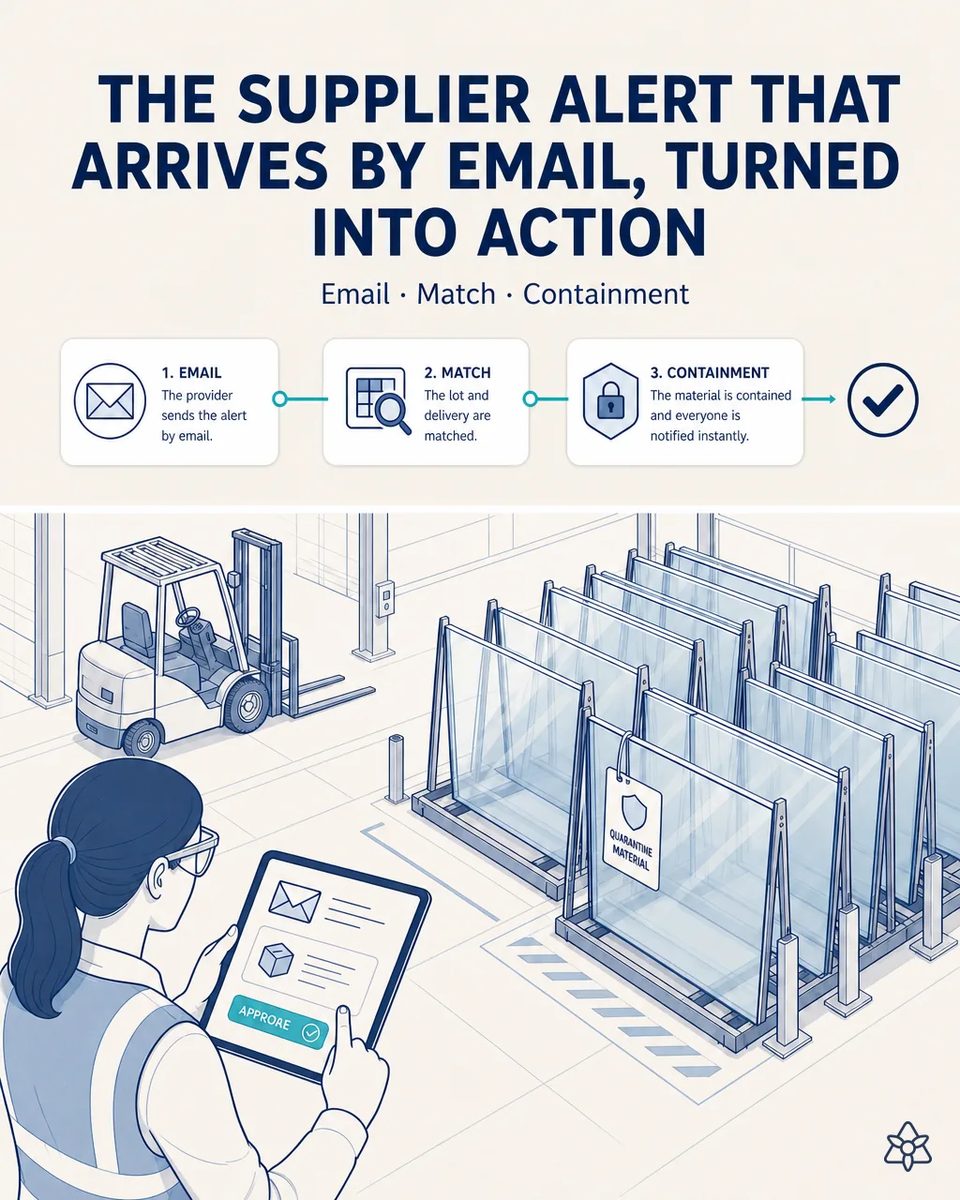
The most important supplier warning arrives through the least structured channel.
In supplier quality, the most important warnings arrive through the least structured channels: an email with a PDF attached, a reply buried in a long thread, a message on a phone. The person responsible handles them between audits, meetings and floor walks, so the latency between warning and containment is measured in hours. During those hours the suspect lot moves forward: it is cut, printed, bent. What could have been a warehouse quarantine becomes a one-hundred-percent sort of work in process, with its cost and with the risk of something reaching the OEM.
- A flat glass supplier warns that a shipped lot may carry a deviation; the PVB supplier reports a delay on a critical roll. It arrives as an email with a PDF, a reply buried in a thread or a message on a phone.
- The supplier quality engineer reads it between audits, meetings and floor walks, so the latency between warning and containment is measured in hours. Nobody is careless; the channel was simply never designed for urgency.
- During those hours the suspect lot moves forward: it is cut, printed and bent.
- What could have been a warehouse quarantine becomes a one-hundred-percent sort of work in process, with its cost and with the risk that a windshield reaches the OEM. And the sort itself is never perfect at line rate.
Connect in chaotic-sources mode — silent copy on the supplier mailbox, around the clock.
Connect in chaotic-sources mode. iLEAN is copied on a dedicated mailbox around the clock. When a message comes in, an anchored LLM extracts the intent (deviation, delay, specification change), the entities (supplier, material, lot, quantities) and queries the ERP and MES live: where that lot is, which orders consume it, what the alternative is. The person in charge receives a card with the suggested action and approves it, corrects it or dismisses it. Containment is decided by the person; the system saves the hours of finding out and searching.
Reading the alert earlier is only half the value. The other half is the cross-check: where that flat glass or PVB lot is right now, which orders consume it and what the alternative is. That is what reaches the person in charge, as a proposal they approve, correct or dismiss. The decision does not change hands; what disappears is the hour spent finding out where the lot is. In flat glass, that hour decides whether the lot is still in its racks or already on the cutting table.
Supplier alert in the inbox versus alert turned into containment
| Aspect | Today, in the inbox | With iLEAN Connect |
|---|---|---|
| Alert to containment | Hours | Minutes |
| Suspect flat glass lot | Already cut and bent | Quarantined in the warehouse |
| Work in process | Sorted one hundred percent | Only what really consumed the lot |
| PVB roll delay | Discovered at the clean room | Orders resequenced in time |
| What the engineer receives | An email with a PDF | Racks, orders and a suggested action |
| Who decides the containment | Whoever read it first | The person in charge — iLEAN proposes |
From hours between alert and containment to minutes. From sorting one hundred percent of work in process to quarantining in the warehouse before cutting.
Impact estimate for supplier quality — to be validated with your numbers.
The block below is an estimate to be validated against your plant's actual data. We put it forward so the committee has an order of magnitude; we refine it during the assessment.
- Estimated payback 3-7 months, depending on how often critical supplier alerts occur.
- Fewer sorting and rework hours, because containment happens before the flat glass is cut. A quarantine at the warehouse costs a forklift move; a sort of bent glass costs shifts.
- Lower exposure to OEM claims for windshields built with suspect material.
- And a written trace of what the supplier warned, when it was read and what was decided. That trace is what supplier quality shows when the supplier later asks what happened to the lot.
Estimated payback of 3 to 7 months depending on how often critical alerts occur; fewer sorting and rework hours and lower exposure to customer claims for suspect material. Estimate to be validated.
And the fair question from the production manager
"Will it confuse a real deviation with a routine notice?" — classifying the intent of a supplier message (deviation, delay, specification change) and extracting supplier, material and lot is an anchored task, where the best models drop below 1.5% error [1]. And nothing is quarantined on its own: the person in charge sees the proposal with the original email attached and decides. If they dismiss it, that decision is recorded too. Every alert keeps its full history: received, read, proposed, decided.
[1] OpenAI paper "Why Language Models Hallucinate", 2025 — on the reliability of AI in anchored tasks.
What people ask about turning flat glass and PVB alerts into containment
Does iLEAN read the personal inbox of the supplier quality team?
No. It sits in copy on a dedicated mailbox that suppliers write to, and only sees what is sent there. Personal mail is never read. Suppliers are simply given that address for quality and logistics notices.
Does it understand the certificate or deviation report attached as PDF?
Yes. The attachment is read with the message, so the lot numbers, thicknesses or PVB references inside the PDF are part of the cross-check. That is usually where the real information is, not in the body of the email.
How does it know where the suspect lot is?
It queries the ERP and MES live: stock in the warehouse, racks already at cutting and the orders that consume that lot. The proposal is built from that picture. If part of the lot is already at cutting, the proposal says so and separates what can still be quarantined.
What if the flat glass supplier writes in another language?
It is normal with flat glass and PVB suppliers from other countries. Intent and entity extraction do not depend on the language of the message. The proposal reaches the person in charge in their own language, with the original attached.
Can it draft the request back to the supplier?
Yes, as a draft: the 8D request, the replacement lot or the new delivery date. The person in charge reviews and sends it. The thread with the supplier then stays linked to the lot and the containment decided.
More cases from this series
- Always audit-readyiLEAN gathers and sorts by requirement the quality evidence for every windshield: IATF and customer…
- Zero escaped defects: from receiving to the shipping rackFour iLEAN verification rings, from receiving to shipment, so that no defective windshield reaches the…
- The autoclave is the same machine, but now it talksA camera reads the autoclave panel and links the pressure and temperature curve to each windshield load,…
- First-piece release, digital from second zeroHow a photo of the first-piece sheet puts the model release into the central system instantly in…
- Raw material receiving, traced with one photoA photo of the supplier's packing slip, labels and certificate: iLEAN records lot and expiry in the ERP…
- What the supervisor sees on the floor, recorded while walkingThe quality supervisor dictates findings by voice while walking the plant; iLEAN structures them and…
Tell us how long the last flat glass deviation alert took to become a quarantine.
We work on your plant's real data, not ours. Assessment with no commitment.
Request estimated ROI within 48h ‹ See all cases of automotive glass See automotive