Mold change validated by camera: jidoka applied to the start-up
The mold or material change is where an injection and extrusion plant concentrates its risk. Start with the previous revision's insert, with a cavity that should have been blocked left open, or with residue of the previous resin unpurged, and the first batch is born non-conforming — and you do not always catch it: a material blend looks perfectly fine and fails the permeation test three months later. With Edge cameras on the critical points, the cell does not start until all of them confirm the state and the manager signs.
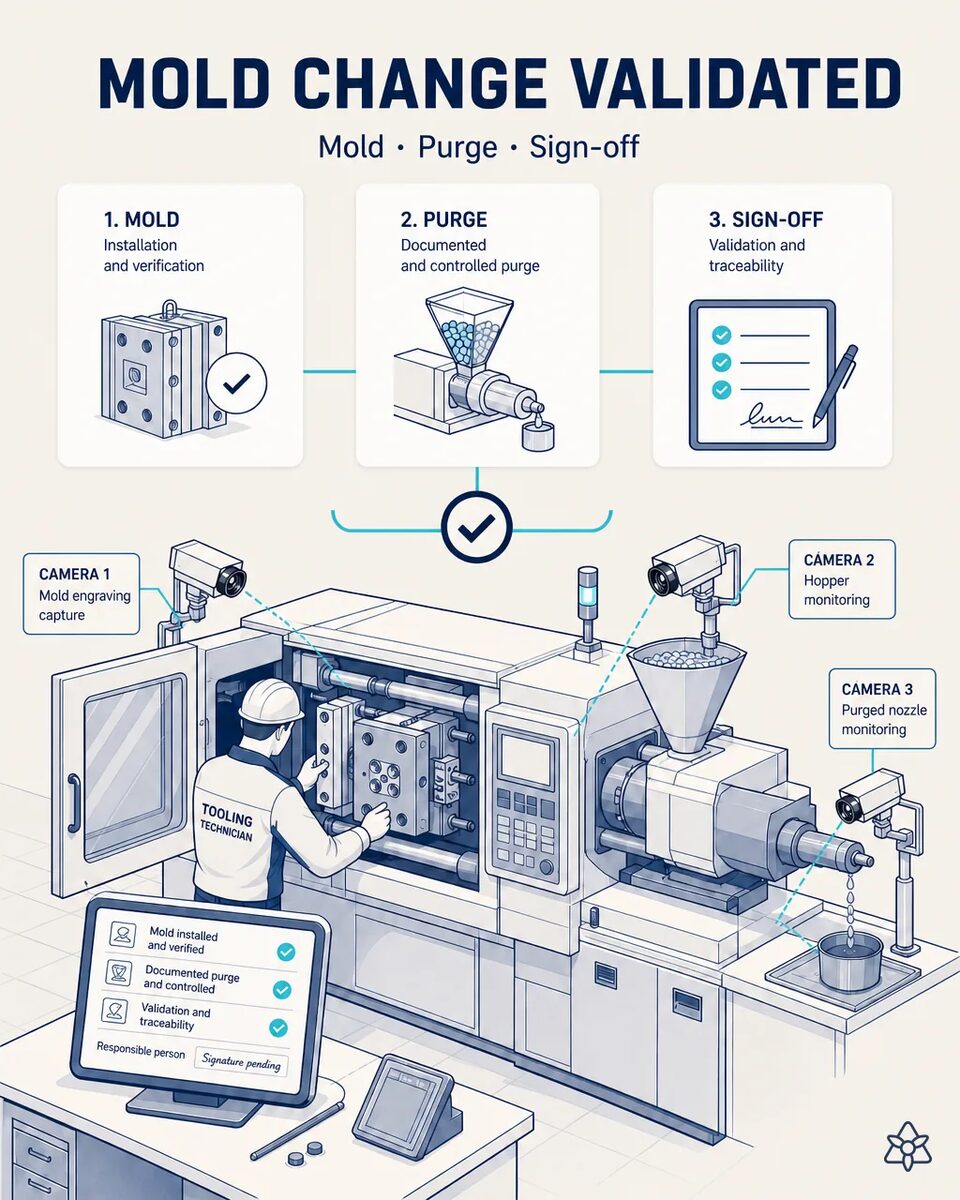
The checklist is well designed. The problem is how it gets signed.
The changeover checklist exists and it is well designed. The problem is when and how it gets signed: under time pressure, because the changeover sits on the shift's critical path, and with no objective evidence behind the tick. When something goes wrong, the investigation runs into a ticked box and no proof. It is not bad faith: it is that a signature is not a measurement. The business's high mix multiplies the number of changeovers, and with it the exposure. A preparation failure that happens once every five hundred changeovers becomes a frequent failure when changeovers double.
- If the cell starts with the previous revision's insert, with a cavity that should have been blocked left open, or with residue of the previous resin unpurged, the first lot is born nonconforming.
- And it is not always caught: a material blend looks perfectly fine and fails later.
- The checklist exists and is well designed. What fails is when and how it is signed: under pressure, because the change sits on the shift's critical path, and with no objective evidence behind the box.
- When something goes wrong, the investigation runs into a ticked box and no proof. It is not bad faith: a signature is not a measurement.
- And the high mix of the business multiplies the number of changes, and with it the exposure.
Edge with JIDOKA AI — the cell does not start without conformity and a signature.
Edge on N critical points with a start-up interlock: JIDOKA AI applied to the start-up, not to the defect. And SMED AI in parallel so the control costs no productivity. Step 1 — A reference state per part number. The 'prepared' state is defined for each specific part number, not generically: which mold, which insert version, which blocked cavities, which pellets, which braid reel. Step 2 — N cameras. Each camera watches one point: the mold identification engraving, the presence and version of inserts, the blocked cavities, the pellets in the hopper, the nozzle purged to clean color, the mounted reel. Step 3 — Interlock. If any camera is not conforming, the order is not released. The quality manager signs on the evidence, not on a tick box. Step 4 — SMED AI. In parallel, the system shortens the changeover itself, so the added control pays for itself with time the same system gives back.
The camera does not decide alone: it checks each point against its reference image and it is the supervisor who signs on that evidence. What changes is not who decides, but what they decide on.
Today's change versus the validated change
| Aspect | Today | With iLEAN Edge |
|---|---|---|
| Signing the checklist | A ticked box | N reference images checked |
| First lot of the new reference | Under suspicion | Validated before the first shot |
| Previous revision's insert | Found afterwards | Detected before start-up |
| Cavity that should have been blocked | Found at inspection | Detected before start-up |
| Incomplete purge | A blend that looks fine | Blocked |
| With high mix | More changes, more exposure | More changes, the same verification |
Estimated impact — to validate with your own numbers.
The block below is an estimate to be validated against your plant's actual data. We put it forward so the committee has an order of magnitude; we refine it during the assessment.
- Estimated elimination of at least 30 % of the start-up scrap linked to a badly prepared change.
- Estimated payback 6-12 months, depending on the number of changes and the mix.
- The first lot stops being born under suspicion: it is validated before the first shot.
- And the investigation stops running into a ticked box and no proof.
Estimated removal of at least 30% of the start-up scrap tied to a badly prepared changeover, with estimated payback of 6 to 12 months. *Estimate to validate* against the real changeover count and start-up scrap. On top of that sits protection against the delayed failure from a material blend — the one you never see coming.
And the fair question from the production manager
«What if the camera blocks the cell for no reason?» — that is the right objection, because the change sits on the shift's critical path. Conformity is checked against the reference state for that specific reference and, in case of doubt, the system does not block silently: it escalates to the supervisor, who signs on the evidence. It stops on a verifiable discrepancy, not on model uncertainty.
[1] OpenAI paper "Why Language Models Hallucinate", 2025 — on the reliability of AI in anchored tasks.
What people ask about validating the mold change
What exactly is checked?
Correct mold and inserts, cavities in the right state, correct pellets and a purged nozzle. The points are defined at commissioning with your tooling team.
Does it detect an incomplete purge?
It is one of the states trained explicitly, and it is the most treacherous: a material blend looks perfectly fine and fails later.
Doesn't it make the change longer?
The check takes seconds. What lengthens the change today is the margin added for lack of evidence, and the change sits on the shift's critical path.
Can it be skipped when in a hurry?
An exception can be defined with a supervisor signature and it is recorded as such. What cannot happen is starting up with no trace of who decided to skip it.
Is it worth it with high mix?
That is where it shows most: the more changes, the greater the accumulated exposure, and this case makes the number of changes stop increasing it.
More cases from this series
- IATF audit always ready: the dossier closes as it happensEvery batch and changeover closes its own dossier as it happens, organised by standard. The audit is…
- Zero field leaks: four verification rings that cross-check each otherConnect, Edge, Agents, JIDOKA AI and SMED AI coordinated in four cross-checked verification rings: if…
- Paperless cell start-up: the batch exists at second zeroHow a photo of the setup sheet and the first-piece record makes the batch exist in the central system at…
- The shift supervisor dictates on the move, and the knowledge staysBluetooth earpiece and Connect in voice mode: the supervisor records what they know without stopping,…
- The laser marker stitched to the ERP: no typing, no obsolete revisionWhat the ERP publishes, the marker prints, and what was printed comes back confirmed to the MES. Zero…
- The leak test bench starts talking (without replacing it)An external camera digitises the leak bench's pressure decay curve without touching the machine or…
Tell us how many mold changes you run per week.
We work on your plant's real data, not ours. Assessment with no commitment.
Request estimated ROI within 48h ‹ See all cases of automotive fluid transfer See automotive