The leak test bench starts talking (without replacing it)
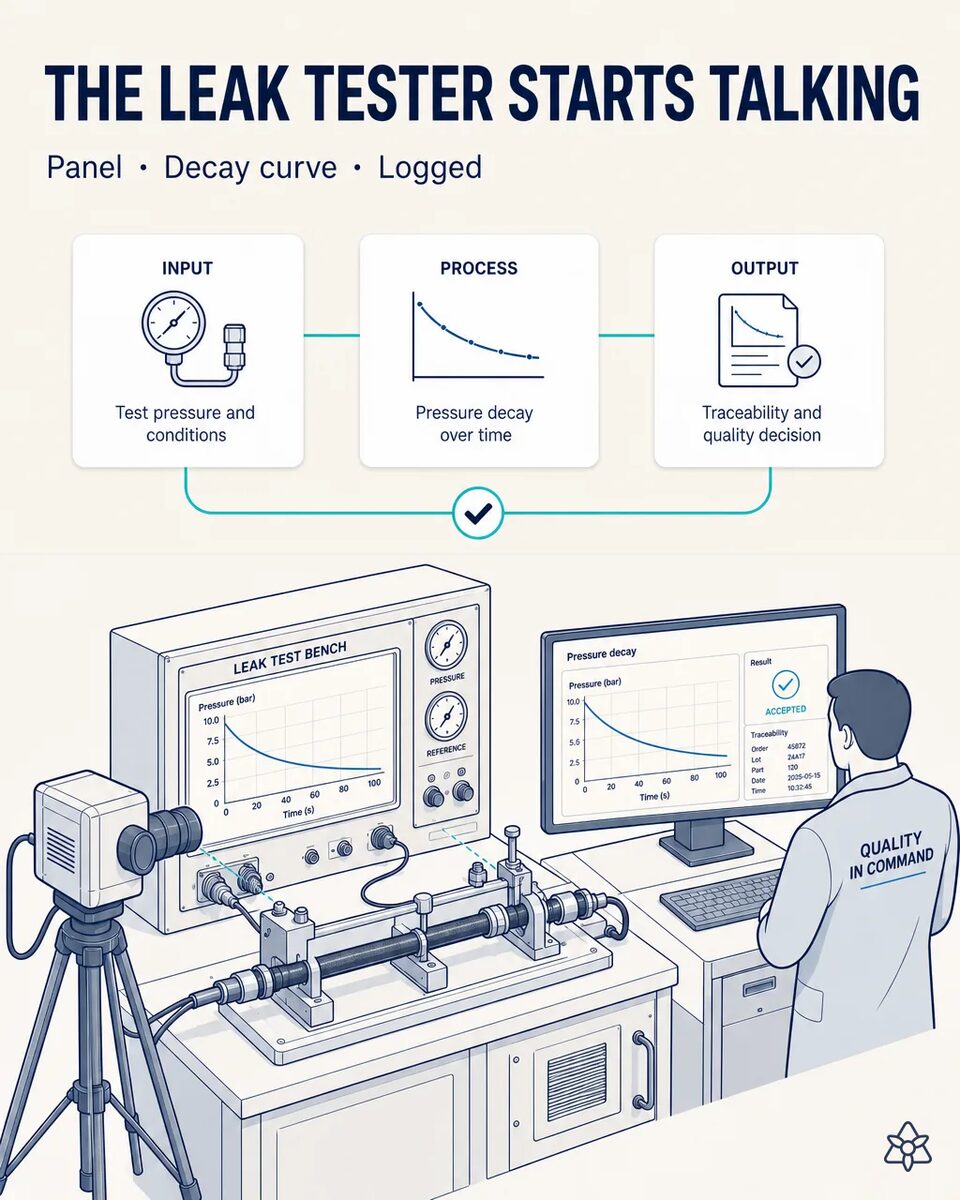
The leak test bench is the guardian of a fluid transfer plant: it is the only thing standing between a defective fuel line and a field leak. Many are ten to twenty years old and run on equipment the manufacturer deliberately kept off the network. Their panel shows the pressure decay curve of every part, and that data evaporates as soon as the next part goes in. With iLEAN Connect one external camera pointed at the panel is enough: the bench stays exactly as it is, and the plant has the curve digitized part by part.
The plant's gatekeeper leaves no trace of why it rejects.
The bench decides pass or fail, and the operator writes the reject count in the shift log. The information that really matters — the curve: initial pressure, decay slope, margin against the threshold — never leaves the screen. The consequence is that no root-cause analysis can answer the question every 8D asks: are this week's rejects concentrated in one cavity, one shift, one material reel or one crimping head? The plant knows how many parts failed. It does not know why. The apparent alternative is to replace the bench: a six-figure capex plus a cell shutdown, plus revalidating the test method with the customer. It gets deferred year after year, with good reason, and the information gap stays.
- The leak bench is the only thing between a defective fuel line and a field leak. Many are ten to twenty years old and run on a machine kept off the network by the manufacturer's decision.
- The bench decides pass or fail, and the operator notes the reject count on the shift report.
- The information that actually matters — initial pressure, decay slope, margin to threshold — never leaves the screen.
- So no analysis can answer the question always asked in an 8D: do this week's rejects concentrate in one cavity, one shift, one material reel or one crimping head?
Connect in photo mode on the panel — solved from outside, not inside.
Connect in panel-photo mode. IRIS solves the interface-less machine from the outside, not from the inside: no integration with the bench software, no demand for a data output it does not have, and nothing revalidated. Step 1 — Fixed camera. An industrial camera pointed at the panel, triggered in sync with the bench cycle. Step 2 — Grounded reading. Optical recognition interpreted by a grounded model that understands that specific screen: initial pressure, decay, threshold and verdict. Step 3 — MES cross-reference. The time series is cross-referenced with the MES to know which part number, which cavity and which operator were active in that cycle. Step 4 — Correlation. With curve and context in the same memory, the correlation between process parameter and leak result stops being a hypothesis and becomes a query.
It does not integrate with the bench's software, does not touch its validation and opens no ports. On the machine that is the quality gatekeeper, that is the difference between an approvable case and a project quality never authorizes.
Today's bench versus the bench being read
| Aspect | Today | With iLEAN Connect |
|---|---|---|
| The leak curve | Invisible and volatile | Digitized part by part |
| What survives a reject | A count on the shift report | The curve, the cavity and the lot |
| Root cause by cavity, shift or material | Impossible | Minutes |
| Closing an 8D | Weeks | Days |
| The bench's software | — | Untouched and not revalidated |
| Replacement capex | In the plan | Deferrable |
Estimated impact — to validate with your own numbers.
The block below is an estimate to be validated against your plant's actual data. We put it forward so the committee has an order of magnitude; we refine it during the assessment.
- Estimated payback 5-10 months.
- Scrap reduction from the curve-to-parameter correlation that is impossible to make today.
- Avoided replacement capex for the bench.
- And closing an 8D goes from weeks to days, which is where the customer actually measures you.
Estimated payback of 5 to 10 months, counting the scrap reduction the curve-to-parameter correlation delivers and the replacement capex avoided. *Estimate to validate* against the plant's reject history. The saving that is hardest to quantify — and the one a quality director values most — is the shorter response time when a customer demands a demonstrated root cause.
And the fair question from the production manager
«Does a camera reading a panel hold up in an 8D?» — here the task is anchored: fixed screen, fields in known positions and expected physical ranges, where the best models drop below 1.5% error [1]. And the system discards any frame whose value falls outside the possible range instead of accepting it, which is what would invalidate the series in front of a customer.
[1] OpenAI paper "Why Language Models Hallucinate", 2025 — on the reliability of AI in anchored tasks.
What people ask about reading the leak bench panel
Does the bench have to be revalidated?
No, and that is the point. It does not integrate with its software, opens no ports and installs nothing on the machine, so its validation is unaffected.
Does it capture each part's curve or just the verdict?
The full curve: initial pressure, decay slope and margin to threshold. You already have the verdict; what is missing is the why.
Can a reject be attributed to a specific cavity?
Yes, by crossing the curve with which cavity produced that part. That is what turns a reject count into a concrete maintenance action.
Does it catch drift before rejects start?
That is the part with the most value: with the curve of every part, a margin narrowing over time shows as a trend before it crosses the threshold.
Does it work for other isolated machines?
Yes, the pattern is the same. You start with the leak bench because that is where the sub-sector's most expensive failure sits.
More cases from this series
- IATF audit always ready: the dossier closes as it happensEvery batch and changeover closes its own dossier as it happens, organised by standard. The audit is…
- Zero field leaks: four verification rings that cross-check each otherConnect, Edge, Agents, JIDOKA AI and SMED AI coordinated in four cross-checked verification rings: if…
- Paperless cell start-up: the batch exists at second zeroHow a photo of the setup sheet and the first-piece record makes the batch exist in the central system at…
- The shift supervisor dictates on the move, and the knowledge staysBluetooth earpiece and Connect in voice mode: the supervisor records what they know without stopping,…
- The laser marker stitched to the ERP: no typing, no obsolete revisionWhat the ERP publishes, the marker prints, and what was printed comes back confirmed to the MES. Zero…
- The metrology spreadsheet reaches the ERP without anyone typing itConnect reads the lab spreadsheet as it is saved and, after human validation, writes it into the ERP.…
Tell us whether you can attribute leak rejects to a cavity or a lot today.
We work on your plant's real data, not ours. Assessment with no commitment.
Request estimated ROI within 48h ‹ See all cases of automotive fluid transfer See automotive