IATF audit always ready: the dossier closes as it happens
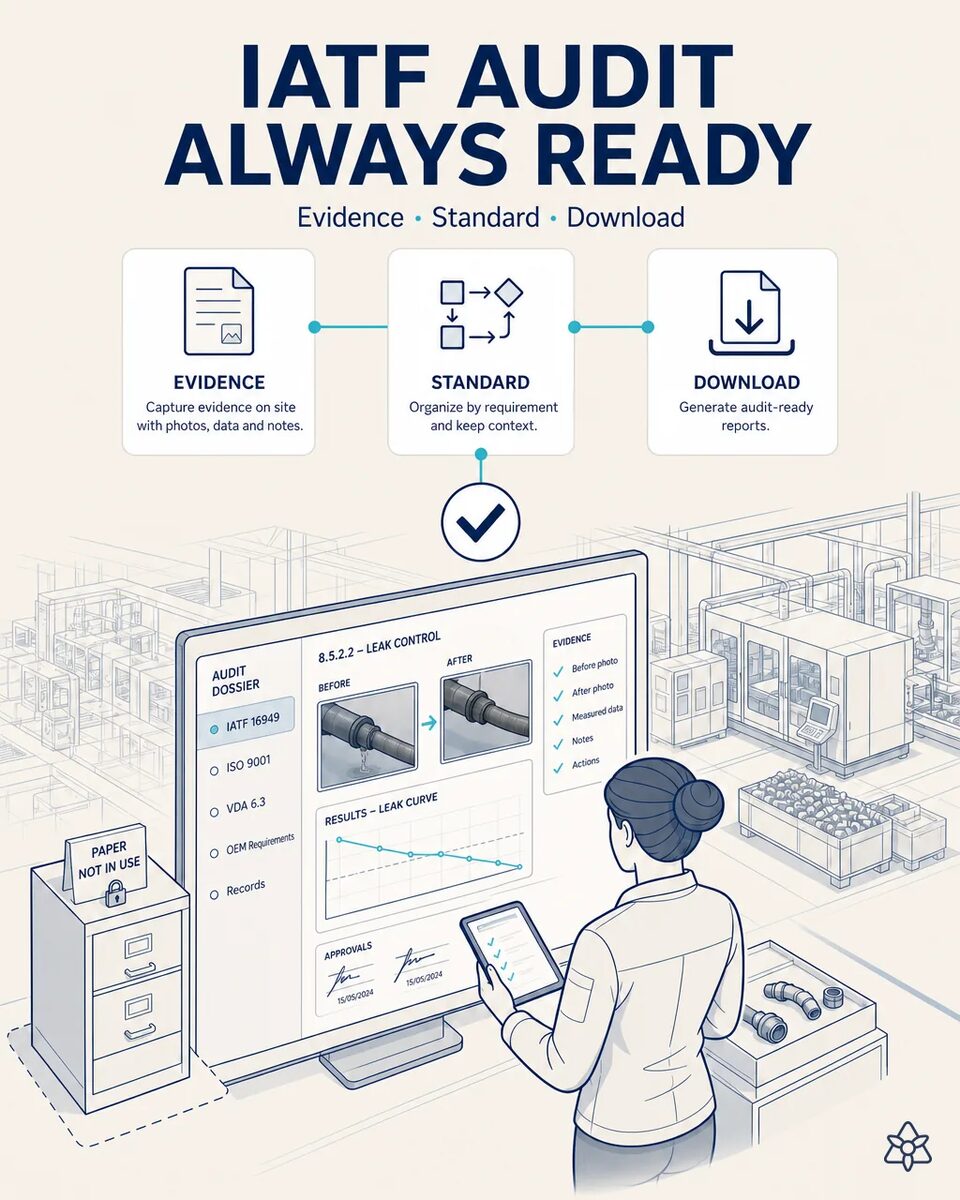
On audit day — from the certification body or, worse, from a customer — somebody in the plant spends one to two weeks reconstructing traceability: hunting down start-up records, cross-referencing batches with certificates, printing process capability, tracking down who signed what. With iLEAN, every batch and every changeover leave their dossier closed at the moment they occur. Agents organises it by whichever standard demands it and the auditor downloads the evidence pack for the period they ask for.
The cost of the audit is not the audit.
The evidence exists, but it is scattered across paper, spreadsheets, the MES and people's memory. That is the honest diagnosis of almost any certified plant. The cost of the audit is not the audit: it is the person-weeks before, repeated for every customer that audits. In a Tier-1 with several OEMs, that multiplies by the number of customers entitled to audit. And in the worst case — a field investigation — the clock runs in hours, not weeks. There, the difference between having the dossier and having to build it is the difference between bounding the problem and widening the containment out of caution.
- The evidence exists, but it is scattered across paper, spreadsheets, the manufacturing system and people's memory. That is the honest diagnosis of almost any certified plant.
- The cost is the preceding person-weeks, repeated for every customer that audits.
- At a Tier-1 with several OEMs, that multiplies by the number of customers with audit rights.
- And in the worst case — a field investigation — the clock runs against you from the first minute.
Edge and Connect capture; Agents organizes by standard.
Agents working on what Connect and Edge already captured. Not one more record is added: what already exists gets organised. Step 1 — Raw material already captured. Before and after photos of the changeover points, part-by-part leak curves, signed crimp parameters, metrology dimensions and process capability, certificates for the material consumed, the content actually marked, the first-piece record and the shift log. Step 2 — Mapping by clause. Agents links each piece of evidence to the clause of the standard that demands it: automotive quality management standard, product approval, customer-specific requirements, environment and safety. Step 3 — Publication. The pack publishes by batch, by part number or by period, and downloads from the web. It serves the certification body and the customer audit equally well. Step 4 — Gap detection. If a batch lacks a piece of evidence its standard requires, the gap appears when it is produced, not on the day of the visit. The documentary nonconformity gets prevented.
Every lot and every change leave their dossier closed at the moment they happen. Anything rebuilt afterwards inherits the gaps of whatever nobody wrote down — and it is precisely in the assembly that nonconformities appear.
Today's preparation versus the permanent dossier
| Aspect | Today | With iLEAN Agents |
|---|---|---|
| Audit preparation | 1-2 person-weeks | Hours of review |
| For each auditing customer | Repeated in full | Same evidence, another view |
| Where the evidence is | In four different places | One downloadable package |
| Documentation nonconformity | Found during the audit | Detected when it occurs |
| Field investigation | The clock against you | The dossier already exists |
| Process capability | Printed and hunted down | In the package |
Estimated impact — to validate with your own numbers.
The block below is an estimate to be validated against your plant's actual data. We put it forward so the committee has an order of magnitude; we refine it during the assessment.
- Estimated recovery of 1 to 2 person-weeks per audit and per auditing customer.
- Estimated payback 5-10 months counting only that preparation time.
- At a Tier-1 with several OEMs, the saving multiplies by the number of customers with audit rights.
- And in a field investigation the dossier already exists instead of starting to be built with the clock running.
Estimated recovery of 1 to 2 person-weeks per audit per auditing customer, with estimated payback of 5 to 10 months counting only that preparation time. *Estimate to validate* against the plant's annual audit count. On top of that comes the ability to answer a field investigation in hours.
And the fair question from the production manager
«Isn't this just another document manager?» — the difference is direction. A document manager stores what somebody decides to upload, after the fact, and inherits the same gaps. Here the dossier closes the instant the lot or the change happens, and what Agents does is reorganize it for whichever standard asks.
[1] OpenAI paper "Why Language Models Hallucinate", 2025 — on the reliability of AI in anchored tasks.
What people ask about the evidence pack
Does it serve the certification body and the customers at once?
Yes, and that is the point: the evidence is the same, what changes is the scheme it is indexed against. That is exactly the work repeated in full for each auditor.
Does it include process capability?
Yes, and it is one of the biggest time savers, because today it gets rebuilt and printed every time a customer asks for it at a review.
Does it warn about a documentation gap?
Yes, and it is the function with the most value: it detects that evidence for a critical event is missing when it should have been generated, not on the auditor's day.
Does the auditor get into our systems?
No. They access a view scoped to the period and scope of their audit, filter and download.
What about history from before?
It stays where it is. The dossier builds from day one forward; bringing in the history is optional.
More cases from this series
- Zero field leaks: four verification rings that cross-check each otherConnect, Edge, Agents, JIDOKA AI and SMED AI coordinated in four cross-checked verification rings: if…
- Paperless cell start-up: the batch exists at second zeroHow a photo of the setup sheet and the first-piece record makes the batch exist in the central system at…
- The shift supervisor dictates on the move, and the knowledge staysBluetooth earpiece and Connect in voice mode: the supervisor records what they know without stopping,…
- The laser marker stitched to the ERP: no typing, no obsolete revisionWhat the ERP publishes, the marker prints, and what was printed comes back confirmed to the MES. Zero…
- The leak test bench starts talking (without replacing it)An external camera digitises the leak bench's pressure decay curve without touching the machine or…
- The metrology spreadsheet reaches the ERP without anyone typing itConnect reads the lab spreadsheet as it is saved and, after human validation, writes it into the ERP.…
Tell us how many customers have the right to audit you and what each visit costs.
We work on your plant's real data, not ours. Assessment with no commitment.
Request estimated ROI within 48h ‹ See all cases of automotive fluid transfer See automotive