Paperless cell start-up: the batch exists at second zero
In a plant making fluid lines and air couplings, every cell start-up produces three documents the trade demands and the audit looks at: the setup sheet with its process parameters, the first-piece approval record with its measured dimensions and signature, and the shift log. Those three define the batch. Today they live in a folder in the production office until somebody transcribes them. With iLEAN Connect the operator takes two photos at start-up and the batch exists in the central system immediately, without changing a single habit.
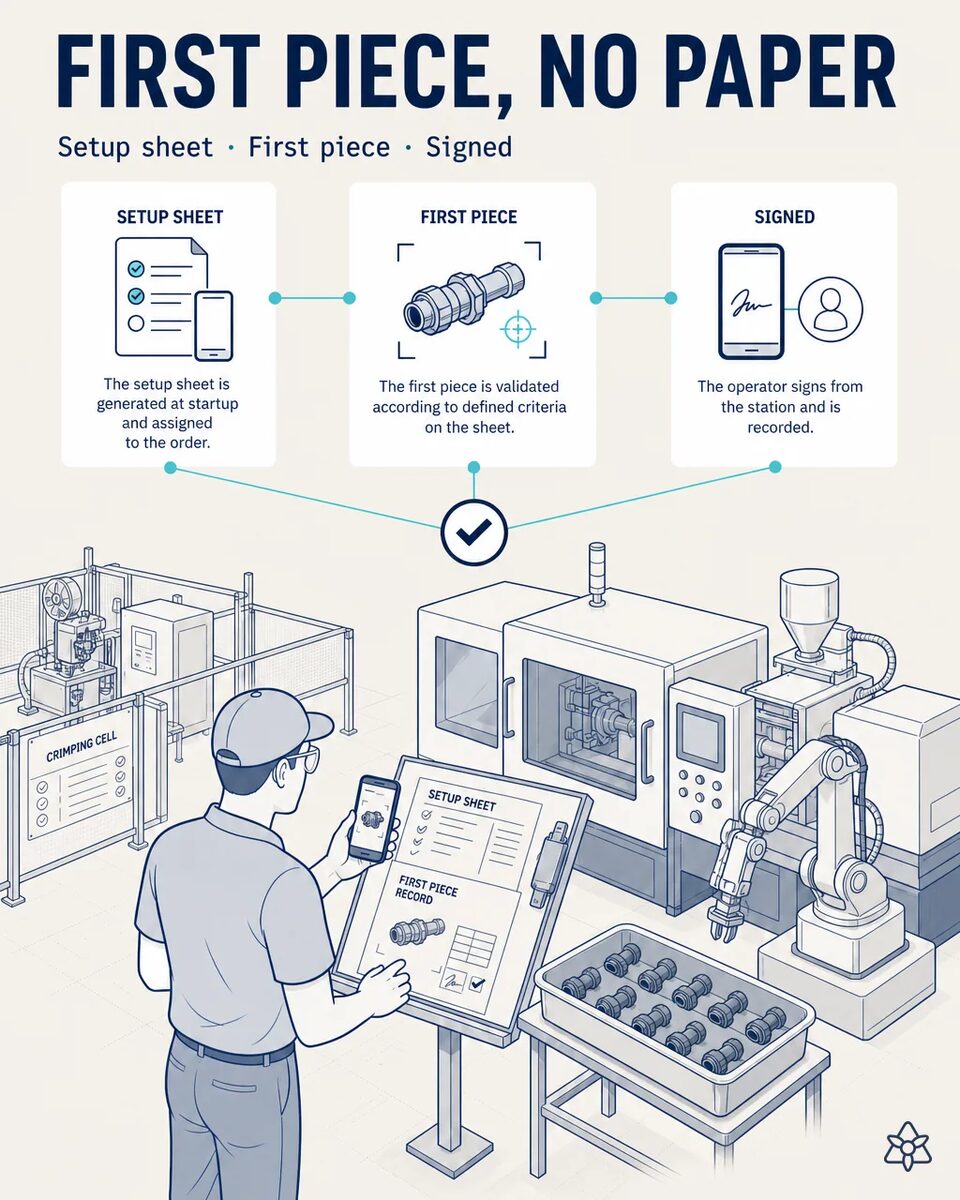
The three documents that define the batch live in a folder.
The setup sheet prints with ERP data, but it gets annotated by hand the moment anything drifts: extrusion pressure, crimp height, a blocked cavity, a change of braid reel. The first-piece record is handwritten as a matter of standard, with measured dimensions and the inspector's signature. The shift log captures downtime, reasons and scrap, also by hand. Four to eight hours pass between the signature and the digitization, and considerably more over a weekend. During that gap the batch does not exist for any system: it cannot be queried, cannot be cross-referenced with the leak test, cannot be correlated with anything. The real cost shows up twice. First every morning, when the production meeting argues about how much scrap there was instead of looking at the number. Second on the day a customer opens an investigation and asks for the traceability of one specific batch: then somebody spends hours doing folder archaeology.
- The start-up sheet prints from the ERP, but gets annotated by hand the moment anything deviates: extrusion pressure, crimp height, a blocked cavity, a braid reel change.
- The first-piece record is handwritten by standard, with the measured dimensions and the inspector's signature. The shift report captures stoppages, reasons and scrap, also by hand.
- Between the signature and digitization, four to eight hours pass — and considerably more over a weekend.
- During that gap the batch exists physically but exists in no queryable system, which is exactly when it is needed if a complaint lands.
Connect in photo mode — the operator keeps filling in their paperwork.
This is Connect in photo-to-the-analogue mode, the simplest to deploy and the one that creates least friction on the floor: the operator keeps filling in the same paper and only adds two photos with a phone or industrial tablet at start-up. Step 1 — Capture. A photo of the setup sheet and of the first-piece record. No form to fill in, no app to learn. Step 2 — Grounded extraction. A grounded language model extracts structured fields: order number, part number, cavity, process parameters, first-piece dimensions, who signed, downtime with its reason, scrap by cause. Anything unclear in the image is flagged for a human to confirm; nothing is invented. Step 3 — Central memory. The batch is created with its full header and available to be cross-referenced with whatever comes next: leak curve, crimp parameters, certificate for the material consumed, content marked by the laser. Step 4 — Query. Production, quality and management see the same number, by cell and by shift, with nobody having typed it.
It is the simplest of the twelve to deploy and the one that creates least friction on the floor, because it asks for no change: the operator adds a photo to what they already did. That is usually why it is the first one approved.
Start-up on paper versus start-up captured
| Aspect | Today, on paper | With iLEAN Connect |
|---|---|---|
| Capture latency | 4-8 h, and more over a weekend | Second zero |
| Scrap by cause | A figure argued over in the morning meeting | Consolidated data per cell and shift |
| First-piece dimensions | Handwritten in a folder | History queryable by part number |
| Deviation noted by hand | Lost unless somebody types it | Extracted and tied to the batch |
| Answering a complaint | Hunt for paper | One query by batch |
| Operator's habit | — | Unchanged: one photo |
Estimated impact — to validate with your own numbers.
The block below is an estimate to be validated against your plant's actual data. We put it forward so the committee has an order of magnitude; we refine it during the assessment.
- Estimated payback 4-9 months, depending on the number of start-ups per day.
- Transcription time recovered by production and quality.
- From 4-8 hours of latency — more over a weekend — down to second zero.
- Scrap stops being a figure people argue about and becomes data per cell and shift.
Estimated payback of 4 to 9 months depending on start-ups per day, coming from the transcription time production and quality get back. *Estimate to validate* against the plant's real volumes. Outside that calculation sits an asset that rarely gets valued: the start-up dataset that ends up built, and that feeds every continuous improvement project that follows.
And the fair question from the production manager
«What if it misreads a dimension on the first-piece record?» — reading fields from a document with a known structure is an anchored task, where the best models drop below 1.5% error [1]. And there is a second net: the summary goes to the cell tablet and the inspector confirms or corrects it before anything crosses into the system.
[1] OpenAI paper "Why Language Models Hallucinate", 2025 — on the reliability of AI in anchored tasks.
What people ask about digitizing cell start-up
Do we have to change the first-piece record?
No, and it could not be done: it is handwritten by standard and tuned to that part number's control plan. Vision reads the document structure exactly as it is.
Does it recognize the handwritten notes on the printed sheet?
They are the part with the most value, because that is where what actually happened is written. They are extracted like any other field, and a low-confidence value is flagged for a person to confirm.
What about weekend start-ups?
That is where it shows most: today the gap is two days, and with capture the batch exists in the system from the first minute just like on a Tuesday.
Do we need MES or ERP integration from the start?
No. The case works from the first start-up against iLEAN's central memory and the push is connected afterwards, once there is demonstrated value.
Does it cover the shift report as well?
Yes, and that is the one that gives scrap by cause: without it, the number taken to the morning meeting is still an estimate.
More cases from this series
- IATF audit always ready: the dossier closes as it happensEvery batch and changeover closes its own dossier as it happens, organised by standard. The audit is…
- Zero field leaks: four verification rings that cross-check each otherConnect, Edge, Agents, JIDOKA AI and SMED AI coordinated in four cross-checked verification rings: if…
- The shift supervisor dictates on the move, and the knowledge staysBluetooth earpiece and Connect in voice mode: the supervisor records what they know without stopping,…
- The laser marker stitched to the ERP: no typing, no obsolete revisionWhat the ERP publishes, the marker prints, and what was printed comes back confirmed to the MES. Zero…
- The leak test bench starts talking (without replacing it)An external camera digitises the leak bench's pressure decay curve without touching the machine or…
- The metrology spreadsheet reaches the ERP without anyone typing itConnect reads the lab spreadsheet as it is saved and, after human validation, writes it into the ERP.…
Tell us how long a cell start-up takes to exist in your system today.
We work on your plant's real data, not ours. Assessment with no commitment.
Request estimated ROI within 48h ‹ See all cases of automotive fluid transfer See automotive