Zero field leaks: four verification rings that cross-check each other
The capital pain of any plant making fluid lines and air couplings is always the same: zero field leaks. An air leak in a brake circuit, fuel in an engine line or coolant in a battery pack does not stay a reject: it becomes containment, controlled shipping, an 8D with the clock running, campaign cost and, at the bottom of it, the loss of the next program's award. The iLEAN flagship system coordinates the eleven previous components into four rings that cross-check each other.
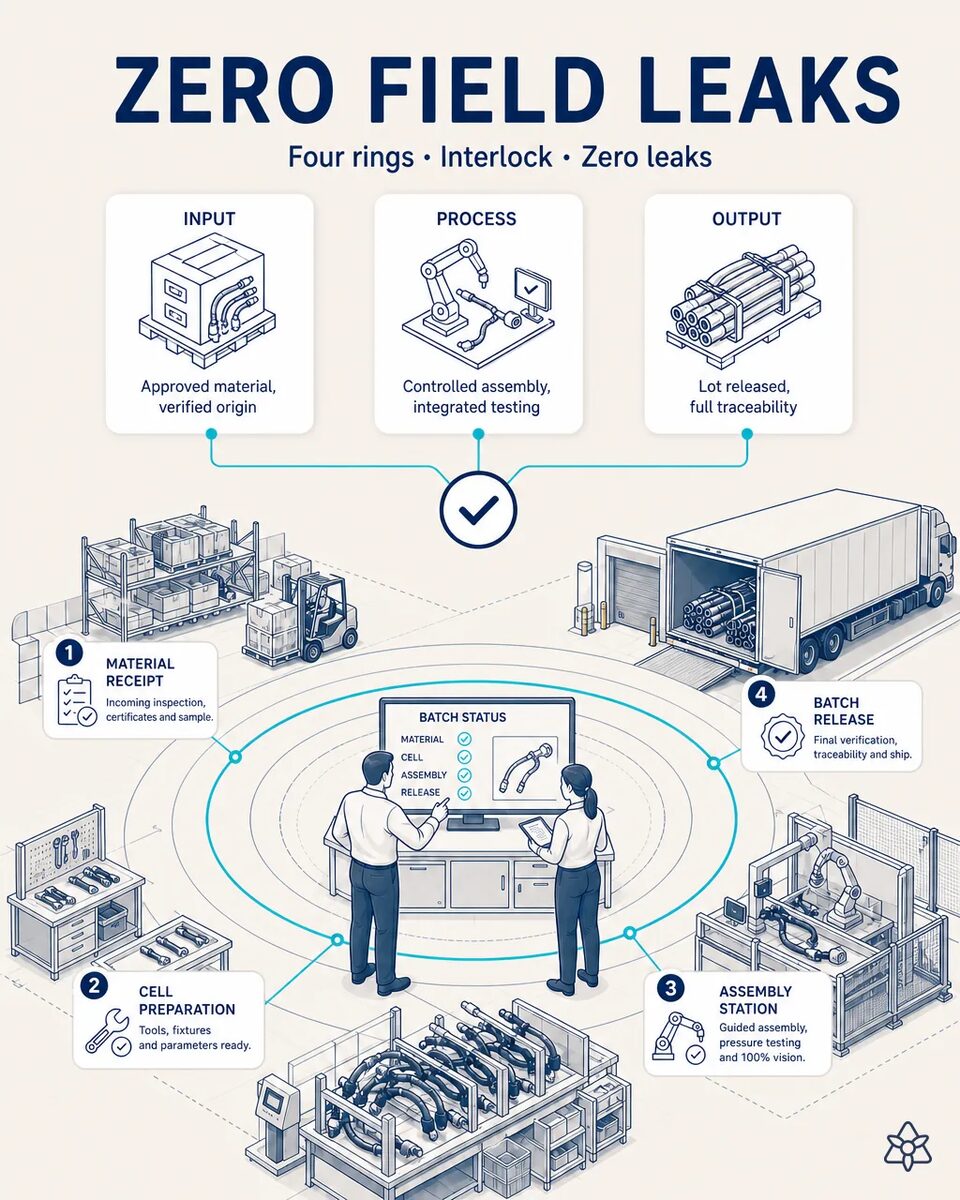
The root cause of a field leak is almost never a single failure.
The root cause of a field leak is almost never a single failure. It is a marginal o-ring, a badly purged changeover, a crimp at the edge of the window and a release signed in a hurry, all in sequence. Each link on its own looks acceptable, and in fact passes every individual control. Together they produce the part that fails six months later in the end customer's hands. That is why isolated controls are not enough: they have to cross-check one another. And when it happens, the second problem is the inability to bound it. Without material genealogy or a record of what was actually produced, the containment widens out of caution to a whole month of production, and the cost multiplies.
- It is the concatenation of a marginal o-ring, a badly purged change, a crimp at the edge of the window and a release signed in a hurry.
- Each link on its own looks acceptable, and in fact passes every individual control. Together they produce the part that fails six months later in the end customer's hands.
- That is why isolated controls are not enough: they have to cross-check each other.
- An air leak in a brake circuit, fuel in an engine line or coolant in a battery pack does not stay a reject: it becomes containment, controlled shipping and an 8D with the clock running.
Four rings that cross-check — it is all of the above, orchestrated.
The four rings are components already described separately in the previous cases. What the flagship adds is the coordination and the cross-interlock. Ring 1 · The material that came in. Every lot of resin, brass, o-rings and braid enters with its certificate linked from receiving. Melt→part genealogy exists from minute one, so any containment is bounded to the real lot. Ring 2 · The preparation you started with. The cell does not start until the Edge cameras confirm mold, inserts, cavities, purged pellets and the correct reel, and until the marker has the current drawing revision the ERP published loaded. SMED AI shortens the changeover so the control costs no productivity. Ring 3 · The part as it was assembled. The Edge camera validates the o-ring part by part before the joint closes. On a non-conforming part, ejection; on a sustained drift, JIDOKA AI interlocks the cell and raises the alarm instead of letting the drift fill a container. Ring 4 · The batch as it was released. No batch is released without the digitized leak curve, crimp parameters inside the window and a two-tap human signature on the tablet. Closing · Agents. Every pallet ships with the dossier that cross-references the four rings. If the four disagree, the pallet does not ship. And if the customer asks, the answer exists before the question.
No single ring solves the problem: each one already exists today in some form and the part still escapes. The strength is in the cross-check, because what gives the concatenation away is four independent sources ceasing to agree.
The four rings, and what each one closes
| Ring | Which cases it draws on | What it closes |
|---|---|---|
| 1 · Origin | Cell start-up (1) + receiving (7) | Which material and parameters make up the lot |
| 2 · Process | Leak bench (2) + metrology (6) + release (5) | Curve, dimensions and the signature of whoever saw the part |
| 3 · Line | O-ring (9) + mold change (10) | The marginal defect that passes every control separately |
| 4 · Evidence | Marker (8) + evidence pack (11) | Unit traceability and a dossier per pallet |
Estimated impact — to validate with your own numbers.
The block below is an estimate to be validated against your plant's actual data. We put it forward so the committee has an order of magnitude; we refine it during the assessment.
- Protection against a containment and recall campaign, whose single impact runs into hundreds of thousands of euros across sorting, freight, rework and penalties.
- Root cause after a field complaint: from rebuilt in weeks to queryable in minutes.
- Scope of the containment: from the whole month to the exact lot.
- And protection of supplier status, which is what conditions the award of future programs.
Protection against a containment and recall campaign, whose one-off impact runs into hundreds of thousands between sorting, freight, rework and penalties; and protection of the program award, whose multi-year value is another order of magnitude. Estimated payback of 6 to 12 months against the first containment avoided. *Estimate to validate* with the quality director and plant management, from the history of containments and controlled shipping.
And the fair question from the production manager
«Do we have to deploy all twelve cases to get this?» — no, and framing it that way would be the way never to start. The rings are built in layers and each case pays on its own from the first month. With cell start-up and the leak bench you already have ring 1 and half of ring 2, which is where half the missing traceability sits.
[1] OpenAI paper "Why Language Models Hallucinate", 2025 — on the reliability of AI in anchored tasks.
What people ask about the complete system
Where do you start?
With the case that has fewest dependencies and the shortest deployment, which in this matrix is cell start-up. What matters is that each layer pays on its own.
What does the cross-check give that each control does not?
Exactly what escapes today: the concatenation. A marginal o-ring passes its control, a crimp at the edge of the window passes its own, and the part that adds the two fails in the field.
What if a ring flags a false discrepancy?
JIDOKA AI stops on a verifiable discrepancy between sources, not on model uncertainty. When the doubt is the model's, the case is escalated to a person.
Does it replace the manufacturing system we already have?
No. Ring 1 rests precisely on the order being the truth. iLEAN cross-checks the systems against each other and against what actually happens in the cell.
Can the return be estimated before committing?
Yes: with your leak reject history, the cost of the last containment and the number of changes per week, the return per layer is estimated before deciding the order.
More cases from this series
- IATF audit always ready: the dossier closes as it happensEvery batch and changeover closes its own dossier as it happens, organised by standard. The audit is…
- Paperless cell start-up: the batch exists at second zeroHow a photo of the setup sheet and the first-piece record makes the batch exist in the central system at…
- The shift supervisor dictates on the move, and the knowledge staysBluetooth earpiece and Connect in voice mode: the supervisor records what they know without stopping,…
- The laser marker stitched to the ERP: no typing, no obsolete revisionWhat the ERP publishes, the marker prints, and what was printed comes back confirmed to the MES. Zero…
- The leak test bench starts talking (without replacing it)An external camera digitises the leak bench's pressure decay curve without touching the machine or…
- The metrology spreadsheet reaches the ERP without anyone typing itConnect reads the lab spreadsheet as it is saved and, after human validation, writes it into the ERP.…
Tell us what your last field containment cost you.
We work on your plant's real data, not ours. Assessment with no commitment.
Request estimated ROI within 48h ‹ See all cases of automotive fluid transfer See automotive