The laser marker stitched to the ERP: no typing, no obsolete revision
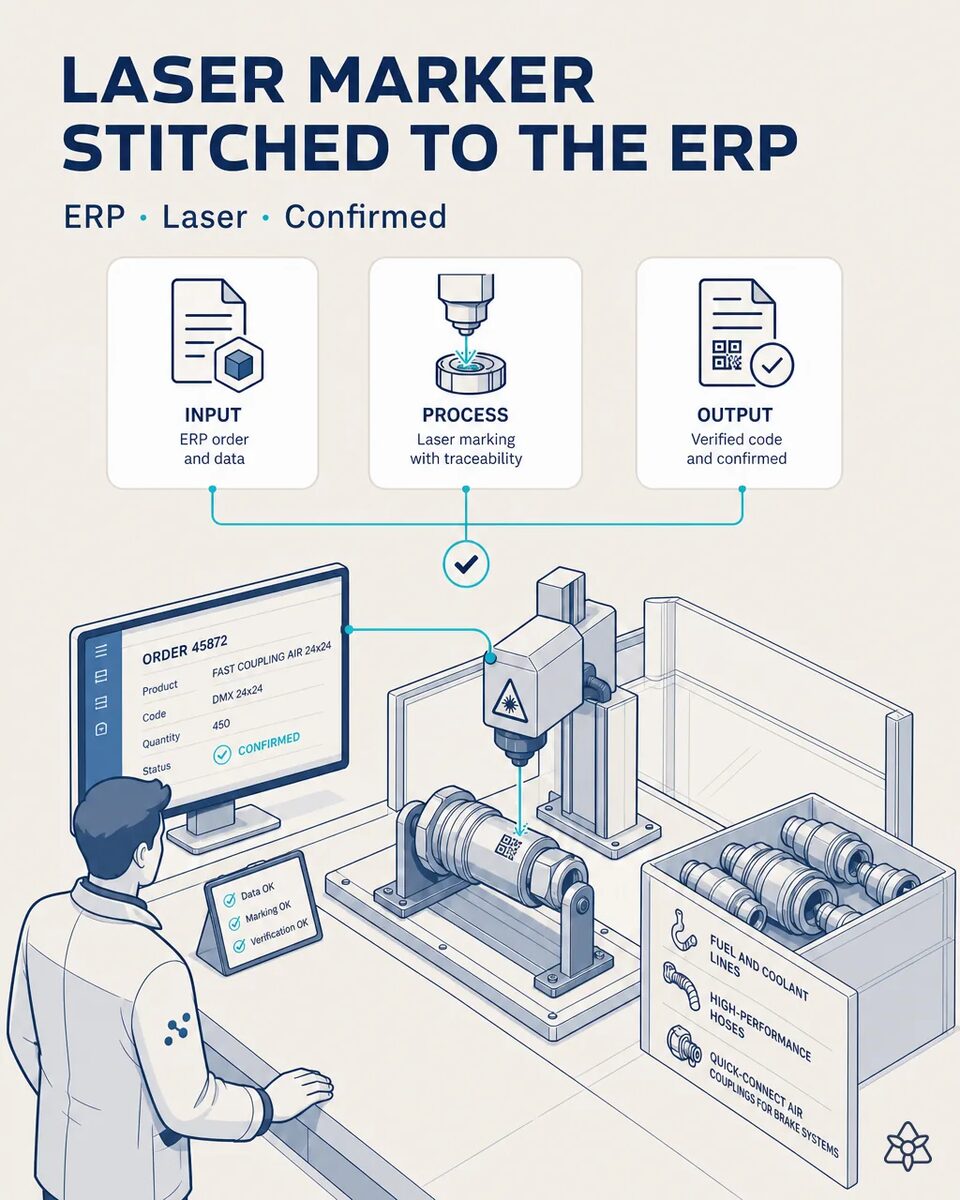
The laser marker engraves on the part the DataMatrix the whole unit-level traceability your customer demands depends on. It is a modern, capable machine with a documented interface — and it is isolated from the real flow. Every part-number or drawing-revision change forces somebody to select the right template by hand on its panel, using data that already sits in the ERP. iLEAN Connect stitches the two systems together: what the ERP publishes, the marker prints, and what was printed comes back confirmed to the MES.
The same data typed twice, and the changes are constant.
The same data gets typed in two places at every changeover, and changeovers are constant because the mix is high. It is the classic case of a modern system that stays isolated because there was never time to integrate it properly. One wrong finger on that panel means a whole batch marked with the previous revision's drawing number: scrap or part-by-part rework, and a nonconformity served on a plate if the batch already shipped. And there is a less visible gap: the MES has no record of what was actually marked, only of what was supposed to be marked. Duplicate typing and missing confirmation are the classic entry route for identification error in this sub-sector.
- The marker engraves the DataMatrix that all the unit traceability the customer requires depends on. It is modern, capable and has a documented interface — and it sits outside the real flow.
- Every part number or drawing revision change forces somebody to pick the right template by hand on its panel, with the same data already in the ERP.
- The changes are constant because the mix is high, so the exposure is permanent.
- One wrong finger on that panel means a whole lot marked with the previous revision's drawing number: scrap or piece-by-piece rework, and a nonconformity served on a plate if the lot has already shipped.
Connect stitches the two systems through APIs, replacing neither.
Connect as an integration layer between two modern systems. Neither the marker nor the ERP is replaced: they are stitched together. Step 1 — Publication. When the order is released, the ERP publishes the data set: template, part number, drawing revision, batch, cavity, date, plant code. Step 2 — Push through the interface. Connect pushes it to the marker through its API or command interface. Nobody selects anything by hand. Step 3 — Confirmation back. The marker confirms the load and Connect records in the MES what was effectively marked, not what was intended. Step 4 — Closing the ring. That record is what later allows what was marked to be cross-referenced with the active order and with the plant's other verification rings.
What was engraved comes back confirmed to the manufacturing system: not what was asked to be engraved, but what the machine says it engraved. That distinction is what turns marking into evidence instead of an assumption.
The isolated marker versus the stitched marker
| Aspect | Today | With iLEAN Connect |
|---|---|---|
| Typing the same data | Twice per change | Once, in the ERP |
| Lot with an obsolete revision | A permanent risk | Eliminated by construction |
| Changeover time on the marker | 10-15 minutes | A tap in the ERP |
| What was actually engraved | Assumed | Confirmed and returned to the system |
| With high mix | More changes, more exposure | More changes, the same exposure: none |
| Either system | — | Neither is replaced |
Estimated impact — to validate with your own numbers.
The block below is an estimate to be validated against your plant's actual data. We put it forward so the committee has an order of magnitude; we refine it during the assessment.
- Estimated payback 3-7 months counting only the changeover time recovered — which is minutes on the critical path of the shift.
- The real value is the error that disappears: a lot marked with an obsolete revision is scrap or piece-by-piece rework.
- And a nonconformity served on a plate if the lot has already left the plant.
- With high mix, the number of changes stops increasing the exposure.
Estimated payback of 3 to 7 months counting only the changeover time recovered, which are critical-path minutes of the shift. *Estimate to validate*. The real value is the identification error avoided: a mismarked batch caught at the customer is paid for in sorting, expedited freight and reputation.
And the fair question from the production manager
«Isn't a classic integration cleaner?» — it is the day the project reaches the top of the list, and that is the problem: it is the classic case of a modern system still isolated because there was never time. This stitching replaces neither system and asks for no shutdown window, so it does not compete in that queue.
[1] OpenAI paper "Why Language Models Hallucinate", 2025 — on the reliability of AI in anchored tasks.
What people ask about connecting the marker
Do we have to replace the marker or the ERP?
Neither. Connect leans on the documented interface the marker already has and on what the ERP publishes when the order starts.
What if the marker fails to engrave?
It is detected, because what comes back is confirmation of what was actually engraved. Today that failure raises no signal: the system assumes what was requested was engraved.
Does it cover drawing revision changes?
That is the most expensive failure and the one that most justifies the case: the revision travels from the ERP, so a lot carrying the previous one stops being possible.
How much is recovered per changeover?
In the order of ten to fifteen minutes, and they are minutes on the critical path of the shift, not idle time.
Does the same pattern work for other machines?
Yes: any modern island with an interface that is fed by hand today fits the same way. You start with the marker because it underpins unit traceability.
More cases from this series
- IATF audit always ready: the dossier closes as it happensEvery batch and changeover closes its own dossier as it happens, organised by standard. The audit is…
- Zero field leaks: four verification rings that cross-check each otherConnect, Edge, Agents, JIDOKA AI and SMED AI coordinated in four cross-checked verification rings: if…
- Paperless cell start-up: the batch exists at second zeroHow a photo of the setup sheet and the first-piece record makes the batch exist in the central system at…
- The shift supervisor dictates on the move, and the knowledge staysBluetooth earpiece and Connect in voice mode: the supervisor records what they know without stopping,…
- The leak test bench starts talking (without replacing it)An external camera digitises the leak bench's pressure decay curve without touching the machine or…
- The metrology spreadsheet reaches the ERP without anyone typing itConnect reads the lab spreadsheet as it is saved and, after human validation, writes it into the ERP.…
Tell us how many part number changes you run per day on the marker.
We work on your plant's real data, not ours. Assessment with no commitment.
Request estimated ROI within 48h ‹ See all cases of automotive fluid transfer See automotive