The o-ring nobody sees: Edge vision at the assembly station
The defect that defines this sub-sector is a two-millimetre rubber ring. O-ring missing, twisted, cut, doubled or badly seated in its groove: the part looks perfect, assembles perfectly, and fails at sealing. At cell rate, a human eye checking thousands of couplings per shift lets the borderline cases through — and the borderline case is precisely the one the leak test can pass cold and lose in the field. An Edge camera over the station decides in milliseconds and rejects before the joint closes.
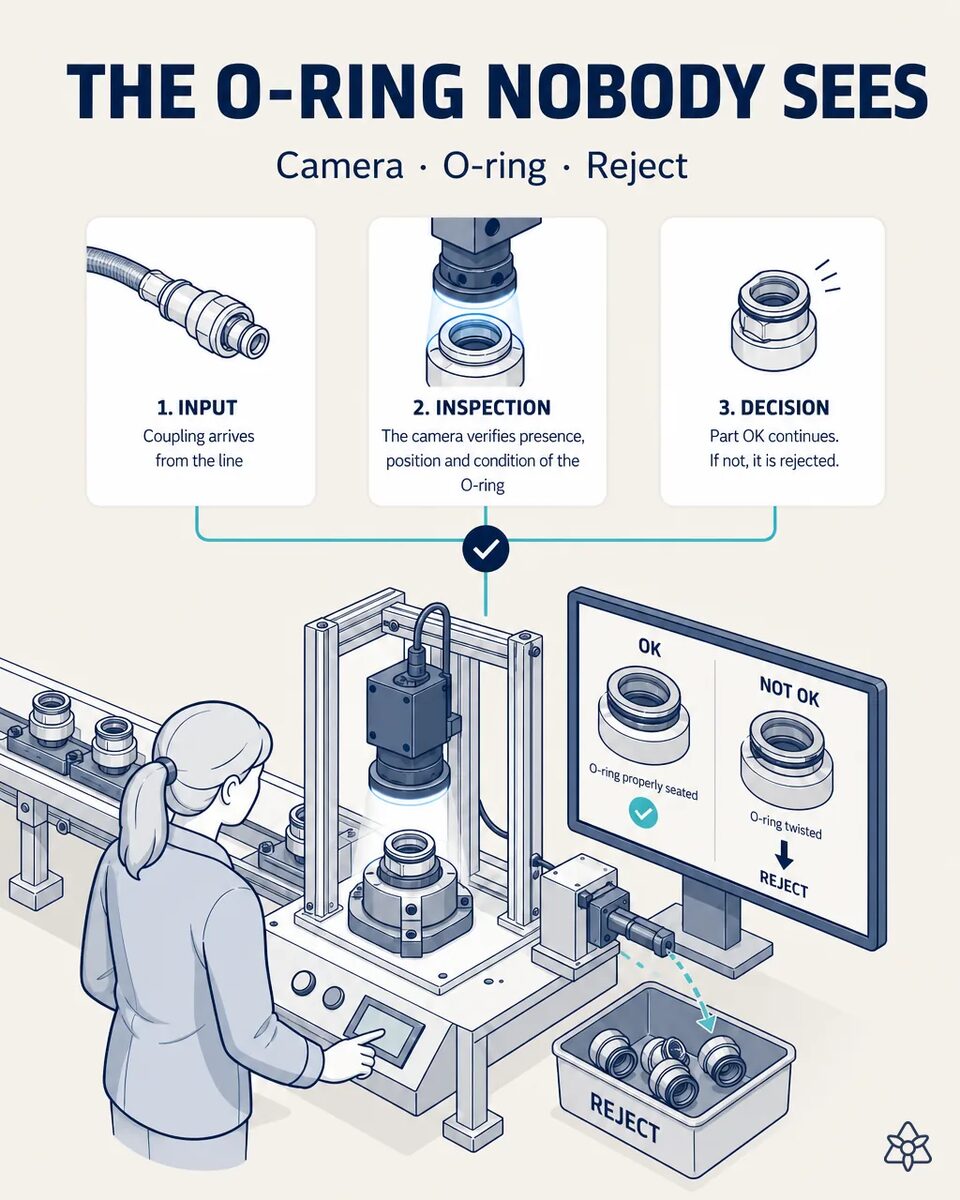
The poka-yoke cannot tell what a camera can.
O-ring assembly is manual or semi-automatic and its verification is visual. Poka-yokes exist, but they do not cover partial seating or a twisted ring: geometries a mechanical fixture cannot distinguish. Rejects that reach the leak test cost one bench cycle each, and the bench is usually the cell's bottleneck. Worse: if the defect is marginal, the cold test can pass it — and then the part leaves the plant. The cost of a leak caught at the customer versus the same leak caught at the station is three orders of magnitude apart. And under thermal cycling and vibration, partial seating is exactly the failure mode that shows up late.
- O-ring missing, twisted, cut, doubled or badly seated in its groove: the part looks perfect, assembles perfectly, and fails at sealing.
- Poka-yokes exist, but they do not cover partial seating or a twisted ring: geometries a mechanical fixture cannot distinguish.
- At cadence, a human eye checking thousands of couplings per shift lets the borderline cases through — and the borderline case is precisely the one that fails.
- Rejects reaching the leak test cost one bench cycle each, and the bench is usually the cell's bottleneck.
- Worse: if the defect is marginal, the cold test can pass it, and then the part leaves the plant.
Edge — part-by-part classification in milliseconds, before closing.
Edge: AI vision with local inference, the IRIS component that works at line rate and without depending on the network. Step 1 — Camera and lighting. An industrial camera with controlled illumination over the o-ring groove, mounted before the joint closes and before the leak test. Step 2 — Local inference. The neural network runs on the device itself, in milliseconds. The network can go down and the station keeps deciding. Step 3 — Trained on real parts. It is trained on conforming and non-conforming parts from the plant's real part numbers, including the rare defects quality has already collected, and classifies: present and seated, missing, twisted, doubled or damaged. Step 4 — Ejection with evidence. On a non-conforming part, automatic ejection and a record with the image that proves it. Root-cause analysis stops being an exchange of opinions.
Catching it at the previous station instead of at the bench frees cycles on the cell's bottleneck. That side effect is often worth as much as the scrap avoided, and it almost never makes it into the business case.
Today's inspection versus Edge vision
| Aspect | Visual inspection | With iLEAN Edge |
|---|---|---|
| Coverage | Depends on fatigue | Objective and constant at cadence |
| Partial seating and twisted ring | The poka-yoke cannot see them | Classified part by part |
| Point of detection | The leak test | The previous station |
| Bench cycles spent on rejects | One per bad part | Freed |
| Marginal defect | The cold test can pass it | Caught earlier |
| Borderline cases | They slip through | Escalated to a person |
Estimated impact — to validate with your own numbers.
The block below is an estimate to be validated against your plant's actual data. We put it forward so the committee has an order of magnitude; we refine it during the assessment.
- Estimated scrap and rework reduction of at least 30 % in the covered family.
- Estimated payback 5-11 months.
- Leak bench cycles freed: if it is the cell's bottleneck, that is capacity.
- And the marginal defect the cold test could pass stops leaving the plant.
Estimated reduction in scrap and rework of at least 30% in the covered family, with estimated payback of 5 to 11 months. *Estimate to validate* against the plant's reject history and mix. What pays for the whole project, though, is the cut in field-leak risk.
And the fair question from the production manager
«What if it rejects good parts?» — the false positive is the real risk of any vision system, which is why the model is trained on good and bad parts of your specific references and with that station's lighting, not on a generic model. Borderline cases are not simply rejected: they are escalated for a person to decide, and every decision feeds back into training.
[1] OpenAI paper "Why Language Models Hallucinate", 2025 — on the reliability of AI in anchored tasks.
What people ask about o-ring vision
Isn't a poka-yoke enough?
It covers the missing o-ring, which is the easy case. It does not cover partial seating or a twisted ring, which are geometries a mechanical fixture cannot distinguish and are the ones that fail at sealing.
Does it keep up with the cell's cadence?
Yes: inference is local and resolves in milliseconds per part. It does not depend on the plant network or the cloud.
How many parts are needed to train it?
Fewer than feared, because an o-ring's defect catalog is short and repetitive. What is needed is that they be real parts from your references.
Does it replace the leak test?
No, and it should not be framed that way. The test remains the reference; what changes is that it stops spending cycles on parts already known to fail.
Does it work for several references on the same camera?
Yes, switching the model according to the active reference. That is normal in a high-mix plant.
More cases from this series
- IATF audit always ready: the dossier closes as it happensEvery batch and changeover closes its own dossier as it happens, organised by standard. The audit is…
- Zero field leaks: four verification rings that cross-check each otherConnect, Edge, Agents, JIDOKA AI and SMED AI coordinated in four cross-checked verification rings: if…
- Paperless cell start-up: the batch exists at second zeroHow a photo of the setup sheet and the first-piece record makes the batch exist in the central system at…
- The shift supervisor dictates on the move, and the knowledge staysBluetooth earpiece and Connect in voice mode: the supervisor records what they know without stopping,…
- The laser marker stitched to the ERP: no typing, no obsolete revisionWhat the ERP publishes, the marker prints, and what was printed comes back confirmed to the MES. Zero…
- The leak test bench starts talking (without replacing it)An external camera digitises the leak bench's pressure decay curve without touching the machine or…
Tell us what percentage of your leak rejects are o-ring related.
We work on your plant's real data, not ours. Assessment with no commitment.
Request estimated ROI within 48h ‹ See all cases of automotive fluid transfer See automotive