No batch is released without a human having seen and signed it
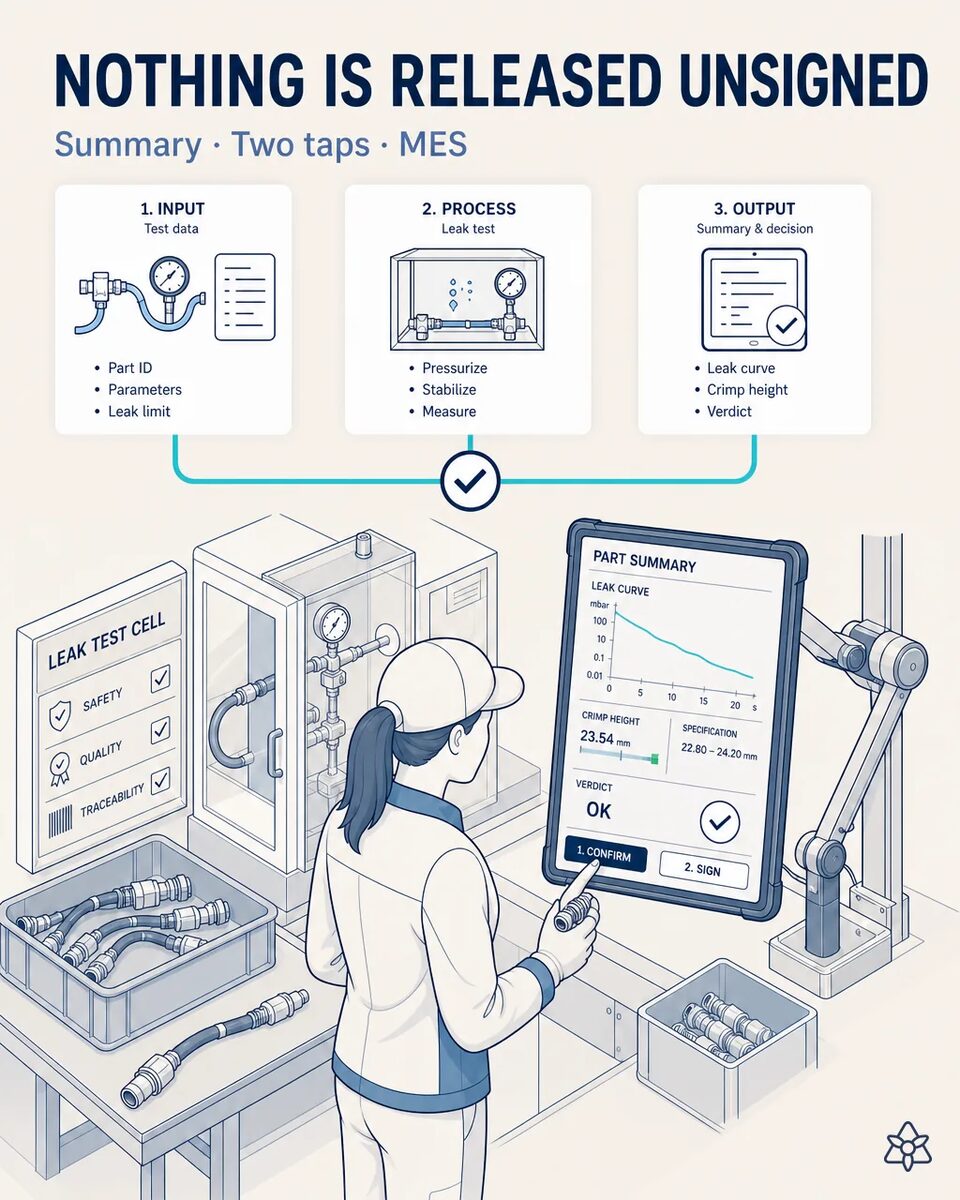
This is the line that separates iLEAN from an autonomous AI agent: nothing the AI captures crosses into the central system without a human having seen it. In a plant that seals pressure, the data that demands that gate is obvious: the leak test result and the crimp parameters the batch is released on. An industrial tablet at the cell shows the summary of what was already captured, and the operator confirms with two taps or corrects. Only then does the data enter the MES. Latency: seconds.
The data is typed by whoever did not look at the part.
Today batch release is signed on paper and typed later, or typed straight into a system whose screen is slow and which the operator cannot reach from their workstation. Both options produce the same result: data arriving late and, frequently, entered by someone who never looked at the part. A batch released with the leak test signed by nobody in particular is the hole a containment campaign escapes through. When the customer asks who decided that part could ship, the answer has to exist and it has to have a name. The opposite mistake is just as expensive: ask the operator to fill in one more form and the form gets filled in badly or not at all. Any validation gate that takes time away from the line eventually gets bypassed.
- Today release is signed on paper and typed later, or typed into a system whose screen is slow and which the operator cannot reach from their station.
- Both options produce the same result: data arriving late and, often, entered by somebody who was not the person who looked at the part.
- A batch released with the leak test not really signed by anybody is the hole a containment campaign escapes through.
- When the customer asks who released it and on what, the answer has to be a name and evidence, not a checkbox.
Connect with early human verification — two taps at the cell.
Connect in early-human-verification mode. This is the IRIS component that guarantees the master does not get contaminated and that every data point has a named owner. Step 1 — A summary, not a form. The industrial tablet sits at the cell on an articulated arm and asks you to fill in nothing: it shows a visual summary of what iLEAN already captured by any route — camera, panel, voice, parser — with the leak curve drawn and any dimension near its limit highlighted. Step 2 — Two taps. Confirm or correct. Nothing more. The cost to the line is seconds, not minutes. Step 3 — Only then does it cross. The data enters the MES with the signature of whoever validated it and a timestamp. Step 4 — The correction is learned too. When the operator corrects something, what changed and who changed it are stored: that leaves the trace of the decision and sharpens the system's judgement for the next part.
It is the piece that guarantees the master is not contaminated and that every datum has a responsible person by name. Without it, the other eleven do not get board approval: nobody signs off on AI writing into the system a release depends on.
Today's release versus the signed release
| Aspect | Today | With iLEAN |
|---|---|---|
| When the data enters | Hours later | In seconds, at the station |
| Who appears as the author | Whoever types it | Whoever looked at the part |
| What the signature proves | That somebody signed | Which result and which parameters they saw |
| Operator's time | Walk to a terminal | Two taps on the tablet |
| When the customer asks | A checkbox | A name and its evidence |
| Who writes to the master | A person, typing | A person, confirming |
Estimated impact — to validate with your own numbers.
The block below is an estimate to be validated against your plant's actual data. We put it forward so the committee has an order of magnitude; we refine it during the assessment.
- Estimated payback 4-9 months.
- The dominant value here is not productivity, it is risk: every release is signed with its evidence attached.
- Which is exactly what gets asked for when a field complaint lands and you have to show who released and on what.
- And authorship moves from whoever types the data to whoever looked at the part.
Estimated payback of 4 to 9 months, *estimate to validate*. The dominant value here is risk rather than productivity: every release ends up signed with its evidence attached, which is exactly what has to be shown when somebody asks why a specific part left the plant.
And the fair question from the production manager
«If a person signs in the end, what is the AI saving?» — the work is not in deciding, it is in assembling. Today somebody would have to go to the terminal, find the batch and type the result. With the verification gate it all arrives assembled in a summary and they only confirm or correct. And every correction is stored: the system learns where its extraction fails.
[1] OpenAI paper "Why Language Models Hallucinate", 2025 — on the reliability of AI in anchored tasks.
What people ask about the signed release
How long does it take the operator?
Seconds: the summary arrives with the leak result and crimping parameters already assembled, and is resolved with two taps from their own station.
Can the AI release a batch on its own?
No, and it is not configurable: it is the architecture. Data crosses into the system only after human confirmation.
What gets recorded?
What summary was shown, who confirmed it, when, and what they corrected if anything. That is what serves later when a field complaint lands.
What if the operator corrects the AI?
The correction is stored with its author. It works as a trail and as feedback so extraction improves at that specific point.
Is it mandatory before deploying the rest?
In practice yes: it is the piece that makes everything else approvable, because it is what guarantees the master is not contaminated.
More cases from this series
- IATF audit always ready: the dossier closes as it happensEvery batch and changeover closes its own dossier as it happens, organised by standard. The audit is…
- Zero field leaks: four verification rings that cross-check each otherConnect, Edge, Agents, JIDOKA AI and SMED AI coordinated in four cross-checked verification rings: if…
- Paperless cell start-up: the batch exists at second zeroHow a photo of the setup sheet and the first-piece record makes the batch exist in the central system at…
- The shift supervisor dictates on the move, and the knowledge staysBluetooth earpiece and Connect in voice mode: the supervisor records what they know without stopping,…
- The laser marker stitched to the ERP: no typing, no obsolete revisionWhat the ERP publishes, the marker prints, and what was printed comes back confirmed to the MES. Zero…
- The leak test bench starts talking (without replacing it)An external camera digitises the leak bench's pressure decay curve without touching the machine or…
Tell us who appears as the author of the release data in your system today.
We work on your plant's real data, not ours. Assessment with no commitment.
Request estimated ROI within 48h ‹ See all cases of automotive fluid transfer See automotive