Material receiving in five minutes, with the certificate attached to the lot
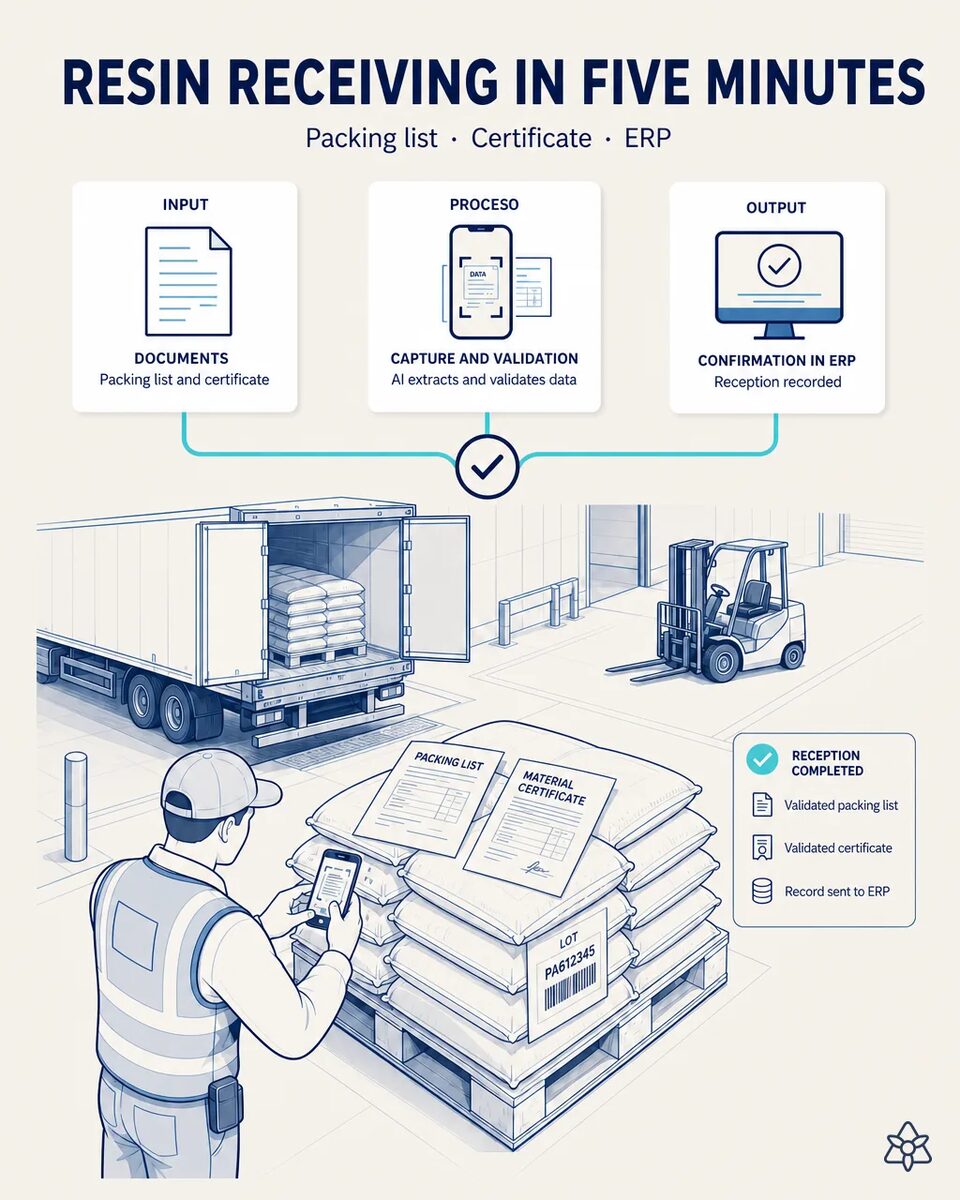
The truck arrives with polyamide resin, fluoropolymer pellets, brass bar, o-rings or a reel of reinforcement braid. The receiving supervisor faces a packing list with twelve to twenty lines, one material certificate per lot and labeled pallets. They have to sign and also get into the ERP to type it line by line. With iLEAN Connect a photo is enough: packing list, certificates and labels are digitized in seconds, validated with one tap, and enter the ERP with their lot traced.
The foundation of all traceability depends on typing under pressure.
Incoming material traceability is the foundation of all product traceability. And today it rests on manual typing done under time pressure, with the carrier waiting. Both exits are bad. Either the truck waits forty-five minutes charging detention, or it gets typed in a hurry and the lots end up badly traced. That resurfaces months later, in the 8D where you have to prove which melt the failed part came from. And there is a second, quieter problem: the material certificate ends up in a filing cabinet or a network folder, unlinked from the production batch that consumed it. When the customer asks, days of documentary archaeology begin.
- The truck arrives with polyamide resin, fluoropolymer pellets, brass bar, o-rings or reinforcement braid reels: a twelve-to-twenty-line delivery note, a material certificate per lot and labeled pallets.
- Both ways out are bad. Either the truck waits forty-five minutes racking up demurrage, or it gets typed in a hurry and the lots end up badly traced.
- That reappears months later, in the 8D where you have to prove which heat the failed part came from.
- And the material certificate ends up unlinked in a filing cabinet, when it is exactly the document that closes the genealogy.
Connect in photo mode — delivery note, certificate and labels, no supplier changes.
Connect in photo-to-the-analogue mode, writing into the ERP after human validation. No supplier has to change their document. Step 1 — Photo. Of the packing list, the material certificates and the pallet labels. Step 2 — Recognition. Vision AI identifies the layout of each packing list and certificate and extracts the tabular structure. For labels it reads GS1 codes, QR, barcodes or plain text. Step 3 — Linking. The certificate is filed against the material lot, so it is automatically associated with every part that consumes it: melt-to-part genealogy exists from minute one. Step 4 — Validation and write-back. One tap on an industrial tablet and everything enters the ERP through the interface. The receiving supervisor never opens the ERP.
The material certificate stops being a filed sheet of paper and becomes linked to the lot from minute one. That is what turns the heat-to-part genealogy into a query instead of a hand reconstruction.
Today's receiving versus captured receiving
| Aspect | Today | With iLEAN Connect |
|---|---|---|
| Truck at the dock | 45 minutes | 5 minutes |
| Material certificate | Unlinked, in a filing cabinet | Linked to the lot from minute one |
| Heat → part genealogy | Rebuilt during the 8D | Complete and queryable |
| Badly traced lots | Surface months later | Do not occur |
| Carrier demurrage | Recurring | Eliminated |
| Receiving and warehouse licenses | Two or three | One, the supervisor who validates |
Estimated impact — to validate with your own numbers.
The block below is an estimate to be validated against your plant's actual data. We put it forward so the committee has an order of magnitude; we refine it during the assessment.
- 💰 CFO angle: the receiving and warehouse module typically requires two or three active licenses; with Connect only the supervisor validates: 50-70 % reduction, recurring.
- From 45 minutes of truck at the dock to 5, truck after truck.
- Carrier demurrage eliminated.
- And a complete heat-to-part genealogy, which is what holds up an 8D when the customer asks.
CFO angle — direct ERP license saving. The receiving and warehouse module typically demands two or three active seats (receiving supervisor, backup, supervisor above); with Connect only the supervisor validates, with one tap, without entering the ERP. Typical 50-70% reduction in receiving/warehouse module seats, plus the elimination of the bulk-capture module cost and the dedicated scanners. Estimated payback of 3 to 8 months, plus the recurring saving and the carrier detention that stops being paid. *Estimate to validate*.
And the fair question from the production manager
«Does it recognize every supplier's delivery note?» — yes, and without asking any of them to change theirs: the model extracts the table structure with no need for a per-supplier template. Labels are read by standard symbology where present and by optical recognition where not. It is an anchored task, where the best models drop below 1.5% error [1], and the supervisor validates before anything enters.
[1] OpenAI paper "Why Language Models Hallucinate", 2025 — on the reliability of AI in anchored tasks.
What people ask about digitizing material receiving
Is the material certificate read?
Yes, and it is the part that adds most: its values end up linked to the lot, so proving which heat a part came from stops being a search through a filing cabinet.
Does it work for materials as different as resin, brass and braid?
Yes. What differs between them is the format of the document and the label, and the model recognizes the structure without a per-supplier template.
What if the delivery note and labels disagree?
The discrepancy is highlighted in the summary before the receiving supervisor validates. Today nobody does that cross-check with a truck waiting.
Do we need a barcode scanner?
Not necessarily: a photo from the phone or industrial tablet is enough. If the plant already has scanners that work well, they integrate just the same.
Can we start with receiving alone?
Yes, and it is a good starting point: the result is visible from the first truck and it does not depend on the other pieces being deployed.
More cases from this series
- IATF audit always ready: the dossier closes as it happensEvery batch and changeover closes its own dossier as it happens, organised by standard. The audit is…
- Zero field leaks: four verification rings that cross-check each otherConnect, Edge, Agents, JIDOKA AI and SMED AI coordinated in four cross-checked verification rings: if…
- Paperless cell start-up: the batch exists at second zeroHow a photo of the setup sheet and the first-piece record makes the batch exist in the central system at…
- The shift supervisor dictates on the move, and the knowledge staysBluetooth earpiece and Connect in voice mode: the supervisor records what they know without stopping,…
- The laser marker stitched to the ERP: no typing, no obsolete revisionWhat the ERP publishes, the marker prints, and what was printed comes back confirmed to the MES. Zero…
- The leak test bench starts talking (without replacing it)An external camera digitises the leak bench's pressure decay curve without touching the machine or…
Tell us how long it takes today to book in a material truck.
We work on your plant's real data, not ours. Assessment with no commitment.
Request estimated ROI within 48h ‹ See all cases of automotive fluid transfer See automotive