Edge vision on final assembly
At final assembly line cadence, the human eye tires and can miss a subtle defect that bench test doesn't always catch. With an Edge camera over the line, millisecond inference rejects the defective unit before packaging.
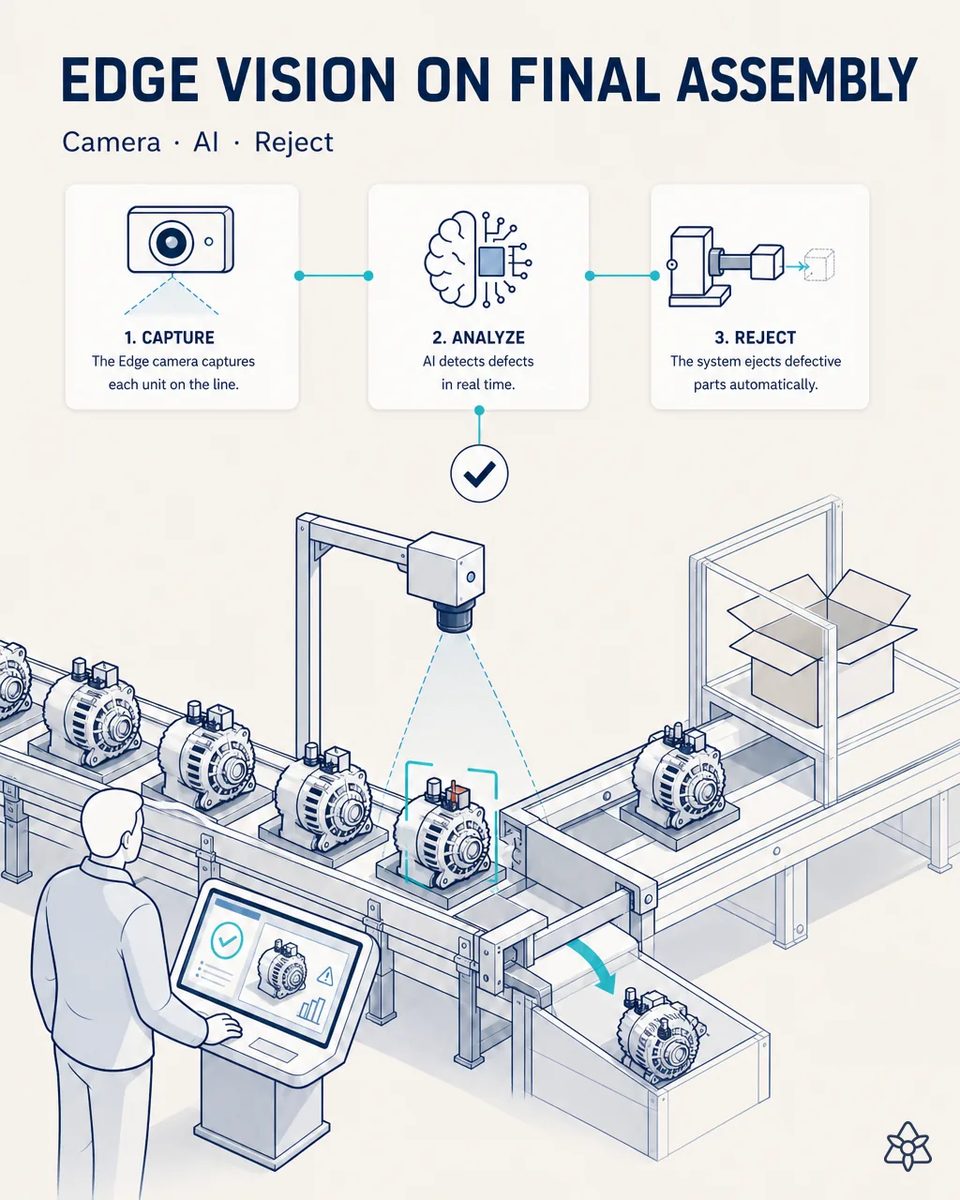
Some defects pass the electrical bench and fail in the vehicle.
- A misseated connector, an incorrectly torqued screw, or a cold solder joint are subtle visual defects that can pass a bench electrical test. - They're also the most expensive defects if they reach a vehicle on the road, triggering an OEM customer complaint.
- At final assembly cadence the human eye tires, and by the end of the shift a subtle defect is easier to miss than at the start. Sampling helps, but it only sees the units it picks.
- A misseated connector, an incorrectly torqued screw or a cold solder joint are subtle visual defects, and they can pass a bench electrical test because contact is still made on the bench.
- Vibration and thermal cycling in the engine bay are what open them up, weeks or months later, when the unit is already fitted to a vehicle.
- They are the most expensive defects once they reach a vehicle on the road: an OEM customer complaint, a warranty return and, if the pattern repeats, a recall discussion.
Edge vision over the line — a CNN trained on your own alternators, starters and connectors.
Edge camera over the line with a CNN trained on good and bad images of the specific product (alternator, starter motor, ECU connector). Millisecond inference, rejecting the defective unit before packaging.
The model is trained on good and bad images of your specific product, not on a generic catalog. It runs on the line, in milliseconds, so the defective unit is diverted before packaging instead of being found by the OEM. Inspectors move from hunting every unit to deciding on the doubtful ones.
Final inspection today versus Edge inspection
| Aspect | Today | With iLEAN Edge |
|---|---|---|
| False negatives at cadence | Rise when the line speeds up | Independent of line speed |
| Misseated connector | Can pass the bench test | Detected and the unit diverted |
| Screw torqued wrong or missing | Caught only if someone looks | Checked on every unit |
| Cold solder joint on a visible terminal | Hard to judge by eye | Classified from the image |
| Evidence per unit | None | Photo linked to the serial number |
| Warranty return analysis | Starts without images | Starts with the unit's photo at shipment |
Human visual inspection with fatigue and false negatives → constant Edge inspection, no fatigue, with photographic evidence per unit.
Impact estimate — to be validated with your numbers.
The block below is an estimate to be validated against your plant's actual data. We put it forward so the committee has an order of magnitude; we refine it during the assessment.
- Estimated payback 5-10 months, depending on line volume.
- Estimated scrap and rework reduction of at least 30% at the control point, because defects are caught where they are still cheap to fix.
- From human inspection with fatigue and false negatives to constant Edge inspection, with photographic evidence per unit.
- And a lower risk of the defect that costs most: the one that passes the bench and fails in the engine bay, where a single escape can open a warranty campaign.
Estimated scrap/rework reduction of at least 30% at the control point, payback 5-10 months depending on line volume. Estimate to be validated.
And the fair question from the production manager
“What if the camera rejects good alternators?” — classifying known defect types on a fixed product under controlled lighting is an anchored task, where the best models stay below 1.5% [1] error. Doubtful units are not scrapped automatically: they are diverted for a person to decide, and every decision feeds back into the model. Over time the doubtful share shrinks, because the model learns from the calls your inspectors make.
[1] OpenAI paper "Why Language Models Hallucinate", 2025 — on the reliability of AI in anchored tasks.
What people ask about vision on final assembly
Which defects can the camera see that the electrical bench cannot?
Those where contact is still made on the bench: a connector not fully latched, a terminal nut not seated, a screw missing its washer, a solder joint with poor wetting. They pass electrically today and open up later with vibration. A camera sees position and seating, which the bench cannot measure.
Does it work on different product families on the same line?
Yes, with one model per family: alternator, starter motor or ECU connector. The line's active order tells the camera which product and which reference it is inspecting. A new reference needs its own good and bad images before the camera judges it.
Why inference at the edge and not in the cloud?
Because the decision has to be made in milliseconds, at line cadence, and cannot depend on a network connection or a server far from the line. Only the results and the evidence images travel to the central system. If the network drops, inspection continues and the data syncs later.
What happens to a rejected unit?
It is diverted before packaging with its image and the defect class. Rework knows what to look at, and quality sees which defect types are rising on which shift. That trend usually points back to a station, a tool or a component lot.
Does it slow the line down?
No. Inference takes milliseconds, well within the cycle of an assembly station, and the camera is mounted over the existing conveyor without changing its layout. Lighting is added around the inspection point so the image stays stable across shifts.
More cases from this series
- The electronic components delivery note, straight to the ERPPhoto the delivery note and the PCB/semiconductor lot labels; one validation tap and it all posts to the…
- Industrial tablet validates ECU assemblyNothing iLEAN captures enters the central system without a human confirming it with two taps on an…
- ICT and AOI stitched to the MES, nothing replacedThe ICT/AOI test station's result reflects automatically in the MES/ERP, with no system replaced.
- The metrology lab spreadsheet, straight to the ERPThe metrology lab spreadsheet posts itself to the ERP after human validation, with -50 to -80% fewer…
- The line lead's earpiece that loses no dataThe line lead dictates while walking, without stopping work; iLEAN listens, structures it, and returns…
- Semiconductor delay alert, read in secondsiLEAN reads the supplier's delay email at zero latency and suggests a replan before the line stops.
Tell us which defect on your final assembly line passes the bench and fails in the vehicle.
We work on your plant's real data, not ours. Assessment with no commitment.
Request estimated ROI within 48h ‹ See all cases of automotive electronics See automotive