Semiconductor delay alert, read in seconds
A component delay is a structural risk for the sector since the semiconductor crisis. With iLEAN Connect sitting in silent copy on the mailbox, the supplier's alert gets read and cross-referenced with active orders in seconds, not hours.
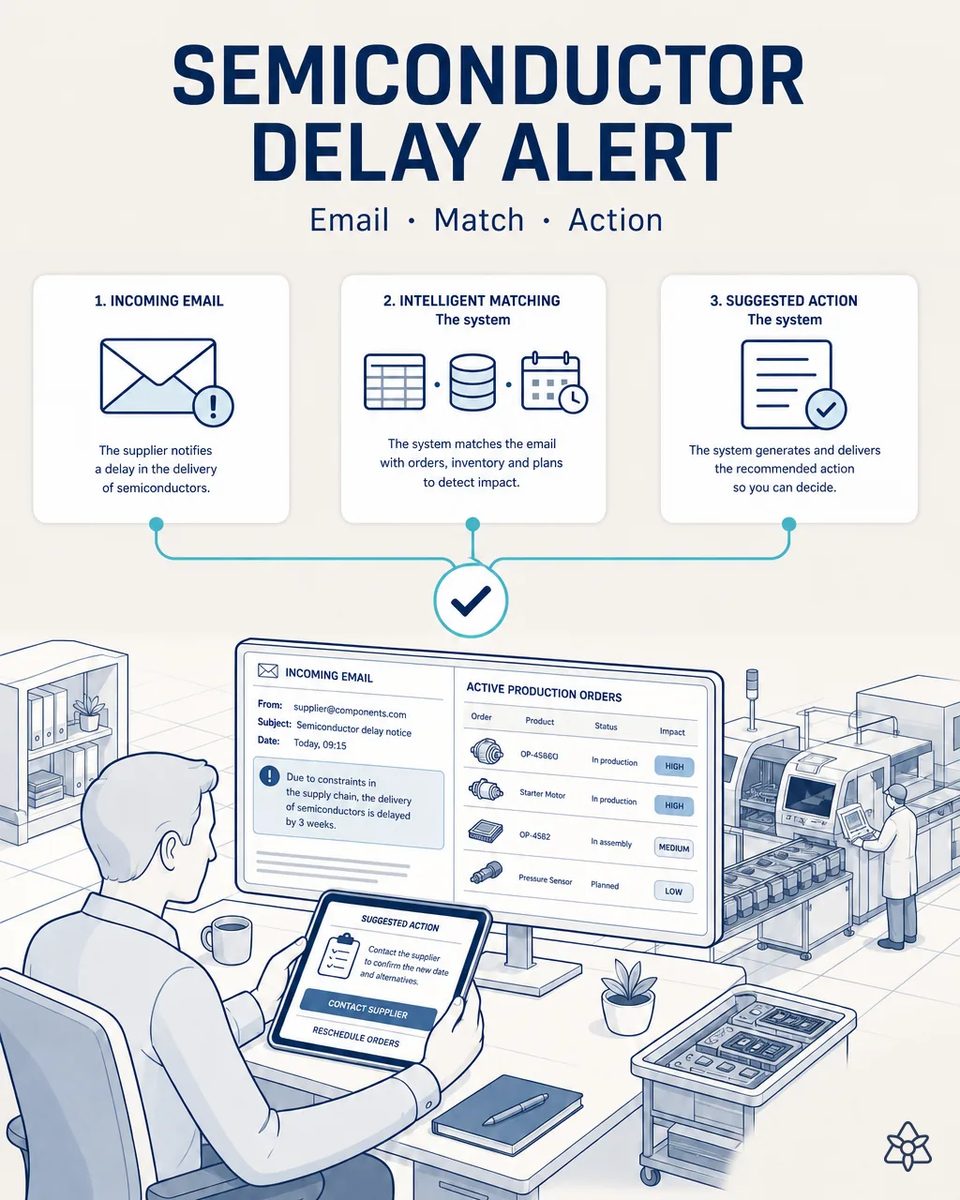
Since the chip shortage, a delay email is a structural risk, not an anecdote.
- The supplier's delay email lands in one person's inbox, who reads it hours later, when an order is already planned to start with that component. - Without a timely alert, the line gets planned anyway and ends up stopped with no prepared alternative.
- A component delay has been a structural risk for the sector since the semiconductor crisis: microcontrollers, power MOSFETs for the voltage regulator, sensor ASICs. Allocation and lead times can change with a single email.
- That email lands in one person's inbox, who reads it hours later — when an order is already planned to start with that component.
- It arrives in free text, sometimes as a reply buried in a long thread, with the part number written the supplier's way rather than yours.
- Without a timely alert, the line gets planned anyway and ends up stopped with no alternative prepared: no reshuffled sequence, no order pulled ahead that does not need the missing part.
Connect in chaotic-sources mode — a dedicated mailbox in silent copy, around the clock.
Connect chaotic-sources mode: a dedicated mailbox in 24/7 silent copy. An LLM extracts the intent (component delay), the entities (supplier, part number, date) and cross-references everything with the ERP to return a concrete action to the production manager.
Nobody changes how suppliers write or how purchasing works. The mailbox just reads in seconds what a person would read in hours, and it hands the production manager an action instead of one more email to interpret. The decision stays human; only the waiting disappears.
The supplier email today versus the email read by iLEAN
| Aspect | Today | With iLEAN Connect |
|---|---|---|
| Time from email to reaction | Hours of human latency | Seconds |
| Supplier part number vs. your own | Matched from memory | Mapped to the internal part number |
| ECU or sensor orders that need that chip | Worked out by hand in the ERP | Listed automatically with their start dates |
| Replanning basis | A late read of the inbox | Real-time order and stock data |
| Delay buried in a reply thread | Easy to miss | Extracted like any other notice |
| Discontinuation or last-time-buy notice | Filed and forgotten | Flagged with the products it will affect |
Hours of human latency → seconds, with replanning based on real-time data instead of a late read.
Impact estimate — to be validated with your numbers.
The block below is an estimate to be validated against your plant's actual data. We put it forward so the committee has an order of magnitude; we refine it during the assessment.
- Estimated payback 3-7 months, depending on how often critical supply alerts reach you.
- From hours of human latency to seconds between the supplier's email and a concrete action on the table.
- Replanning based on real-time data: the order that cannot start is swapped before the line is set up for it, not after.
- And fewer line stops with no alternative prepared, which is where a semiconductor delay really costs money in a plant running to OEM call-offs and their delivery windows.
Estimated payback 3-7 months depending on the frequency of critical supply alerts. Estimate to be validated.
And the fair question from the production manager
“What if it takes a routine lead-time update for a real delay?” — extracting intent, supplier, part number and date from a supplier email is an anchored task, and in anchored tasks the best models stay below 1.5% [1] error. And it only proposes: the production manager sees the source email next to the suggested action and decides whether to replan.
[1] OpenAI paper "Why Language Models Hallucinate", 2025 — on the reliability of AI in anchored tasks.
What people ask about reading semiconductor delay notices
Does purchasing have to change how it works with suppliers?
No. The dedicated mailbox is simply put in copy on the supplier threads that already exist. Suppliers keep writing the way they do, and purchasing keeps owning the relationship. The mailbox reads; it never replies to a supplier on anyone's behalf.
Can it tell which of our part numbers a supplier reference corresponds to?
Yes, through the cross-reference the ERP already holds between manufacturer part numbers and internal ones. When the mapping is ambiguous, it asks rather than guessing. Every answer given once is remembered for the next notice from that supplier.
Does it cover change and discontinuation notices, not just delays?
Yes. A discontinuation or a change to a qualified automotive-grade chip is precisely the kind of notice that gets filed and forgotten. It is extracted and linked to every product that uses the part.
Will it move orders in the ERP on its own?
No. It returns a concrete action, meaning which orders are affected and which could be pulled ahead, and the production manager decides. Nothing is replanned without a person, and the decision is logged next to the email that triggered it.
Does it matter for alternators and starter motors, or only for ECUs?
For all of them. The voltage regulator of an alternator and the control electronics of a modern starter also depend on semiconductors, so the same notice can hit several product families at once. The cross-reference shows all of them in one list, ordered by start date.
More cases from this series
- The electronic components delivery note, straight to the ERPPhoto the delivery note and the PCB/semiconductor lot labels; one validation tap and it all posts to the…
- Industrial tablet validates ECU assemblyNothing iLEAN captures enters the central system without a human confirming it with two taps on an…
- ICT and AOI stitched to the MES, nothing replacedThe ICT/AOI test station's result reflects automatically in the MES/ERP, with no system replaced.
- The metrology lab spreadsheet, straight to the ERPThe metrology lab spreadsheet posts itself to the ERP after human validation, with -50 to -80% fewer…
- The line lead's earpiece that loses no dataThe line lead dictates while walking, without stopping work; iLEAN listens, structures it, and returns…
- Photo of the startup travelerThe startup traveler stops getting lost on paper: one photo gets it into the central system at zero…
Tell us how you found out about your last semiconductor delay, and how late.
We work on your plant's real data, not ours. Assessment with no commitment.
Request estimated ROI within 48h ‹ See all cases of automotive electronics See automotive