The line lead's earpiece that loses no data
The line lead walks the whole shift between SMT, winding and assembly with their hands constantly busy. With iLEAN Connect earpiece mode, knowledge that today dies at shift end becomes available in the system in real time.
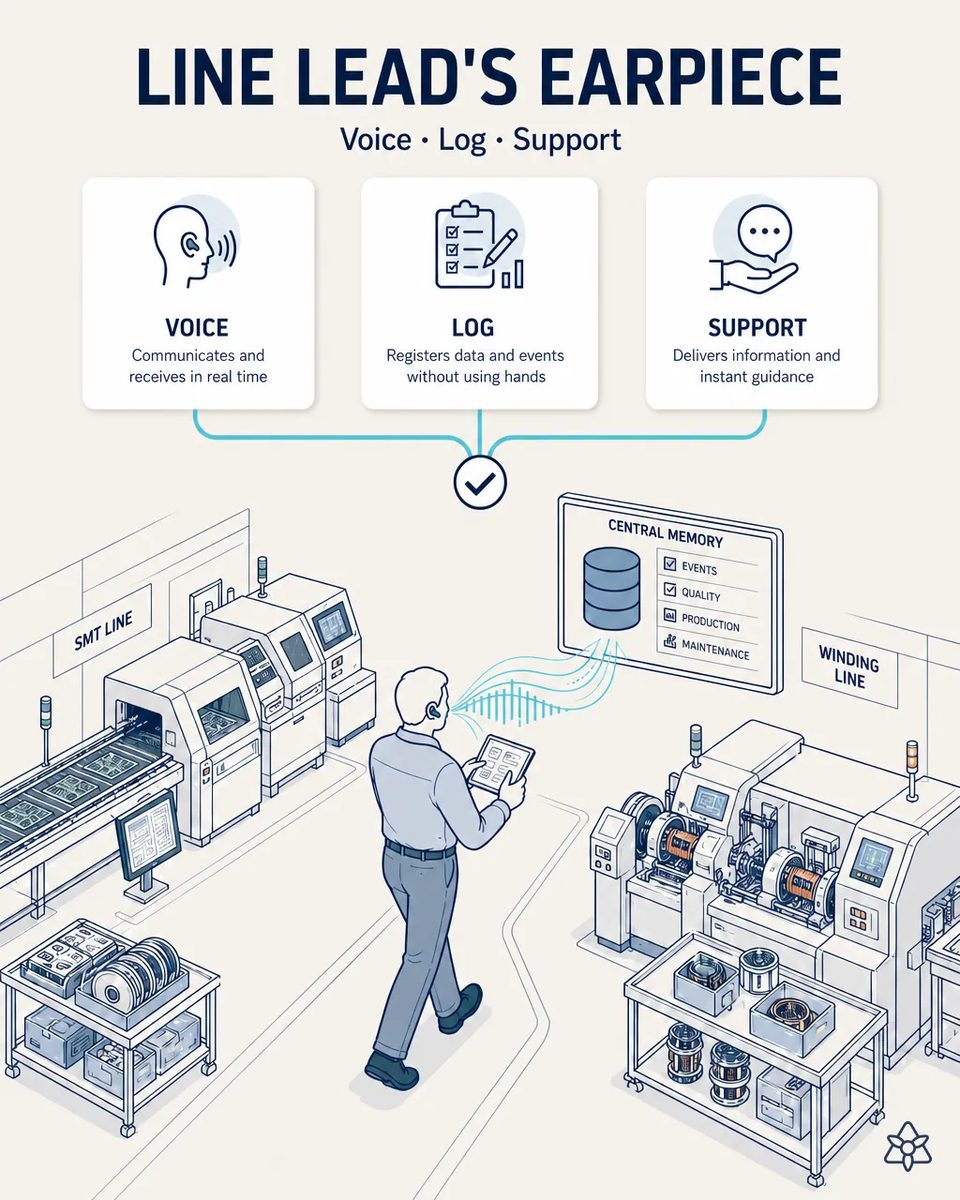
The person who sees the whole floor has no free hand to record it.
- No one asks the line lead anything because they can't type while adjusting a parameter or holding a tray of components. - All the critical operational knowledge in their head, a bigger reject rate in test, an operator who needs backup, a drifting adjustment, dies at the end of the shift unrecorded.
- The line lead walks the whole shift between SMT, winding and electromechanical assembly: adjusting a parameter, holding a tray of components, covering a station for a few minutes.
- No one asks them to log anything because they cannot type while doing any of that, and walking to a terminal means leaving the line.
- So the critical knowledge stays in their head: a reject rate creeping up at functional test, an operator on the rotor line who needs backup, a varnish cure that keeps running long.
- At the end of the shift that knowledge dies unrecorded, and the next line lead meets the same drift without knowing it was already seen.
Connect in voice mode with a custom wake word — the line lead dictates while walking.
Connect voice mode with a custom wake word: the line lead dictates while walking, the AI structures the dictation as an incident linked to the active lot/line/shift, and returns support by voice or push in seconds.
The earpiece records only what the line lead chooses to say after the wake word; nobody else on the floor is listened to. What they get back is support in seconds, by voice or push, instead of one more task at the end of the shift.
The line lead's shift today versus the shift with an earpiece
| Aspect | Today | With iLEAN Connect |
|---|---|---|
| A drift noticed at end-of-line test | Remembered, if at all | Logged as an incident on the active lot |
| Link to lot, line and shift | Rebuilt from memory later | Added automatically at dictation |
| Hands needed to record | Both, plus a terminal | None: wake word and speech |
| Support for the line lead | Phone calls and walking to find someone | Answer by voice or push in seconds |
| Knowledge at shift change | Leaves with the person | Available to the incoming line lead |
| Talk without the wake word | — | Never recorded |
Knowledge that dies at shift end → enters the system in real time and gets cross-referenced with live production and quality data.
Impact estimate — to be validated with your numbers.
The block below is an estimate to be validated against your plant's actual data. We put it forward so the committee has an order of magnitude; we refine it during the assessment.
- No standalone payback: this is an enabling piece, and we do not put a month range on it because its value shows up in the other cases.
- It is hard to monetize upfront, but it underpins all continuous improvement on the floor: without recorded incidents there is nothing to analyze.
- Knowledge that dies at shift end enters the system in real time and is cross-referenced with live production and quality data.
- We estimate its effect together with your continuous-improvement lead, on the incidents that start appearing in the record.
Hard to monetize upfront, but it underpins all continuous improvement on the floor. Estimate to be validated with the continuous-improvement lead.
And the fair question from the production manager
“Is this a way to listen to the floor?” — no: it only records what follows the line lead's wake word, and operators are never listened to. Turning a dictation into a structured incident with lot, line and shift is an anchored task, where the best models stay below 1.5% [1] error; and the line lead hears the summary back and can correct it before it is stored.
[1] OpenAI paper "Why Language Models Hallucinate", 2025 — on the reliability of AI in anchored tasks.
What people ask about the line lead's earpiece
Why a custom wake word?
So that recording starts only when the line lead decides. It avoids accidental captures during ordinary conversation and makes it obvious to everyone nearby when the system is listening and when it is not. That clarity is what keeps the earpiece accepted on the floor months after deployment.
How does it know which line or lot the line lead means?
From what they say and from the context: the line they name, the station they are standing at and the lots active at that moment. If it is still ambiguous, it asks back by voice before storing the incident.
What kinds of incidents are worth dictating?
Anything that would otherwise be passed on verbally: a yield drop at functional test, a varnish cure running long, a station short of an operator, an adjustment made on the winder. Small observations are the first to disappear, and they are often the first sign of a nonconforming lot.
Does it work in the languages spoken on the floor?
Yes. The line lead dictates in the language they think in, and the incident is stored in structured form, so whoever reads it later can query it in their own language.
Who can see what the line lead dictated?
The roles you authorize, typically the incoming line lead, the production manager and continuous improvement. Incidents are tied to lots and lines, not published as a feed of what a person said.
More cases from this series
- The electronic components delivery note, straight to the ERPPhoto the delivery note and the PCB/semiconductor lot labels; one validation tap and it all posts to the…
- Industrial tablet validates ECU assemblyNothing iLEAN captures enters the central system without a human confirming it with two taps on an…
- ICT and AOI stitched to the MES, nothing replacedThe ICT/AOI test station's result reflects automatically in the MES/ERP, with no system replaced.
- The metrology lab spreadsheet, straight to the ERPThe metrology lab spreadsheet posts itself to the ERP after human validation, with -50 to -80% fewer…
- Semiconductor delay alert, read in secondsiLEAN reads the supplier's delay email at zero latency and suggests a replan before the line stops.
- Photo of the startup travelerThe startup traveler stops getting lost on paper: one photo gets it into the central system at zero…
Tell us how much of your line leads' knowledge survives the shift change today.
We work on your plant's real data, not ours. Assessment with no commitment.
Request estimated ROI within 48h ‹ See all cases of automotive electronics See automotive