The electronic components delivery note, straight to the ERP
Receiving PCBs and semiconductors means signing the delivery note and typing line by line into the ERP while the carrier waits. With iLEAN Connect, one photo of the delivery note and lot labels is enough for everything to cross into the ERP after a single validation tap.
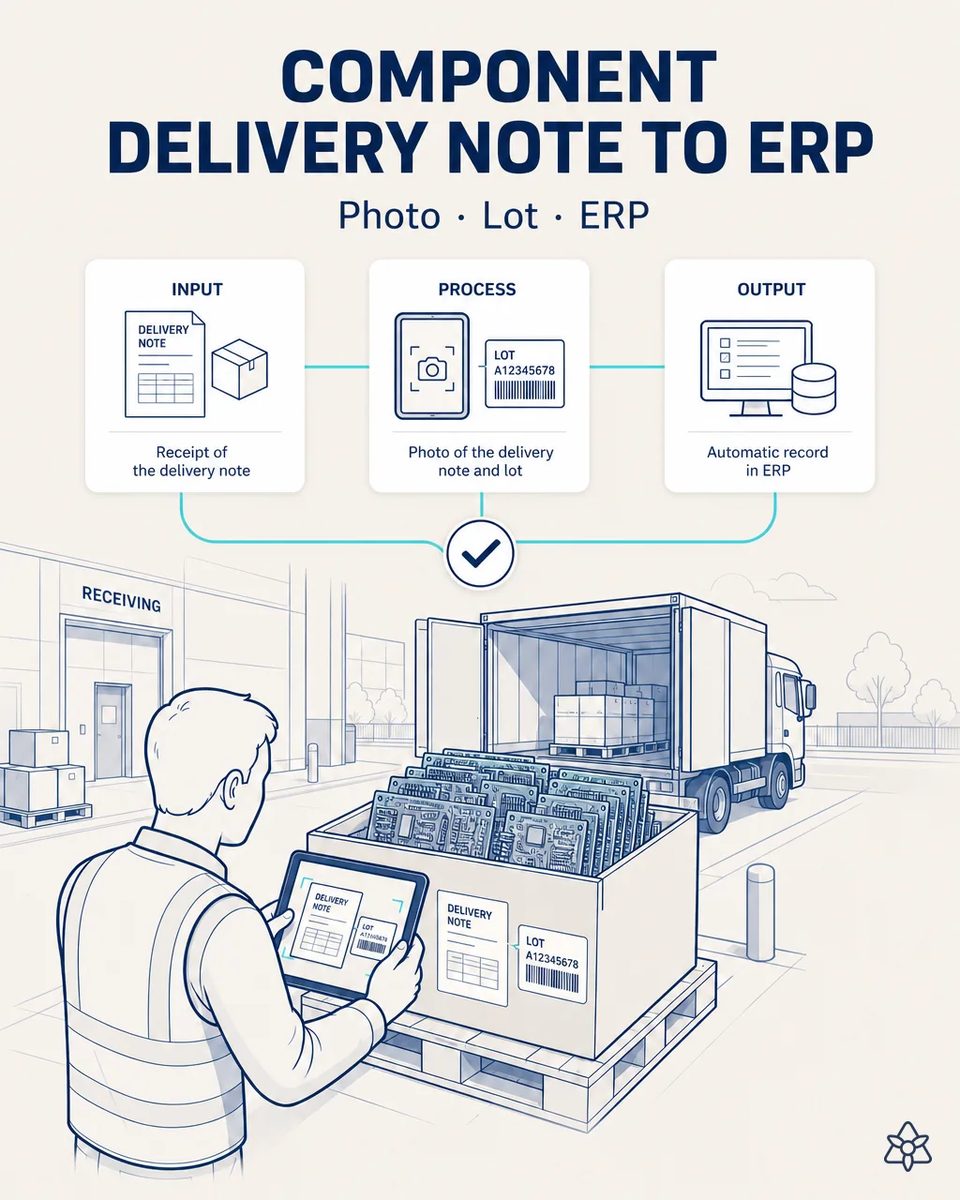
Component-to-unit traceability starts at the dock, under time pressure.
- A supplier's delivery note can carry 10-20 different reference lines, each pallet or reel with its own lot label. - Typing it all in by hand while the truck waits causes demurrage, or it gets rushed and the lot ends up poorly traced, a problem that surfaces weeks later against any traceability claim.
- Receiving PCBs and semiconductors means signing the delivery note and typing it line by line into the ERP while the carrier waits.
- A single delivery note can carry 10-20 different reference lines, and each pallet, box or reel has its own lot label with a barcode, a QR code or plain text.
- Typing it all by hand while the truck waits causes demurrage — or it gets rushed, and the lot ends up poorly traced.
- That gap surfaces weeks later, when a recall or a customer complaint asks which alternators, starter motors or ECUs carry a specific component lot, and the answer is a date range instead of a list.
Connect photographs the delivery note and the lot labels — one validation tap, then the ERP.
Connect photographs the delivery note and lot labels, recognizing barcode, QR and plain OCR. The supervisor validates with one tap and Connect posts everything to the ERP via API, with full component-to-unit traceability.
Suppliers keep their formats, whether a printed delivery note or a label with a QR code, and the dock keeps its routine. A photo replaces 30-45 minutes of typing, and the lot that enters the ERP is the one printed on the label, not the one someone had time to write. Traceability starts right, so nothing downstream has to repair it.
Receiving at the dock today versus receiving with Connect
| Aspect | Today | With iLEAN Connect |
|---|---|---|
| Time to book a delivery | 30-45 minutes of typing | Minutes, validated with one tap |
| Lot labels: barcode, QR, plain text | Read by eye and retyped | Recognized from the photo |
| Delivery note vs. labels mismatch | Noticed later, if ever | Flagged before posting |
| Component lot to finished unit | Reconstructed by date range | Traced from receiving onward |
| Proof of what arrived | The signed paper in a binder | Photo attached to the receipt |
| Demurrage charged by carriers | Recurring when the dock is busy | Truck leaves after the photo |
30-45 minutes of typing or truck demurrage → validated receiving in minutes with full photographic traceability.
Impact estimate — to be validated with your numbers.
The block below is an estimate to be validated against your plant's actual data. We put it forward so the committee has an order of magnitude; we refine it during the assessment.
- Estimated payback 4-9 months.
- Direct savings of -50 to -70% on ERP seats in the receiving module, since clerks no longer type every line.
- From 30-45 minutes of typing or truck demurrage to validated receiving in minutes, with full photographic traceability.
- We validate the figures with purchasing and IT, on your real number of deliveries, their reference lines and your receiving seats.
Direct savings of -50 to -70% on ERP seats in the receiving module, with estimated payback 4-9 months. Estimate to be validated with purchasing/IT.
And the fair question from the production manager
“What if it misreads a lot number on a label?” — reading barcodes, QR codes and printed labels with a known layout is an anchored task, where the best models stay below 1.5% [1] error. When a code is readable, the barcode wins over OCR; when the delivery note and the labels disagree, nothing is posted until the supervisor resolves it with the photo in front of them.
[1] OpenAI paper "Why Language Models Hallucinate", 2025 — on the reliability of AI in anchored tasks.
What people ask about booking in component deliveries
What if a pallet carries several component lots?
Each label is read separately and each lot becomes its own receipt line with its quantity. That split is what later allows a recall to be narrowed to the units that actually carry that lot. Mixed-lot pallets are exactly where manual typing tends to simplify.
Does it read handwritten corrections on the delivery note?
Yes. If the carrier or the clerk crosses out a quantity and writes the real one, that correction is extracted and shown for validation, instead of the printed quantity being booked silently. Stock in the ERP then matches what is physically on the shelf.
What happens with a short or damaged delivery?
The clerk notes the discrepancy at the moment of the photo, and it travels with the receipt to purchasing. The claim to the supplier starts with evidence instead of memory, with the photo of the damaged box attached to it.
How does the component lot reach the finished alternator or ECU?
The receipt lot is what the ERP/MES later consumes on each order. Once it enters correctly at the dock, the link from component lot to finished serial number exists without extra work. That is what turns a recall scope from a date range into a list of serial numbers.
Does the photo count as receiving evidence in an audit?
Yes. The photo of the signed delivery note and the labels is stored with the receipt, so an auditor can see what physically arrived alongside what was booked. Supplier disputes over quantities are settled with the same image.
More cases from this series
- Industrial tablet validates ECU assemblyNothing iLEAN captures enters the central system without a human confirming it with two taps on an…
- ICT and AOI stitched to the MES, nothing replacedThe ICT/AOI test station's result reflects automatically in the MES/ERP, with no system replaced.
- The metrology lab spreadsheet, straight to the ERPThe metrology lab spreadsheet posts itself to the ERP after human validation, with -50 to -80% fewer…
- The line lead's earpiece that loses no dataThe line lead dictates while walking, without stopping work; iLEAN listens, structures it, and returns…
- Semiconductor delay alert, read in secondsiLEAN reads the supplier's delay email at zero latency and suggests a replan before the line stops.
- Photo of the startup travelerThe startup traveler stops getting lost on paper: one photo gets it into the central system at zero…
Tell us how many lines your last component delivery note had and how long it took to book.
We work on your plant's real data, not ours. Assessment with no commitment.
Request estimated ROI within 48h ‹ See all cases of automotive electronics See automotive