ICT and AOI stitched to the MES, nothing replaced
The SMT line's ICT or AOI test station already produces a per-unit result, but it lives isolated from the MES/ERP because there was never time to integrate it well. With iLEAN Connect, both systems get stitched via API without replacing either.
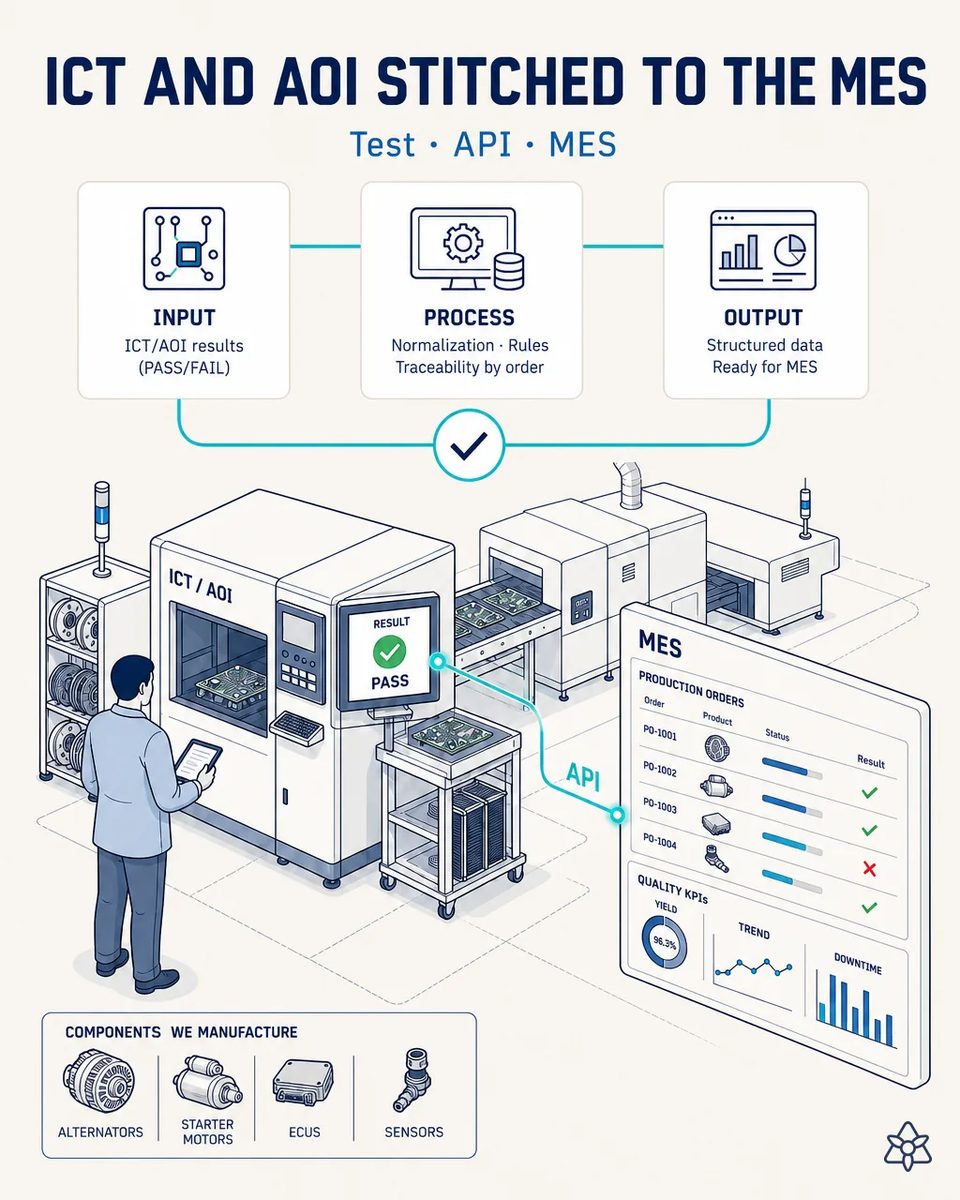
The tester knows the verdict; the system that releases the lot does not.
- The test result (pass/fail, electrical values, serial number) stays isolated in the tester's own software. - To release the lot, someone has to note or review the on-screen result and re-type it into the central system, risking transcription errors.
- The SMT line's ICT or AOI station already produces a result per unit: pass or fail, measured values per test point, and the serial number of the board.
- That result stays isolated in the tester's own software, because there was never time to integrate it properly when the station was commissioned.
- To release the lot, someone has to read or review the on-screen result and re-type it into the central system, with the transcription errors that implies.
- And when a field return comes back, linking that ECU or sensor serial to its in-circuit measurements means opening the tester's logs by hand, station by station.
Connect as the API bridge between tester and MES — both stay as they are.
Connect stitches two modern systems via API: whatever happens on the ICT/AOI station is automatically reflected in the MES/ERP as soon as it's generated, including the link to the unit's serial number.
The test station keeps its fixtures, programs and software; the MES keeps its logic. What changes is that the result stops depending on someone reading a screen and typing it again, which is the step where a fail can quietly become a pass.
The isolated test station today versus the stitched station
| Aspect | Today | With iLEAN Connect |
|---|---|---|
| Per-unit ICT or AOI verdict | On the tester's screen and local log | In the MES as soon as it is generated |
| Link between result and serial number | Typed by hand | Carried automatically |
| Lot release | Waits for someone to review and re-type | Released on the recorded results |
| Measured values per test point | Kept only in the tester | Available for trend analysis per lot |
| Field return on one ECU serial | Search through tester logs | One query in the MES |
| Retest after repair | Unclear which result counts | Every attempt kept, final verdict clear |
Manual transcription of the test result → automatic, immediate reflection in the central system.
Impact estimate — to be validated with your numbers.
The block below is an estimate to be validated against your plant's actual data. We put it forward so the committee has an order of magnitude; we refine it during the assessment.
- Estimated payback 3-6 months.
- Shorter lot-release time, because release no longer waits for someone to review and re-type test results.
- Lower transcription-error risk: a fail typed as a pass is exactly the error that reaches a customer.
- From manual transcription of the test result to automatic, immediate reflection in the central system, linked to each serial number and available to quality the moment the unit leaves the station.
Estimated payback 3-6 months, reducing lot-release time and transcription-error risk. Estimate to be validated.
And the fair question from the production manager
“What if the integration passes a wrong verdict to the MES?” — here nothing is interpreted: the result travels from one API to another as structured data, which is even more anchored than reading a document, where the best models already stay below 1.5% [1] error. And every message is checked for completeness: a result with no serial number or an unknown test program is held and flagged, never written. A person resolves it with the tester log in front of them.
[1] OpenAI paper "Why Language Models Hallucinate", 2025 — on the reliability of AI in anchored tasks.
What people ask about connecting ICT and AOI to the MES
What if our tester does not have a modern API?
Most current ICT and AOI stations export results through an interface or a log file. If a station only shows the verdict on screen, the camera-reading approach used on older machines covers it instead. Either way, the tester itself stays exactly as it was commissioned.
Can it stop a lot from being released if a fail was never repaired?
Yes. The MES sees every unit whose last verdict is a fail and can keep the lot on hold until that serial is repaired, retested or scrapped. Today that check depends on someone reading the screen at the right moment.
Are the analog measurements stored or only pass/fail?
Both. The verdict drives lot release, and the measured values per test point are kept so that a slow drift on a component can be seen before it turns into fails. That is the data a supplier quality discussion about a component lot needs.
Does it help with fixture wear?
Indirectly, yes. With measurements per test point stored over time, a rising number of fails on the same pins points at the bed-of-nails fixture rather than the boards, and maintenance can act before false fails pile up and good ECUs are sent to repair for nothing.
Does the tester vendor need to be involved?
Rarely, and only to confirm the export format. Nothing is installed inside the tester and its test programs are not modified. Its validation and its calibration records remain untouched.
More cases from this series
- The electronic components delivery note, straight to the ERPPhoto the delivery note and the PCB/semiconductor lot labels; one validation tap and it all posts to the…
- Industrial tablet validates ECU assemblyNothing iLEAN captures enters the central system without a human confirming it with two taps on an…
- The metrology lab spreadsheet, straight to the ERPThe metrology lab spreadsheet posts itself to the ERP after human validation, with -50 to -80% fewer…
- The line lead's earpiece that loses no dataThe line lead dictates while walking, without stopping work; iLEAN listens, structures it, and returns…
- Semiconductor delay alert, read in secondsiLEAN reads the supplier's delay email at zero latency and suggests a replan before the line stops.
- Photo of the startup travelerThe startup traveler stops getting lost on paper: one photo gets it into the central system at zero…
Tell us how long your ECU lots wait for someone to re-type test results.
We work on your plant's real data, not ours. Assessment with no commitment.
Request estimated ROI within 48h ‹ See all cases of automotive electronics See automotive