So the engraved code is always the one the system says
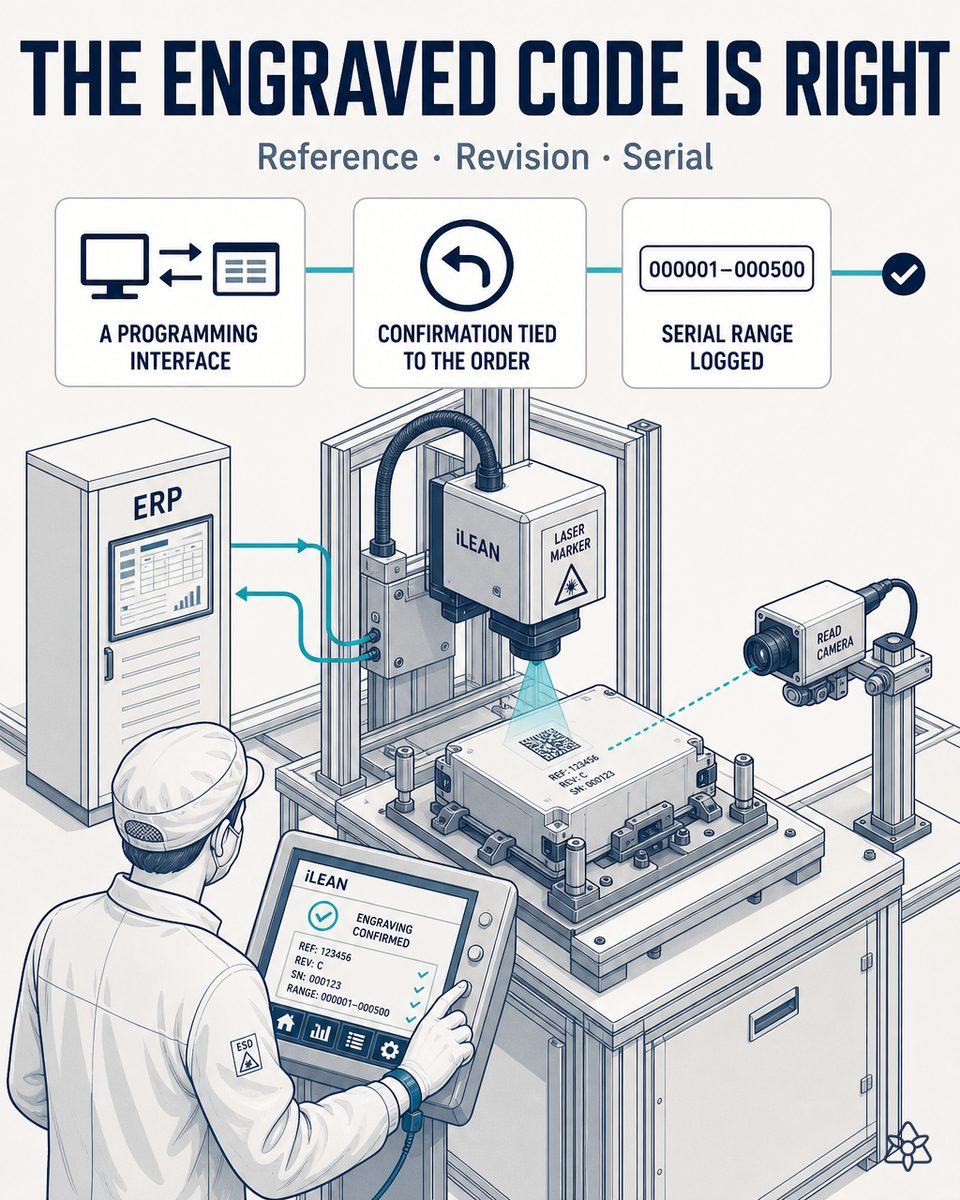
The laser marker engraves the data matrix code that uniquely identifies each piece for its whole life: it is the machine the entire traceability rests on. It has an interface, and yet in most plants it is "almost integrated": someone loads the job on each reference change, someone checks the revision, someone writes down the consumed serial range. With iLEAN Connect the intermediate typing disappears.
The identification error is detected by no functional test.
That is its especially unpleasant characteristic: it passes every check because the piece works perfectly. It is merely misidentified:
- If the previous revision is engraved, the piece is misidentified and the problem is discovered when the customer sees it — with the wrong revision printed on the piece itself as evidence.
- In the back-end the equivalent happens with the decoration laser — the lacquer ablation program defines which symbol lights up. The wrong program produces a cosmetically perfect and functionally wrong panel.
- And the consumed serial number range, written down by hand, is a data point that seems minor until the day a containment has to be scoped.
It is the most frustrating gap: the machine has an interface, the management system does too, and the only thing missing is for them to talk — while the risk repeats on every reference change.
Connect stitching two modern systems through their interfaces, replacing neither.
When both ends already expose an interface, stitching is not a project: it is closing a specific gap. And here, moreover, it can close with a confirmation back.
The management system publishes reference, engineering revision and serial range for the active order. Connect delivers the correct job to the marker through its interface. The marker engraves and the engraving confirmation returns to the central system tied to the order, with the consumed serial range logged automatically.
How Connect operates on laser marking:
- The job is published by the system, not selected by a person — reference, engineering revision and serial range travel from the active order on every change.
- Through a programming or file interface — depending on what the marker exposes. The machine's software is not touched beyond its documented interface.
- Confirmation back, tied to the order — sending the correct job is not enough: you need to know the machine applied it. The confirmation closes the loop.
- Serial range logged automatically — and queryable. It stops being a hand-written note and becomes the data a containment is scoped with.
- Same pattern for the back-end decoration laser — where the ablation program defines which symbol lights up, and the error is just as invisible.
An "almost integrated" marker vs. a marker stitched to the system
| Aspect | Job selected by hand | With iLEAN Connect via interface |
|---|---|---|
| Job selection on each change | Manual | Published by the system from the order |
| Revision check | On a person's shoulders | Travels with the job |
| Consumed serial range | Written down by hand | Logged automatically and queryable |
| Wrong-identification defect | Reaches the customer: no test detects it | Eliminated as a class |
| Confirmation of what was engraved | None | Returns to the system tied to the order |
| Back-end decoration laser | Same risk, no control | Same pattern applied |
Impact estimate for your plant — to be validated with your own numbers.
The block below is an estimate to be validated against your plant's actual data. We put it forward so the committee has an order of magnitude; we refine it during the assessment.
- Electronic panel plant with a data matrix laser marker and a decoration laser in the back-end, both with interfaces but isolated from the management system.
- Connect pilot stitching the management system and the marker through its documented interface. Without replacing any machine. First value expected within a few weeks.
- Estimated payback between 5 and 10 months. Estimate to be validated.
- What gets eliminated is not a percentage of defects, but an entire class that systematically reaches the customer because no test detects it.
- And a data point that seems minor until it is needed: the consumed serial range, logged automatically, is what allows scoping a containment instead of extending it.
And the fair question from the quality director
"What if the system publishes the wrong job?" — here the AI does not generate data, it transports it anchored from the active order: reference, revision and serial range come out of the management system. It is an anchored task, where the best models brought the error below 1.5% [1]. And the loop closes: the engraving confirmation returns to the central system tied to the order, so what was published and what was actually engraved check each other.
[1] OpenAI paper "Why Language Models Hallucinate", 2025 — on the reliability of AI in anchored tasks.
What people ask about stitching the laser marker to the system
Why is it "almost integrated" if it has an interface?
Because closing that last stretch never becomes the quarter's priority. The marker exposes its interface from day one and so does the management system, but the integration falls between the scope of the systems project and that of the machine vendor, so it gets covered by a person who loads the job on each reference change. And since the resulting error is sporadic, it never generates enough pressure to climb the list either. It is the classic pattern of the gap that survives for years without anyone prioritizing it.
Why does no test detect the identification error?
Because the piece works perfectly: it is merely misidentified. The electrical, functional and cosmetic tests check that the panel does what it should do, not that the engraved code corresponds to the revision being manufactured. If the previous revision is engraved, the piece passes every check and leaves the plant. The problem is discovered when the customer sees it — and they see it with the wrong revision printed on the piece itself as evidence, which is the worst possible way to discover it.
What about the back-end decoration laser?
It has the same problem and is solved with the same pattern. There, the lacquer ablation program defines which symbol lights up when the panel is backlit. Loading the wrong program produces a panel that is cosmetically perfect and functionally wrong: the finish is impeccable, but the symbol that lights up is not the one for that reference. It is even harder to detect than the marking, because there is not even a code to check at a glance.
What is logging the serial range automatically for?
For scoping. The serial number range consumed in each order is a data point that seems minor until the day a containment has to be scoped: if the pieces built with a specific component batch or a given revision have to be isolated, the serial range is what turns "that whole week's production" into "these units". Today it is written down by hand, with everything that implies in omissions and approximations. Logged automatically and queryable, it stops being a note and becomes a tool.
Is the machine's software touched?
Not beyond its documented interface, whether programming or file-based depending on what the equipment exposes. The marker is not replaced, its internal program is not modified and its configuration is not altered. What gets integrated is the data flow: the system publishes the correct job and the machine confirms what it engraved. If the marker is swapped tomorrow, the connection on that side is re-pointed and the rest of the circuit — publication from the order, confirmation back, range logging — stays the same.
More cases from this series
- Evidence is not reconstructed: it is generated at the moment of the factEvery critical change leaves its dossier with photos, signatures and measurements, organized by…
- Your product’s genealogy starts at the receiving dockDelivery note, reel labels, certificates and moisture data captured by photo and fed into the ERP. From…
- The laboratory’s measurements, in the ERP in minutes and with fewer licensesLuminance, chromaticity and force-travel: iLEAN reads the laboratory’s Excel on save and feeds it into…
- So an engineering change never catches you producing the previous revisionCustomer email and portal read on arrival: iLEAN cross-checks the notice against active orders and…
- The line startup file, available at second zeroSetup sheet, reflow profile and first article captured with a photo: the startup file exists at second…
- Recording what the person walking the plant knows — without them stoppingEarpiece and voice mode: the process engineer dictates while walking and iLEAN structures the incident…
How many times a day is a marking job selected by hand in your plant?
We work on your plant's real data, not ours. We look at your marker and your management system and size the gap. Assessment with no commitment.
See how we would apply it in your plant ‹ See all 12 electronic panel cases See automotive