What decides an incident’s cost is not the defect: it is how much you must contain
The capital pain of an electronic panel and steering column module plant is not the scrap: it is the defect that reaches the vehicle. And what decides the size of the blow is not the defect, but how much production has to be contained because it cannot be scoped. With complete unit genealogy, a containment is a serial number range and resolves in days; with gaps, it is months of production across several of the customer's plants.
A date range in a three-shift plant is tens of thousands of parts spread across several countries.
A zero-kilometer claim, a containment at the customer's plant or a campaign on a safety-function component are not paid in scrap. They are paid in containment, in analysis with the clock running, in penalties and, above all, in supplier ranking position:
- When the genealogy has gaps — the reel batch that entered approximate, the thermal profile that was not recorded, the serial range written down by hand — the only containment possible is by date range.
- And that multiplies the scope — tens of thousands of parts spread across several of the customer's plants in several countries, with all the operations that drags along.
- For a young plant that wants to win the next programs, this is not an operational risk: it is a strategic risk.
Hence the system's goal is not to avoid all defects — nobody promises that — but to guarantee that, if one escapes, it can be scoped exactly.
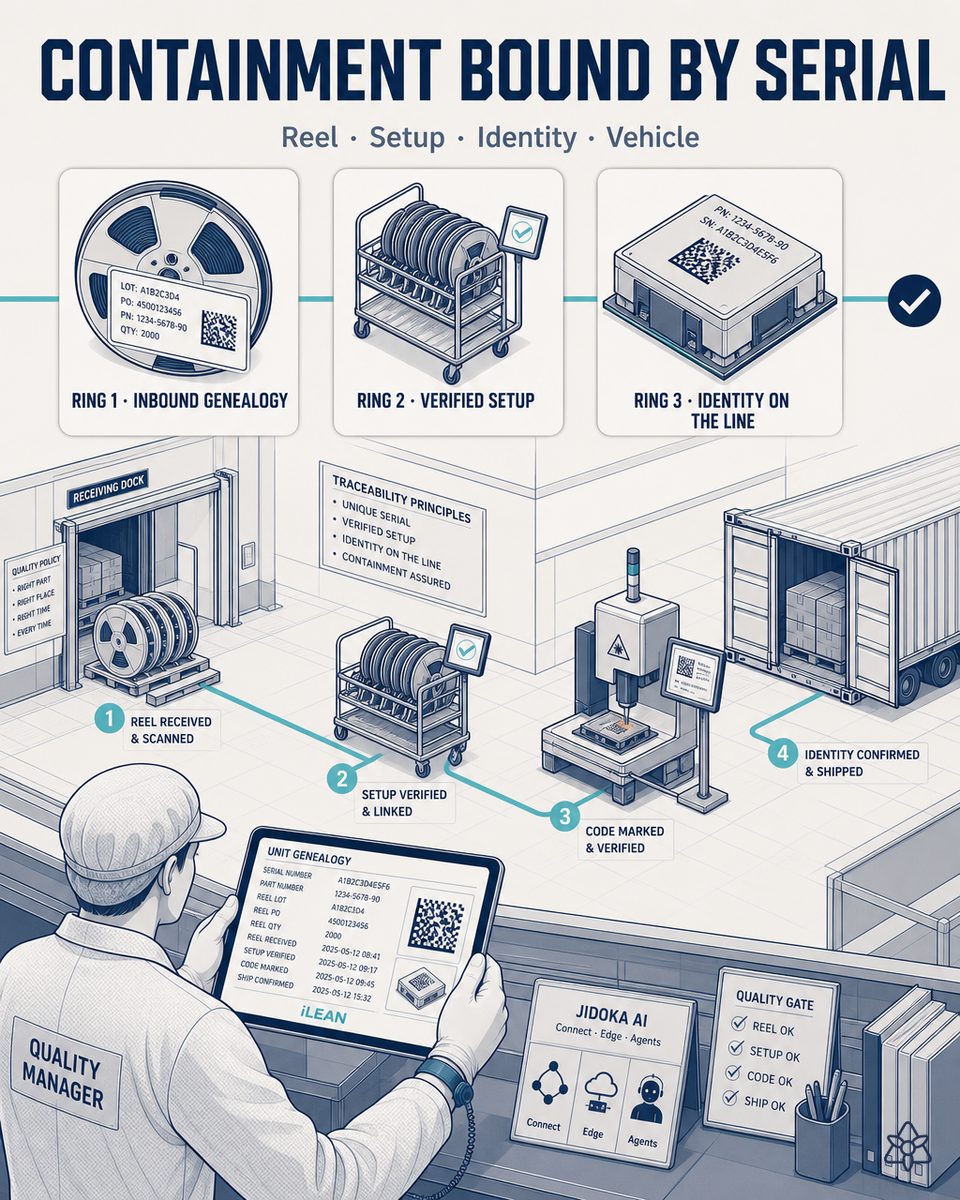
The four coordinated rings — not new pieces, but the eleven cases working together.
Each ring closes a stretch of the genealogy, from reel to vehicle. The value is not in each one separately, but in the chain having no broken link.
With the genealogy complete, a containment goes from being a date range to being a serial number range: bounded, demonstrable to the customer and resolved in days.
The four rings, and which stretch each one closes:
- Ring 1 · Inbound genealogy — every reel is tied to its manufacturer batch, its certificate and its moisture data; every board passing through the oven is tied to the real thermal curve of that moment.
- Ring 2 · Verified setup — the line does not start if the reels, the stencil and the program are not the ones the reference demands. What gets built is what was meant to be built.
- Ring 3 · Identity and control on the line — the laser engraves the code with the revision the system publishes, with no intermediate typing, and Edge vision verifies the result before packing. If the code read does not match the active order, JIDOKA AI stops the line.
- Ring 4 · Evidence and coordination — every part leaves with its cross-referenced dossier, every decision carries an identified signature, and if the customer issues a notice, Connect reads it instantly and Agents already knows which serial numbers are affected.
- And above them, SMED AI — accelerates the change between references so coordinating the four rings does not penalize productivity.
Containment by dates vs. containment by serial number
| Aspect | Genealogy with gaps | With the four iLEAN rings |
|---|---|---|
| Scope of a containment | Date range: tens of thousands of parts | Serial number range: bounded |
| Resolution time | Months, across several customer plants | Days |
| Before the customer | Hard to demonstrate | Bounded and demonstrable |
| Root cause analysis | Starts by gathering data | Starts with the data in front of you |
| Where the defect is detected | The customer detects it | On the line |
| Customer quality notice | The scope has to be figured out | Agents already knows which serials are affected |
Impact estimate for your plant — to be validated with your own numbers.
The block below is an estimate to be validated against your plant's actual data. We put it forward so the committee has an order of magnitude; we refine it during the assessment.
- Young electronic panel and steering column module plant that wants to win the next programs from its OEM customers.
- Phased deployment: start with the shortest-payback Connect cases, raise rings 1 and 2, incorporate Edge and close with the evidence.
- The argument is not operational savings, it is the asymmetry: the cost of a single badly scoped containment far exceeds that of the complete deployment.
- Estimated payback between 6 and 12 months against the first correctly scoped incident. Estimate to be validated with the incident history and the scope of each containment.
- And an effect that appears in no spreadsheet and that in this industry decides: the position in the customer's supplier ranking.
And the fair question from plant management
"Isn't this too much project for a young plant?" — you do not start here. The four rings are not new pieces: they are the previous eleven cases working together, and you get there in phases starting with the shortest-payback Connect cases. On the reliability of the whole: everything the AI does in these rings is an anchored task — reading a code, comparing against a reference state, cross-checking two records — where the best models brought the error below 1.5% [1], with a human signature on every critical decision.
[1] OpenAI paper "Why Language Models Hallucinate", 2025 — on the reliability of AI in anchored tasks.
What people ask about the bounded-containment flagship
Why does the containment decide the cost and not the defect?
Because the defect itself usually affects few parts; what gets paid is how much production has to be withdrawn because nobody knows which ones they are. With complete unit genealogy, a containment is a serial number range: exactly which parts carry the affected reel batch or passed through the oven in the problematic window is identified, and it resolves in days. With gaps in the genealogy, the only option is containing by date range — and in a three-shift plant that is tens of thousands of parts spread across several of the customer's plants in several countries.
Which specific gaps break the genealogy?
Three, and all three are closed by cases in this matrix: the reel batch that entered approximate because receiving was logged in a hurry, the thermal profile that was not recorded because the oven panel gave no data, and the serial range written down by hand at laser marking. Any of the three is enough to break the chain: you can have perfect traceability in two stretches and be unable to scope because the third is missing. That is why the flagship adds no new pieces — it coordinates the ones that close each link.
What exactly does each ring do?
Ring 1 closes the inbound side: every reel tied to its batch, certificate and moisture data, and every board tied to the oven's real thermal curve. Ring 2 guarantees that what gets built is what was meant to be built: the line does not start if reels, stencil and program are not the right ones. Ring 3 secures identity: the laser engraves what the system publishes and vision verifies the result; if it does not match the active order, JIDOKA AI stops the line. And ring 4 closes evidence and coordination: every part with its dossier, every decision with a signature, and if the customer issues a notice, Agents already knows which serial numbers are affected.
Does this avoid all defects?
No, and we do not frame it that way. No system guarantees zero defects, and promising it would be dishonest. What the four rings guarantee is that if something escapes, it can be scoped exactly — and that is what decides the size of the blow. Moreover, three of the four rings do reduce the probability of it happening: the verified setup eliminates the startup error, vision detects the cosmetic defect on the line and the engraved identity eliminates the identification failure. But the value of the whole lies in the asymmetry between scoping and not scoping.
Why is it a strategic risk and not just an operational one?
Because in automotive the supplier ranking position decides the award of the next program, and a badly managed containment weighs on that evaluation for years. For a mature plant with decades of history, an incident gets absorbed; for a young plant that wants to win the next programs, a badly scoped incident can close the door to an entire model. That is the reason for framing the economic case on avoided risk and not on efficiency: the cost of a single badly scoped containment far exceeds that of the complete deployment.
More cases from this series
- Evidence is not reconstructed: it is generated at the moment of the factEvery critical change leaves its dossier with photos, signatures and measurements, organized by…
- Your product’s genealogy starts at the receiving dockDelivery note, reel labels, certificates and moisture data captured by photo and fed into the ERP. From…
- The laboratory’s measurements, in the ERP in minutes and with fewer licensesLuminance, chromaticity and force-travel: iLEAN reads the laboratory’s Excel on save and feeds it into…
- So an engineering change never catches you producing the previous revisionCustomer email and portal read on arrival: iLEAN cross-checks the notice against active orders and…
- The line startup file, available at second zeroSetup sheet, reflow profile and first article captured with a photo: the startup file exists at second…
- Recording what the person walking the plant knows — without them stoppingEarpiece and voice mode: the process engineer dictates while walking and iLEAN structures the incident…
If you had to contain tomorrow, could you scope by serial number or would you have to go by dates?
We work on your plant's real data, not ours. With your incident history and the scope of each containment we put numbers on each ring. Assessment with no commitment.
Talk to a consultant about the four rings ‹ See all 12 electronic panel cases See automotive