So the line never starts with an unverified setup
The reference change is an SMT line's moment of maximum risk, and in a plant that industrializes projects continuously it happens many times a day. The setup error is not detected at setup: it is detected afterwards, with material already built. With iLEAN Edge, several cameras compare the real state against the reference state before authorizing the startup, and JIDOKA AI does not let the line start until everything conforms and the responsible person signs.
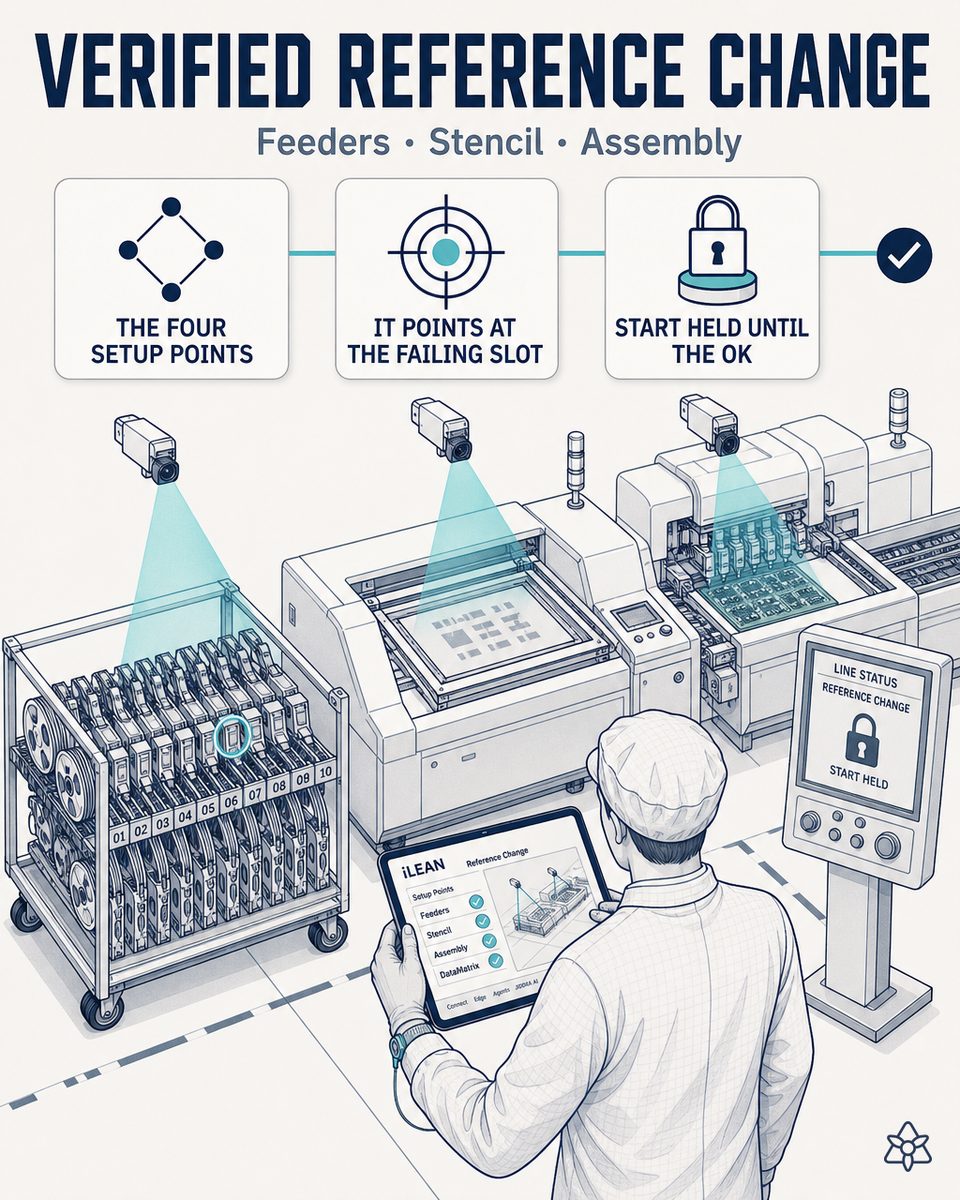
The setup error is not detected at setup.
The correct reels must go in the correct positions, the correct printing stencil must be mounted, the correct program loaded and the back-end adjusted. Any discrepancy is discovered later, at inspection, with material built and the plan's clock running:
- In the best case it is scrap and rework — built material that has to be dismantled or discarded, with the plan already compromised.
- In the worst, a wrong component with the same footprint passes optical inspection, sometimes even the in-circuit test, and reaches the customer.
- And there is a silent cost — a good part of the changeover time today goes into manually verifying, two and three times, things one cannot fully trust.
That last point explains why automatic verification does not lengthen the change: it replaces work already being done, only by hand and leaving no record.
Multi-point Edge with JIDOKA AI and SMED AI — the machine does not start on its own, and the person does not start blind.
The verification is not added to the change: it replaces the repeated manual check. And in doing so, besides eliminating the error, it shortens the change itself.
Cameras at the critical points: feeder bank, printing stencil frame, head, final assembly station. Comparison of the real state against that reference's reference state — each mounted reel's label against the bill of materials, the stencil's engraved identifier, the station's configuration. If anything does not match, JIDOKA AI does not allow the startup and points at the specific position.
How Edge operates on the reference change:
- The four points where the setup is decided — feeder bank, stencil frame, head and final assembly station. Each with its own verdict.
- Each reel's label against the bill of materials — not a generic check: what is mounted in each position is contrasted with what the reference demands.
- It points at the specific position that fails, not a generic alarm. The practical difference is enormous: one feeder gets corrected, the whole bank is not reviewed.
- Conformity of everything and a signature — the machine does not start on its own and the person does not start blind. Both conditions.
- With the repeated manual check gone, the change gets shorter — that is SMED AI: a verification is not added, one that was already done worse is replaced.
Repeated manual verification vs. objective point-by-point verification
| Aspect | Classic reference change | With iLEAN Edge + JIDOKA AI |
|---|---|---|
| Setup verification | Visual, dependent on the person and the hurry | Objective and recorded point by point |
| Mounted reels | Checked by eye against the list | Contrasted position by position |
| Startup with a wrong setup | Happens, and is discovered at inspection | Zero: JIDOKA AI does not allow it |
| Wrong component with the same footprint | Can reach the customer | Detected before starting |
| What gets flagged when something fails | A generic alarm | The specific position |
| Changeover time | Inflated by repeated checking | Reduced by eliminating it |
Impact estimate for your plant — to be validated with your own numbers.
The block below is an estimate to be validated against your plant's actual data. We put it forward so the committee has an order of magnitude; we refine it during the assessment.
- Electronic panel plant with an SMT line and several reference changes per day due to continuous project industrialization.
- Multi-point Edge pilot on the change, with startup blocking and signature. Without changing the procedure or who authorizes. First value expected within a few weeks.
- Estimated changeover time reduction of at least 20%, with the associated increase in line availability, plus the elimination of scrap from setup errors.
- Estimated payback between 5 and 10 months depending on the number of changes per shift. Estimate to be validated.
- The risk lever: a wrong component with the same footprint can pass optical inspection and sometimes the in-circuit test — and reach the customer. That class of failure is eliminated at startup.
And the fair question from the line manager
"Doesn't this lengthen the change, which is exactly what I want to shorten?" — on the contrary: the estimate is a reduction of at least 20%, because the verification is not added, it replaces the repeated manual check that today consumes a good part of the change. And on reliability, comparing a reel label against the bill of materials is an anchored task, where the best models brought the error below 1.5% [1].
[1] OpenAI paper "Why Language Models Hallucinate", 2025 — on the reliability of AI in anchored tasks.
What people ask about verifying the reference change
Why is the setup error so dangerous?
Because it is not detected at setup: it is detected afterwards, with material already built and the plan's clock running. In the best case that is scrap and rework. In the worst, a wrong component with the same footprint passes automated optical inspection — because it physically fits and looks the same — and sometimes even the in-circuit test, and reaches the customer. That is the scenario that justifies putting the control before startup: it is the only moment when correcting costs minutes instead of a containment.
Doesn't the verification lengthen the changeover time?
No, and the reason is that a verification is not added: one already being done is replaced. Today a good part of the changeover time goes into manually verifying, two and three times, things one cannot fully trust — real work that consumes minutes and, moreover, leaves no record. With the camera doing it objectively and in a single pass, that time is recovered. The starting estimate is a reduction of at least 20% of the changeover time, with the associated increase in line availability.
What exactly is compared?
The real state against the reference state defined for that reference, at four points: the feeder bank — each mounted reel's label against the bill of materials, position by position —, the printing stencil frame through its engraved identifier, the head and the final assembly station's configuration. Each point has its own separate verdict, so exactly what to correct can be flagged instead of forcing a review of the whole.
What happens if something does not match?
JIDOKA AI does not allow the startup and points at the specific position that fails, not a generic alarm. That difference is what makes the system help instead of hinder: the feeder in position 23 gets corrected, the whole bank is not reviewed. Once the discrepancy is corrected, the responsible person signs and the line starts. Both conditions at once — all verifications conforming and the signature —: the machine does not start on its own and the person does not start blind.
How many changes does it take to pay off?
It depends on the number of changes per shift, which is exactly the variable in the calculation. In a plant that industrializes projects continuously the changes are many per day, and there the case closes fast — each change contributes recovered time and eliminates a risk window. The estimated 5-to-10-month payback moves within that range with frequency: the more changes, the closer to the low end. It is an estimate to be validated with your own numbers of changes and average duration.
More cases from this series
- Evidence is not reconstructed: it is generated at the moment of the factEvery critical change leaves its dossier with photos, signatures and measurements, organized by…
- Your product’s genealogy starts at the receiving dockDelivery note, reel labels, certificates and moisture data captured by photo and fed into the ERP. From…
- The laboratory’s measurements, in the ERP in minutes and with fewer licensesLuminance, chromaticity and force-travel: iLEAN reads the laboratory’s Excel on save and feeds it into…
- So an engineering change never catches you producing the previous revisionCustomer email and portal read on arrival: iLEAN cross-checks the notice against active orders and…
- The line startup file, available at second zeroSetup sheet, reflow profile and first article captured with a photo: the startup file exists at second…
- Recording what the person walking the plant knows — without them stoppingEarpiece and voice mode: the process engineer dictates while walking and iLEAN structures the incident…
How many reference changes do you run per day, and how long does each take?
We work on your plant's real data, not ours. With those two numbers we calculate the case. Assessment with no commitment.
See how we would apply it in your plant ‹ See all 12 electronic panel cases See automotive