The defect the driver sees on day one, caught on the line
A control panel can pass automated optical inspection, the in-circuit test and the functional test, and still be defective. Because the defects the customer claims most in this product family are not electrical: they are cosmetic and perceptual. With iLEAN Edge, a camera with controlled lighting inspects every part with the same criterion at line speed, and the inspector goes from hunting defects to deciding on the cases that matter.
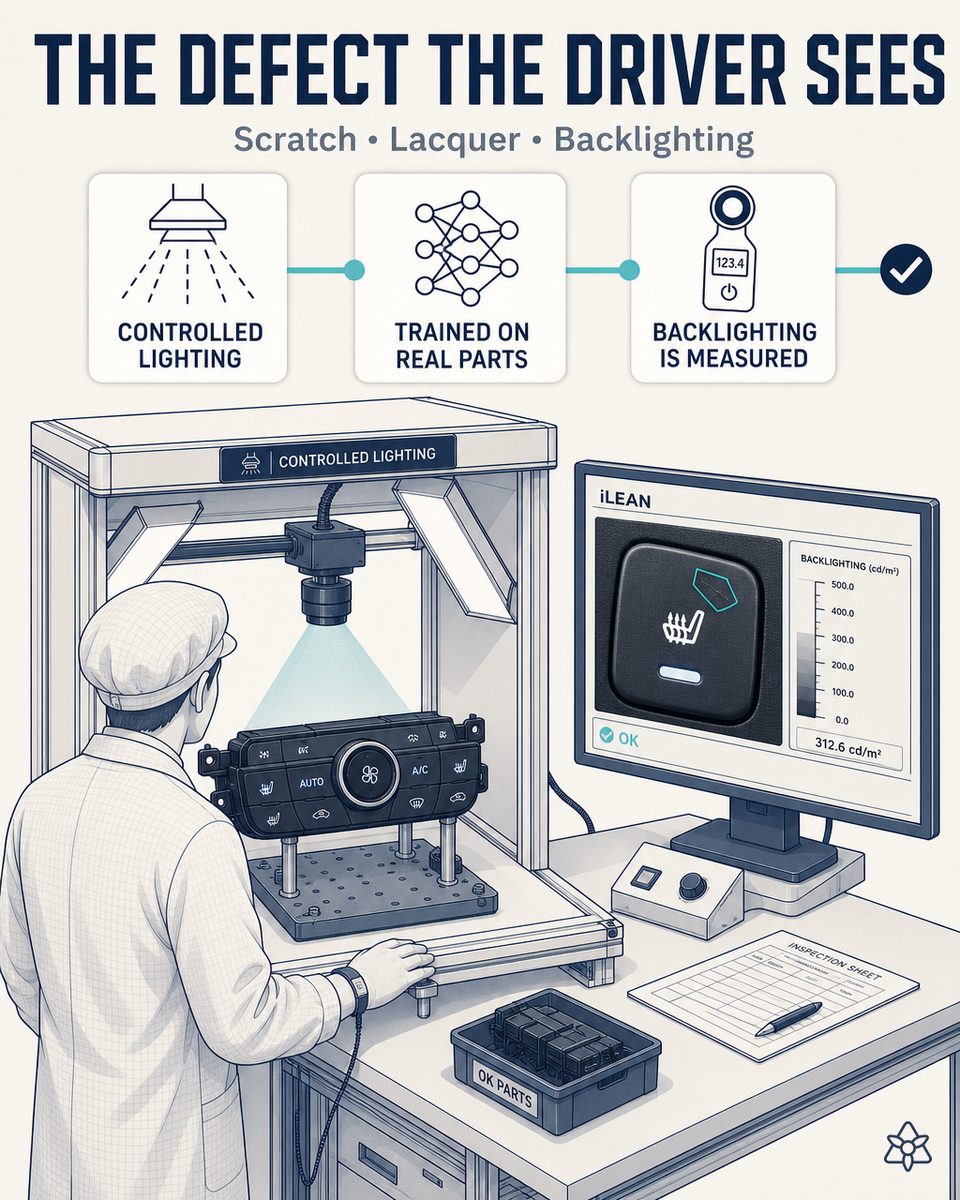
It is the defect the driver sees every day from their seat.
A scratch on the decorated surface. A paint speck. A symbol whose laser lacquering left an uneven edge. Unequal backlighting between two adjacent keys. An out-of-tolerance fit between housing and trim. None of those is detected by an electrical test:
- Today a person hunts for them at the end of the line — at rate, shift after shift, under the hall's lighting and with accumulated fatigue.
- It is not a professionalism problem — two inspectors at the same station rarely classify borderline parts the same way, and the same person does not classify the same at the start of the shift as at its end.
- And it is the defect that generates the most claims in interface electronics for a simple reason: an intermittent electrical failure can go unnoticed for months; a badly lit symbol is seen on day one.
Hence the cosmetic acceptance criterion is the most argued point with the customer — and the only one that today is written nowhere it can be taught from.
Edge — the person goes from hunting defects to deciding on the cases that matter.
The problem is not one of judgment but of constancy and measurement: applying the same threshold on every part and every shift, and being able to measure what today is assessed by eye.
An industrial camera with controlled lighting over the final inspection station. A model trained on real good and bad parts of the specific reference, not on a generic catalog. Local inference in milliseconds and objective measurement of backlighting uniformity, instead of assessment by eye.
How Edge operates at final inspection:
- Controlled lighting, not the hall's — a scratch looks the same at the start of the shift and at its end only if the light is the same. Half the problem of cosmetic inspection is lighting.
- Trained on real parts of the reference — what counts as a defect depends on the finish and the product. A generic catalog does not know the borderline your customer argues about.
- Backlighting is measured, not assessed — uniformity between adjacent keys goes from being an impression to being a number, which is what allows arguing it with data.
- Local inference in milliseconds — it does not depend on the cloud: the line does not stop if the link drops.
- Borderline parts go to the person — who decides. And each human decision refines the model's criterion. Humans in command.
Human cosmetic inspection vs. Edge-powered inspection
| Aspect | A person at the end of the line | With iLEAN Edge |
|---|---|---|
| Criterion across people and shifts | Variable, above all on borderline parts | Single and measured |
| Constancy along the shift | Degrades with fatigue | The same at the start and at the end |
| Backlighting uniformity | Assessed by eye | Objectively measured |
| Lighting | The hall's | Controlled and stable |
| Where the defect is detected | Sometimes the customer detects it | On the line, before packing |
| The person's role | Hunting defects at rate | Deciding on the cases that matter |
Impact estimate for your plant — to be validated with your own numbers.
The block below is an estimate to be validated against your plant's actual data. We put it forward so the committee has an order of magnitude; we refine it during the assessment.
- Interface electronic panel plant with final cosmetic inspection and customer claims for scratches, lacquering or backlighting.
- Edge pilot on the final inspection station: camera with controlled lighting, local inference and training on real parts of the reference. First value expected within a few weeks.
- Estimated reduction of cosmetic claims and customer incidents of at least 30%. Estimate to be validated with the claims history.
- Indicative payback between 6 and 12 months depending on rate and the current cost of a claim.
- The least obvious return: the cosmetic criterion stops being tacit and becomes measurable and teachable — both to newcomers and to the customer itself when a borderline has to be argued.
And the fair question from the quality manager
"What if the camera rejects good parts?" — borderline parts are not rejected on their own: they are presented to the inspector, who decides. And each of their decisions refines the model's criterion, so the margin adjusts with use. On reliability, classifying an image against a pattern trained on real parts of the reference is an anchored task, where the best models brought the error below 1.5% [1].
[1] OpenAI paper "Why Language Models Hallucinate", 2025 — on the reliability of AI in anchored tasks.
What people ask about cosmetic inspection with AI vision
Why don't the tests we already have detect it?
Because they check something else. Automated optical inspection, the in-circuit test and the functional test verify that the board is well assembled and does what it should do — and a panel with a scratch on the decorated surface, an uneven symbol lacquering or unequal backlighting passes all three without a problem. They are appearance and perception defects, not electrical ones. And they are precisely the ones that generate the most claims in interface electronics, because the driver sees them every day from their seat: an intermittent electrical failure can go unnoticed for months, a badly lit symbol is seen on day one.
Does it replace the inspector?
No: it changes their job. Today they hunt defects at rate, shift after shift, under the hall's lighting and with accumulated fatigue — a task of visual endurance. With Edge, the camera does the sweep with a constant criterion and the borderline parts are presented to the person, who decides. They go from hunting to deciding on the cases that matter, which is where their judgment adds value. And there is a return effect: each human decision refines the model's criterion, so the system converges towards the house's real standard.
How is backlighting uniformity measured?
Objectively, which is the key difference. Today the inequality between two adjacent keys is assessed by eye, and that is why it is one of the most argued borderlines with the customer: there is no number to put on the table. With the camera and controlled lighting, uniformity becomes a measurement, so a threshold can be set, compliance checked and demonstrated. That changes the conversation with the customer from an impression to a data point — and it also allows detecting drift before anyone perceives it with the naked eye.
Does the line stop if the connection drops?
No. Inference is local, in milliseconds, on a device at the line: it does not depend on the cloud, so the line does not stop if the link drops. It is a design decision with two motives: latency — at final inspection rate you cannot wait for a remote response — and operational robustness. What syncs afterwards is the record of each decision with its image, not the decision itself, which has already been made in the plant.
Why train on our parts and not on a catalog?
Because in cosmetics what counts as a defect depends on the finish, the color and the reference. A scratch that is unacceptable on a matte surface can be invisible on a textured one; an uneven lacquer edge has a different tolerance depending on the symbol. A generic catalog does not know those borderlines and produces two problems at once — it rejects the good and lets the bad through. Training on real good and bad parts of the specific reference, the model learns the limit your customer argues about, which is the only one that matters.
More cases from this series
- Evidence is not reconstructed: it is generated at the moment of the factEvery critical change leaves its dossier with photos, signatures and measurements, organized by…
- Your product’s genealogy starts at the receiving dockDelivery note, reel labels, certificates and moisture data captured by photo and fed into the ERP. From…
- The laboratory’s measurements, in the ERP in minutes and with fewer licensesLuminance, chromaticity and force-travel: iLEAN reads the laboratory’s Excel on save and feeds it into…
- So an engineering change never catches you producing the previous revisionCustomer email and portal read on arrival: iLEAN cross-checks the notice against active orders and…
- The line startup file, available at second zeroSetup sheet, reflow profile and first article captured with a photo: the startup file exists at second…
- Recording what the person walking the plant knows — without them stoppingEarpiece and voice mode: the process engineer dictates while walking and iLEAN structures the incident…
What percentage of your customer claims are cosmetic?
We work on your plant's real data, not ours. With parts of your reference we show you what it detects. Assessment with no commitment.
See how we would apply it in your plant ‹ See all 12 electronic panel cases See automotive