The human gate that makes artificial intelligence auditable
This is what separates iLEAN from an autonomous AI agent that inserts unsigned data and ends up contaminating the master data. In a certified plant, a process data point with no traceability of who validated it is worth nothing to an auditor, and if it is also wrong it contaminates the product's genealogy forever. The tablet at the line shows what was captured at a glance and the technician confirms or corrects with two taps.
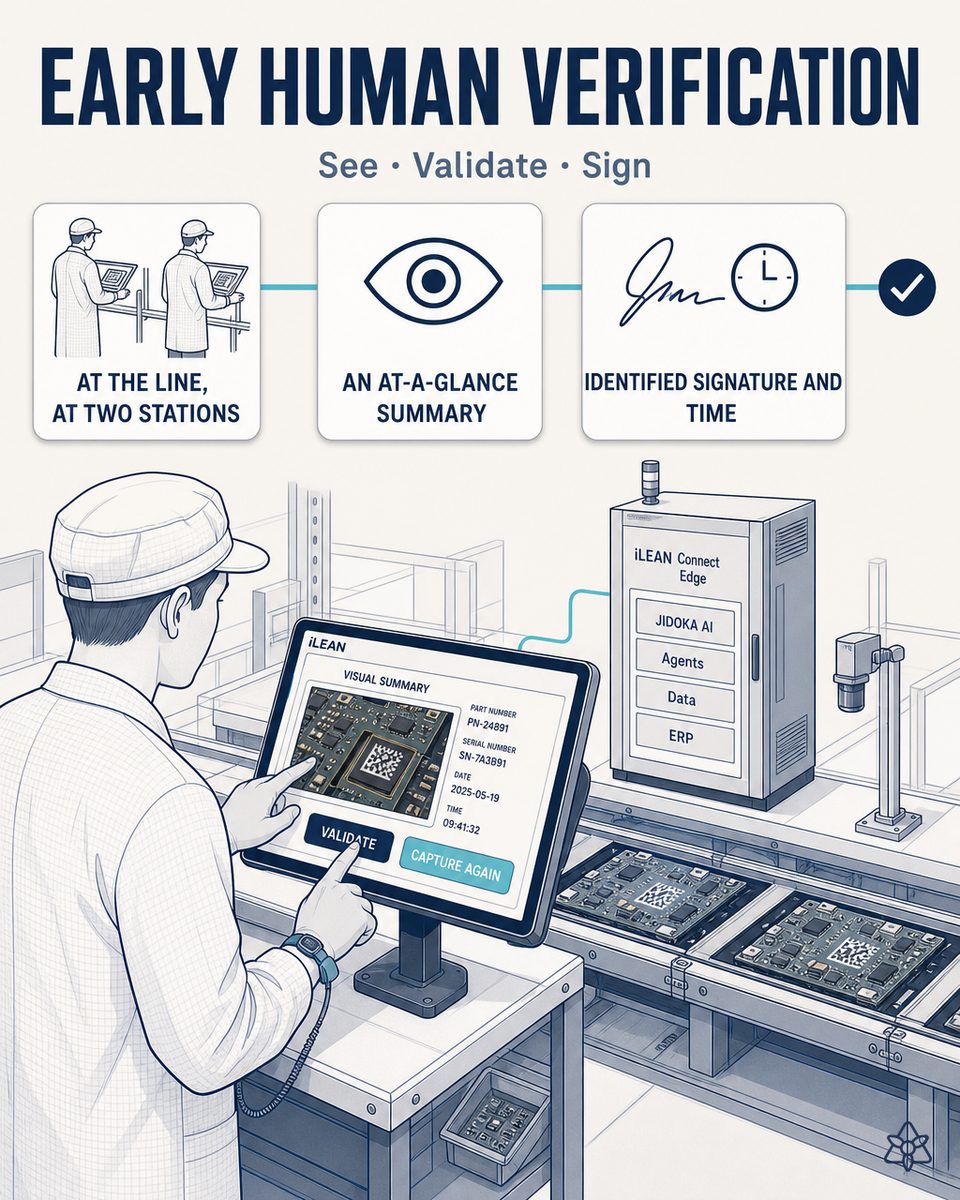
Automatic capture, by itself, is not enough in a certified environment.
A system that introduces data without an identified signature creates two risks at once: the technical risk of contaminating the genealogy with an erroneous reading, and the regulatory risk of not being able to demonstrate who validated what:
- The data demanding that validation is very specific — the reel batch mounted on each feeder, the first-article approval result, an out-of-range measurement, the assigned serial number, the loaded engineering revision.
- Any of them badly captured breaks unit traceability — which in an automotive panel is what allows scoping a campaign to the affected units instead of the entire production.
- But the human gate cannot cost line time — if validating costs more than typing, nobody validates. And then you are back at the starting point.
Hence the solution is not choosing between automating and controlling, but separating the capture — which can be automatic — from the validation, which must be human and identified but can take seconds.
Early human verification — Connect's fourth mode, which applies to the other three.
It is not just another case: it is the doctrinal mode that makes all the others signable. Everything captured by photo, by panel, by file or by voice passes through here before existing in the central system.
An industrial tablet at the line — startup station and final assembly station. An at-a-glance visual summary of what was captured, whether it came from a photo, a dictation, a panel reading or a laboratory file. Two taps: confirm, or correct the specific field that does not add up. Only then does the data cross, with signature and timestamp.
How early human verification operates on the line:
- At the line, at two stations — startup and final assembly, which is where data is born and where it closes. A validation that demands walking to an office piles up and ends up done in bulk, without looking.
- An at-a-glance visual summary — not a form. The interface is designed for reviewing what was already extracted, not for transcribing.
- Two taps: confirm or correct the specific field — the whole record is not rewritten, only what does not add up.
- Identified signature and timestamp — which is exactly what an auditor asks for and what today goes unrecorded when the data is typed in.
- What gets corrected improves recognition — so the number of corrections drops with use: validation gets cheaper over time, not more expensive.
Unsigned capture vs. early human verification
| Aspect | Data entering directly | With iLEAN + validation tablet |
|---|---|---|
| Entry into the central system | Unacceptable in a certified environment | Only with an identified signature |
| Traceability of who validated | Does not exist | Signature and timestamp per data point |
| Product genealogy | Risk of permanent contamination | Protected |
| Technician's work | Complete manual transcription | Review of what was already extracted |
| Cost of validating | — | Seconds, and decreasing with use |
| Before a process auditor | A data point with no backing | Data with origin, confidence and signature |
Value of this piece — enabling, with no isolated return.
This case is deliberately presented without its own payback: its value is that it makes the others auditable.
- Certified electronic panel plant with unit traceability and process data that cannot enter the system without a signature.
- Pilot of the tablets at the startup station and at final assembly, together with the first capture case. It is not deployed on its own.
- It has no isolated return: it is the enabler that makes the photo, panel, file and voice capture cases auditable. Without this gate, automatic capture does not pass a process audit. Its ROI is accounted together with those cases'.
- And there is an effect that improves over time: what gets corrected feeds the improvement of the recognition itself, so the number of corrections — and therefore the cost of validating — drops with use.
- Direct regulatory benefit: every process data point keeps its origin, its confidence level and the person who validated it, with a timestamp.
And the fair question from the line manager
"If everything must be validated, don't we lose rate?" — no, because validating and transcribing do not cost the same: nothing is entered here, an already-extracted summary is reviewed and confirmed. And it is that validation which lets the AI work on anchored tasks safely: even with an error below 1.5% [1], that remainder never reaches the master data or the genealogy. On top of that the system learns from every correction, so the number of interventions drops with use.
[1] OpenAI paper "Why Language Models Hallucinate", 2025 — on the reliability of AI in anchored tasks.
What people ask about early human verification
Why is capturing automatically not enough?
Because in a certified environment unsigned capture creates two risks at once. The technical one: an erroneous reading that enters on its own contaminates the product's genealogy permanently, and in unit traceability that means losing the ability to scope a campaign to the truly affected units. And the regulatory one: a process data point with no record of who validated it is worth nothing to an auditor, however correct it may be. Automating capture without solving the signature is not half a project: it is a project that does not pass the audit.
Which specific data demands this validation?
The data that sustains the panel's unit traceability: the reel batch mounted on each feeder, the first-article approval result, an out-of-range measurement, the assigned serial number and the loaded engineering revision. Any of them badly captured breaks the chain. It is not a theoretical list: it is the set of data an OEM customer asks about when a field failure appears and the scope of an action has to be decided.
How much line time does validating cost?
Seconds, and it is a design requirement more than an aspiration: if validating costs more than typing, nobody validates. The screen does not ask for data entry, it shows an at-a-glance visual summary of what iLEAN just captured, and there are two gestures: confirm, or correct the specific field that does not add up. Compared with the real alternative — transcribing those same data by hand — the difference is an order of magnitude. And it drops over time, because what gets corrected improves recognition.
Does the same tablet work for everything iLEAN captures?
Yes: early human verification is Connect's fourth mode and applies to the other three. Whether the data comes from a photo of the setup sheet, a dictation by the process engineer, the reading of the reflow oven panel or a laboratory file, everything converges on the same summary and the same two-tap gesture. The technician does not learn one interface per channel, and the boundary is single for the whole architecture: what is not signed does not cross.
Why does it have no ROI of its own?
Because it does not generate a saving: it makes possible the ones that do. Without this gate, the photo, panel, file and voice capture cases would not pass a process audit — and therefore would not be approved, making their return zero. Presenting it with an invented payback would be misleading; the honest thing is to account its value together with the cases it enables, and defend it for what it is: the condition for the rest to exist in a certified plant.
More cases from this series
- Evidence is not reconstructed: it is generated at the moment of the factEvery critical change leaves its dossier with photos, signatures and measurements, organized by…
- Your product’s genealogy starts at the receiving dockDelivery note, reel labels, certificates and moisture data captured by photo and fed into the ERP. From…
- The laboratory’s measurements, in the ERP in minutes and with fewer licensesLuminance, chromaticity and force-travel: iLEAN reads the laboratory’s Excel on save and feeds it into…
- So an engineering change never catches you producing the previous revisionCustomer email and portal read on arrival: iLEAN cross-checks the notice against active orders and…
- The line startup file, available at second zeroSetup sheet, reflow profile and first article captured with a photo: the startup file exists at second…
- Recording what the person walking the plant knows — without them stoppingEarpiece and voice mode: the process engineer dictates while walking and iLEAN structures the incident…
Which of your plant's data cannot enter the system without someone signing it?
We work on your plant's real data, not ours. We show you the validation working on your own captures. Assessment with no commitment.
See the human gate working ‹ See all 12 electronic panel cases See automotive