Vision-validated changeover: no OK and sign-off, no first article
A cluster line may change model several times per shift: another customer, another variant, another software build, another housing. Every changeover has dozens of things that must match. With iLEAN Edge, cameras at each critical point compare what is set up against the new model's reference, and the flashed software version is checked against the MES.
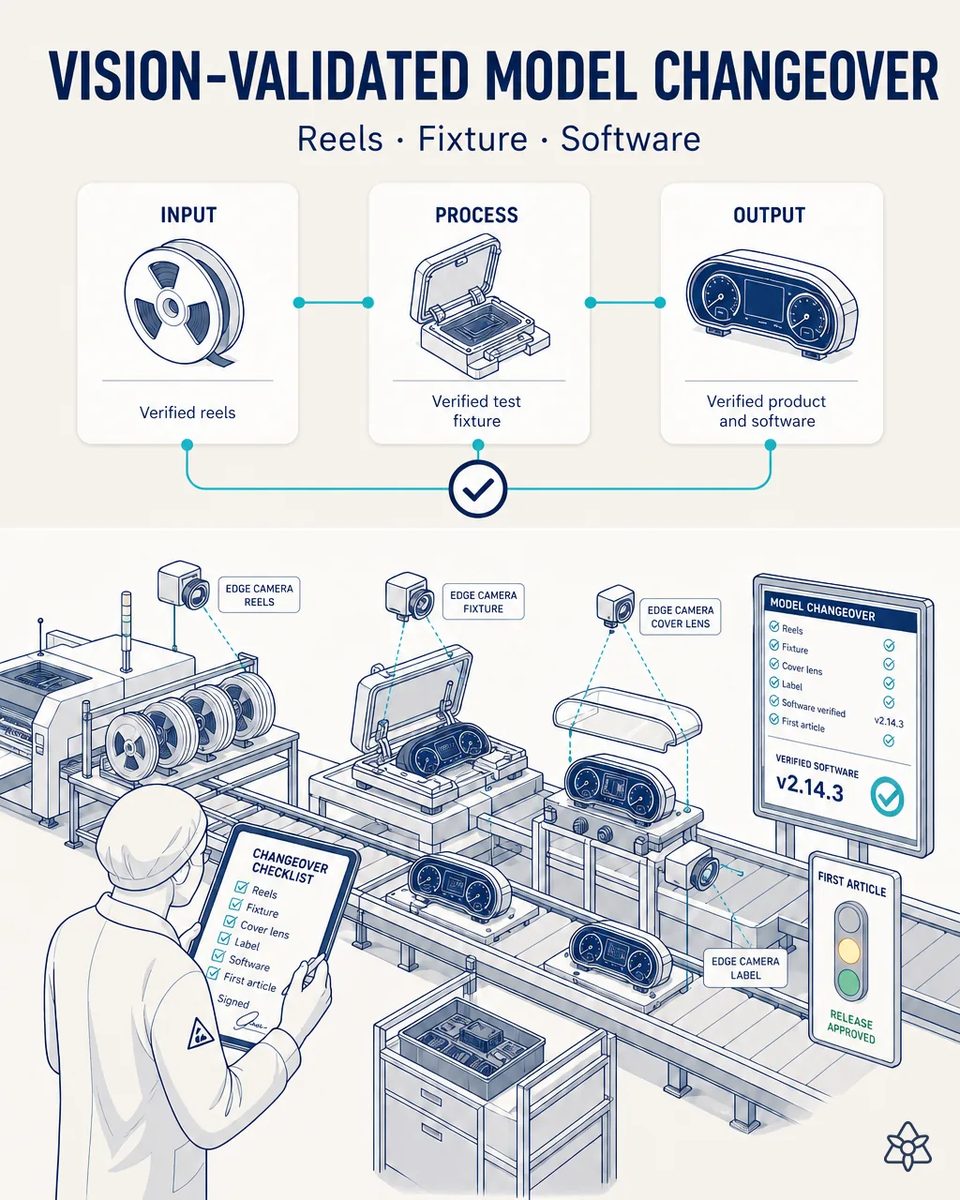
Dozens of details must match after every changeover, and one crossed detail ships the wrong variant.
A cluster line may change model several times per shift: another customer, another variant, another software build, another housing. Every changeover has dozens of things that must match. Reels, test fixture, cover lens, label and program version are confirmed today with a signed checklist. One crossed detail produces a lot with the wrong variant that can reach the OEM.
- A cluster line may change model several times per shift: another customer, another variant, another software build, another housing.
- Reels on the feeders, the test fixture, the cover lens, the label and the flashed program version must all match the new model, and many variants look almost identical.
- Today they are confirmed with a signed checklist, under time pressure, because the changeover sits on the shift's critical path and every minute is lost output. The signature certifies that someone signed, not what they actually saw.
- One crossed detail produces a lot with the wrong variant or software, and a model-mix escape can reach the OEM before anyone notices at end-of-line test, because the wrong variant often works perfectly on the bench.
Edge with JIDOKA AI on the changeover — no OK on every point and no sign-off, no first article.
With iLEAN Edge, cameras at each critical point compare what is set up against the new model's reference, and the flashed software version is checked against the MES. The first article is not released until every point is OK and the lead signs with the evidence in front of them. The AI checks; the person releases. It fits the IRIS architecture as the Edge piece of the iLEAN system.
The camera checks and the person releases. What changes is not who decides, but what they decide on: the lead signs with an image of every critical point and the verified software version in front of them, not a ticked box filled in from memory. And the same images become the changeover evidence the next customer audit will ask for.
Changeover release by checklist versus release by visual evidence
| Aspect | Today | With iLEAN Edge |
|---|---|---|
| Feeder reels for the new model | Ticked from memory | Checked by camera against the reference |
| Test fixture and cover lens | Visual check under pressure | Matched to the new variant |
| Flashed software version | Assumed correct | Checked against the MES |
| Label for the OEM variant | Read by eye | Verified before release |
| First-article release | A signature on paper | OK on every point plus sign-off |
| Changeover validation time | Long and uneven | Minutes, with evidence |
Before: release based on a checklist from memory. After: release based on visual evidence per critical point, validated in minutes.
Impact estimate — to be validated with your numbers.
The block below is an estimate to be validated against your plant's actual data. We put it forward so the committee has an order of magnitude; we refine it during the assessment.
- Estimated payback 4-10 months, depending on changeovers per shift and the cost of a mix-up.
- A target of zero model or software mix escapes to the OEM.
- An estimated 15-30% less changeover validation time, because the check is done by cameras in parallel rather than item by item on paper.
- And every release leaves visual evidence per critical point, ready for the evidence pack and the next customer audit without anyone rebuilding it. An estimate to be validated with your changeover and escape history.
Payback 4-10 months · zero model-mix escapes, −15-30% validation time. A target of zero model or software mix escapes and an estimated fifteen to thirty percent less changeover validation time. Payback of four to ten months. An estimate to be validated.
And the fair question from the production manager
“Will the camera stop the line on a changeover because of a reflection on the cover lens?” — comparing a set-up against the stored reference of the new model is an anchored task, where the best models drop below 1.5% error [1]. The software version is not read by vision at all: it is checked against the MES. And when a point is doubtful, the system escalates to the lead instead of blocking silently, with the image of the point in question on the screen.
[1] OpenAI paper "Why Language Models Hallucinate", 2025 — on the reliability of AI in anchored tasks.
What people ask about camera-validated changeovers on cluster lines
Which critical points are checked at each changeover?
Typically feeder reels, test fixture, cover lens, housing, label and the flashed software version. The list is defined per line with your process and quality engineers, and can grow over time as new variants or failure modes appear.
Where do the reference images for each model come from?
From a validated first changeover of each variant, approved by quality. After that, every new set-up is compared against that reference until the model is revised. A new revision gets a new approved reference, with its date.
How is the software build verified?
The version flashed at programming or end-of-line test is checked against the version the MES expects for that model. A mismatch blocks the first-article release until it is resolved. It is the mix-up that is invisible to the eye and the most expensive at the OEM.
Can the line start if the lead is busy elsewhere?
No first article is released without OK on every point and a sign-off. An exception can be defined, but it is recorded with the name of who authorized it and why. The exception is part of the changeover evidence, not a gap in it.
Does it slow down changeovers that are already tight?
The opposite is expected: cameras check points in parallel, so validation time drops while the evidence improves. The longest part today is usually the manual double check. Here the lead reviews the result instead of walking the line point by point.
More cases from this series
- The customer audit stops being a reconstruction: evidence organized by standardEvery model changeover and first article generates evidence organized by IATF 16949 and customer…
- Changeovers with no escapes and no material stops: four coordinated ringsAI agents coordinate plan, material, prep, release and shipping in 4 rings: fast changeovers with no…
- Every AOI reject travels to the MES and rework on its own, image includedEvery AOI reject travels to the MES and rework with its image and serial number. No more triple entry,…
- The chip distributor's alert reaches the planner with a proposed fixiLEAN reads semiconductor allocation and delay alerts in second zero, matches them against the MRP and…
- The shift supervisor talks to the AI without breaking strideThe shift supervisor dictates issues while walking the lines; iLEAN structures them by line, model and…
- The hour-by-hour board stops being erased: losses by line and model in minutesOne photo of the hour-by-hour board and every SMT line's loss reasons reach the system structured. A…
Tell us how many model changeovers you run per shift and how you release the first article.
We work on your plant's real data, not ours. Assessment with no commitment.
Request estimated ROI within 48h ‹ See all cases of cockpit electronics See automotive