The customer audit stops being a reconstruction: evidence organized by standard
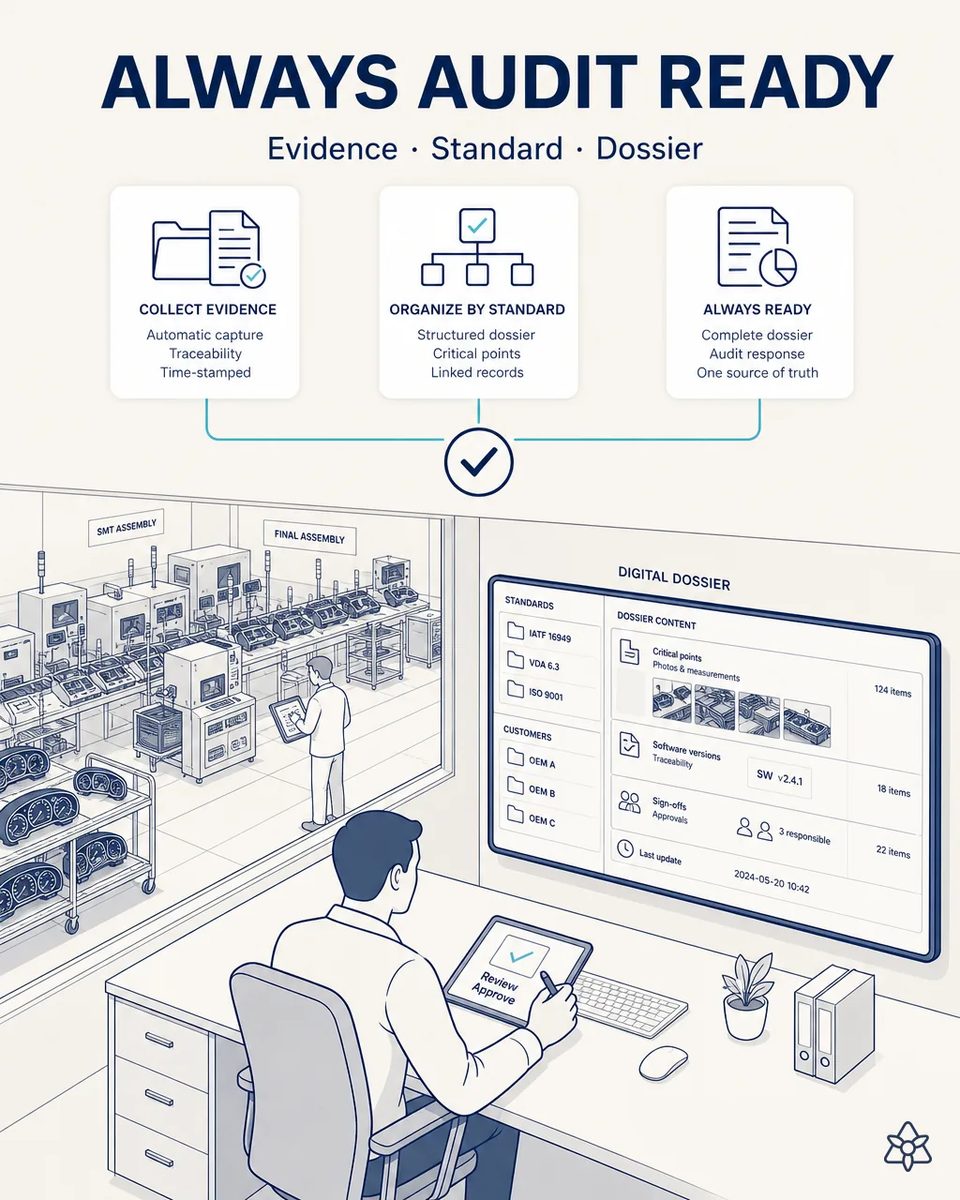
When an OEM audit or the IATF 16949 recertification comes around, someone spends weeks rebuilding changeover checklists, first-article releases, ESD records and software traceability. With iLEAN, every model changeover and every first article generate their evidence: critical-point photos, software version, decisions and time-stamped sign-offs. The agents organize it by standard and by customer.
Audit prep at a cockpit electronics plant means rebuilding weeks of changeover paperwork.
When an OEM audit or the IATF 16949 recertification comes around, someone spends weeks rebuilding changeover checklists, first-article releases, ESD records and software traceability. Every OEM has customer-specific requirements on top of IATF. The evidence exists in pieces, and documentation gaps end up as non-conformities.
- When an OEM audit or the IATF 16949 recertification comes around, someone spends weeks rebuilding changeover checklists, first-article releases, ESD records and software traceability.
- Every OEM adds its own customer-specific requirements on top of IATF, so the same evidence has to be reassembled for each customer that audits the plant.
- The evidence exists, but in pieces: paper checklists, MES screens, folders of photos and the memory of the people who signed each release, some of whom have since changed shift or left.
- Gaps found during the audit end up as documentation non-conformities, and repeated ones put certification and preferred-supplier status at risk. Each finding then needs its own corrective action and follow-up.
Agents filing evidence by standard and by OEM — the dossier builds as changeovers happen.
With iLEAN, every model changeover and every first article generate their evidence: critical-point photos, software version, decisions and time-stamped sign-offs. The agents organize it by standard and by customer. Before the audit, the agents flag gaps so they can be closed in time, and the quality lead reviews and signs the period's dossier. Humans in command. It fits the IRIS architecture as the Agents piece of the iLEAN system.
The dossier is not prepared for the audit; it closes every time a changeover or a first article happens. What the agents add is the order: the same evidence indexed by IATF clause and by each OEM's requirements, with gaps flagged by line and period while there is still time to close them. The audit becomes a review of what already exists, instead of a race to rebuild what nobody wrote down.
Rebuilding for the auditor versus the evidence pack kept by iLEAN
| Aspect | Today | With iLEAN Agents |
|---|---|---|
| Prep time before an OEM audit | Weeks of reconstruction | Hours of review |
| Changeover and first-article records | Paper checklists to hunt down | Photos, version and sign-off per event |
| Software traceability per model | Rebuilt from the MES | Filed with each release |
| Each OEM's CSR on top of IATF | Reassembled per customer | Same evidence, indexed per OEM |
| Missing changeover records | Found by the auditor | Flagged before the audit |
| Searching the dossier | Folders and memory | By period, line and model |
Before: weeks of audit prep and documentation non-conformity risk. After: hours of prep and a dossier searchable by period, line and model.
Impact estimate — to be validated with your numbers.
The block below is an estimate to be validated against your plant's actual data. We put it forward so the committee has an order of magnitude; we refine it during the assessment.
- Estimated payback 6-12 months, depending on the number of customers and audits per year.
- Audit preparation from weeks to hours, for IATF 16949 and for each OEM that audits with its own customer-specific requirements. The time saved repeats with every audit and every customer.
- Protection of certification and preferred-supplier status, by closing documentation gaps before the auditor finds them, period by period.
- And a dossier searchable by period, line and model when a customer asks about one specific changeover, one software build or one first-article release, months after it happened. An estimate to be validated with your audit calendar.
Payback 6-12 months · audit prep from weeks to hours. Protection of preferred-supplier status and certification. Estimated payback of six to twelve months depending on the number of customers and audits. An estimate to be validated.
And the fair question from the production manager
“Can we let agents file audit evidence without someone checking it?” — they do not sign anything. Classifying a changeover record, a first-article release or a software version against IATF clauses and customer requirements is an anchored task, where the best models drop below 1.5% error [1]. The quality lead reviews and signs the period's dossier before it goes to any auditor or customer. The agents prepare; the person signs.
[1] OpenAI paper "Why Language Models Hallucinate", 2025 — on the reliability of AI in anchored tasks.
What people ask about IATF 16949 evidence for cockpit electronics
Can it index evidence by each OEM's customer-specific requirements?
Yes. The evidence is captured once and indexed against IATF 16949 and against each customer's requirements, so nobody reassembles it per audit or per customer visit. When a customer updates its requirements, the index changes, not the evidence.
What goes into the evidence of a single changeover?
Critical-point photos, the verified software version, decisions taken, and time-stamped sign-offs of the lead who released the first article. Everything an auditor asks for on one event, already linked to line, model and date.
Does it cover ESD records and software traceability?
Yes, both are typical gaps in electronics audits. They are filed alongside each changeover and release, so the link between model, software build and line is explicit. ESD checks are tied to the shift and station where they were done.
How does it warn about a documentation gap?
When a changeover or first article lacks an expected record, the agents flag it within the period, while it can still be completed, not on audit day in front of the auditor. The quality lead sees an open-gaps list with owners and dates.
Who decides what an auditor or OEM gets to see?
The quality lead. They review and sign the period's dossier and choose the scope shared with each auditor; nobody outside the plant gets direct access to your systems. The auditor receives a view scoped to the period and lines of the audit.
More cases from this series
- Changeovers with no escapes and no material stops: four coordinated ringsAI agents coordinate plan, material, prep, release and shipping in 4 rings: fast changeovers with no…
- Every AOI reject travels to the MES and rework on its own, image includedEvery AOI reject travels to the MES and rework with its image and serial number. No more triple entry,…
- The chip distributor's alert reaches the planner with a proposed fixiLEAN reads semiconductor allocation and delay alerts in second zero, matches them against the MRP and…
- The shift supervisor talks to the AI without breaking strideThe shift supervisor dictates issues while walking the lines; iLEAN structures them by line, model and…
- The hour-by-hour board stops being erased: losses by line and model in minutesOne photo of the hour-by-hour board and every SMT line's loss reasons reach the system structured. A…
- Humans in command: nothing enters the MES without two taps from a personNothing the AI captures enters the MES or ERP until a person has seen it and confirmed it with two taps.…
Tell us how many OEM audits you face per year and how long each one takes to prepare.
We work on your plant's real data, not ours. Assessment with no commitment.
Request estimated ROI within 48h ‹ See all cases of cockpit electronics See automotive