Every AOI reject travels to the MES and rework on its own, image included
The AOI on an SMT line produces thousands of images and decisions per day and has its own database. But it is isolated from the MES, rework and the functional tester. iLEAN Connect stitches AOI, MES and rework together through API or database, replacing none of them. Every reject travels with its image, with the serial number as the common thread.
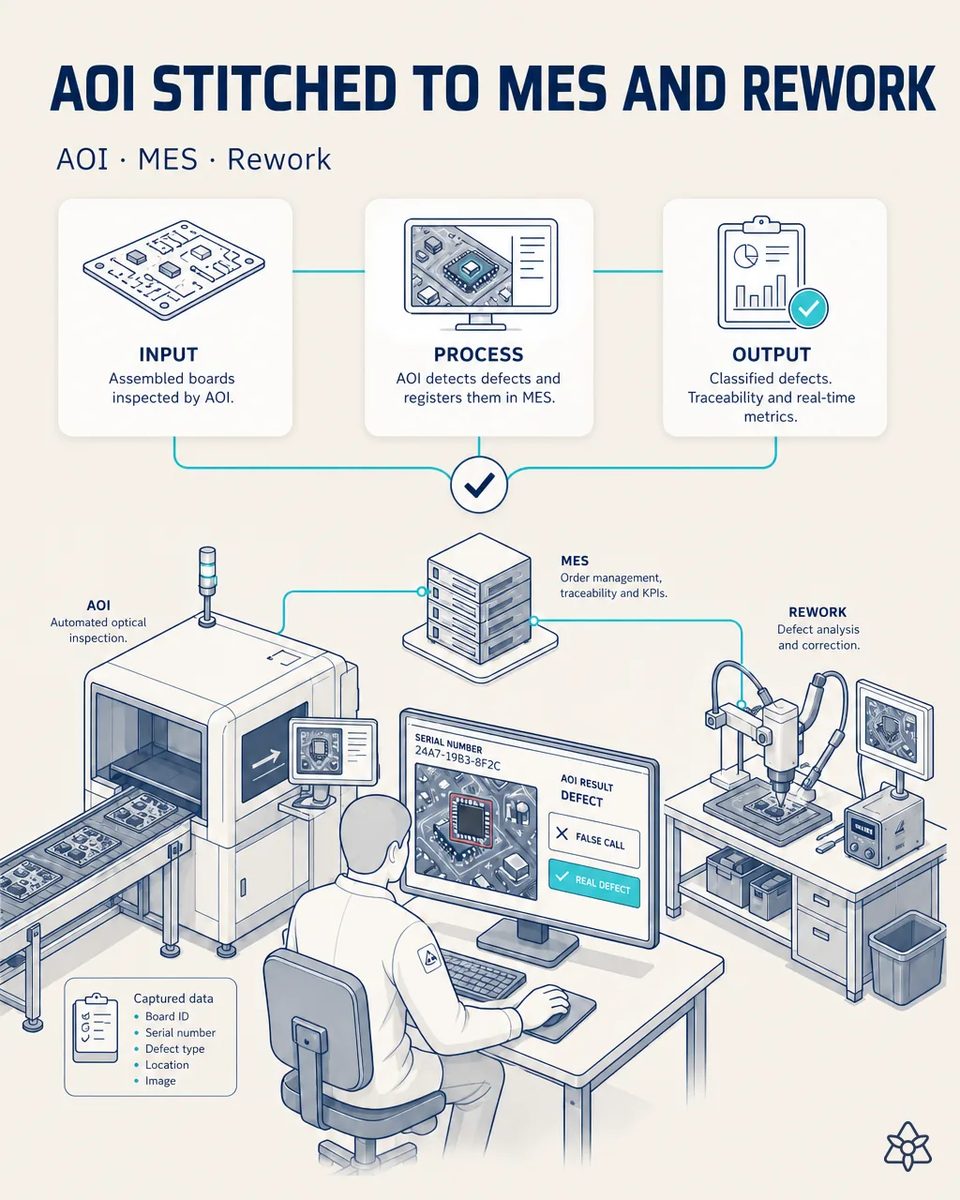
The AOI decides thousands of times a day and the MES hears none of it.
The AOI on an SMT line produces thousands of images and decisions per day and has its own database. But it is isolated from the MES, rework and the functional tester. When a board is rejected, the verifier types the defect into the MES and the rework technician records it again in an Excel file. False calls are confirmed one by one and nobody learns from them.
- The AOI on an SMT line produces thousands of images and decisions per day and keeps them in its own database, in the vendor's own format, which nobody outside the SMT team ever opens.
- It is isolated from the MES, from rework and from the functional tester. The serial number exists in all of them, but nothing connects them automatically.
- When a board is rejected, the verifier types the defect into the MES and the rework technician records it again in Excel: triple entry for one solder joint on one cluster board.
- False calls are confirmed one by one and forgotten, so the AOI program is never tuned on what it gets wrong most often, and verification load never drops, however many boards the line produces.
Connect stitching AOI, MES and rework by API — the serial number as the common thread.
iLEAN Connect stitches AOI, MES and rework together through API or database, replacing none of them. Every reject travels with its image, with the serial number as the common thread. The verifier decides whether it is a false call or a real defect; that decision flows back to the MES and the AOI. Humans in command, and every verdict feeds the analysis. It fits the IRIS architecture as the Connect piece of the iLEAN system.
Nothing is replaced: the AOI keeps inspecting, the MES keeps tracing, rework keeps repairing. What changes is that every reject arrives once, with its image, and every verdict from the verifier goes back to the AOI as data instead of dying at the verification bench. It is a fast payback because it removes work that adds nothing: typing the same defect three times.
The isolated AOI today versus the AOI stitched by iLEAN
| Aspect | Today | With iLEAN Connect |
|---|---|---|
| Defect entry per reject | Three times, by hand | Once, automatically |
| Reject image | Stays in the AOI database | Travels to MES and rework |
| False-call verdict | Confirmed and forgotten | Stored per component and program |
| AOI program tuning | Based on impressions | Based on a false-call Pareto |
| Rework technician | Retypes the defect | Receives it with its image |
| AOI and MES vendors | — | Both kept, neither replaced |
Before: triple manual entry and false calls never analyzed. After: zero re-entry and a false-call Pareto by component and program to tune the AOI.
Impact estimate — to be validated with your numbers.
The block below is an estimate to be validated against your plant's actual data. We put it forward so the committee has an order of magnitude; we refine it during the assessment.
- Estimated payback 3-6 months, one of the fastest in this matrix, to be validated with your reject volume per line.
- An estimated 20-40% less time verifying AOI rejects, from the image arriving with the reject and from fewer false calls over time.
- Zero re-entry between AOI, MES and rework, which also removes the typos and mismatched defect codes between them. Each reject has one record, with one image, from AOI to repair.
- And a false-call Pareto by component and program, so the AOI is tuned on evidence and the verification load keeps dropping month after month.
Payback 3-6 months · −20-40% AOI reject verification time. An estimated twenty to forty percent less time verifying rejects. Fast payback of three to six months. An estimate to be validated.
And the fair question from the production manager
“Is the AI going to decide which AOI calls are false?” — no, the verifier decides; iLEAN carries the image, the serial and the verdict between systems. Where iLEAN does interpret, such as mapping AOI defect codes to MES fields, it is an anchored task, where the best models drop below 1.5% error [1]. And the verifier's decision is what flows back to the MES and the AOI, so the next program tuning starts from real verdicts, not from impressions.
[1] OpenAI paper "Why Language Models Hallucinate", 2025 — on the reliability of AI in anchored tasks.
What people ask about connecting AOI rejects to the MES and rework
Do we have to replace our AOI or MES to do this?
No. iLEAN connects them through their API or database and replaces neither. The AOI vendor's software and the MES configuration stay as they are, with no new screens for the verifier. Both vendors keep their support contracts untouched.
What if our AOI only exports files, with no API?
Then iLEAN reads the export folder or the database directly. The connection method depends on the machine; the serial number remains the common thread in every case. Older AOI models on secondary lines are usually connected this way.
Does the false-call Pareto break down by component and program?
Yes, by component reference, package, AOI program and line. That is what the process engineer needs to decide which inspection windows to retune first. Each tuning can then be measured by the false calls it removes.
Does the rework technician see the AOI image of the defect?
Yes. The reject reaches rework with its image and location on the board, so the technician knows what to repair without searching the panel or asking the verifier. The repair is then recorded against the same serial and the same defect.
Can the same link include functional test results?
Yes. Once the serial number is the thread, the functional tester verdict can join the same record, closing the loop from AOI to end-of-line test for every cluster or controller. A board that passed AOI and failed test becomes visible as a pattern, not an anecdote.
More cases from this series
- The customer audit stops being a reconstruction: evidence organized by standardEvery model changeover and first article generates evidence organized by IATF 16949 and customer…
- Changeovers with no escapes and no material stops: four coordinated ringsAI agents coordinate plan, material, prep, release and shipping in 4 rings: fast changeovers with no…
- The chip distributor's alert reaches the planner with a proposed fixiLEAN reads semiconductor allocation and delay alerts in second zero, matches them against the MRP and…
- The shift supervisor talks to the AI without breaking strideThe shift supervisor dictates issues while walking the lines; iLEAN structures them by line, model and…
- The hour-by-hour board stops being erased: losses by line and model in minutesOne photo of the hour-by-hour board and every SMT line's loss reasons reach the system structured. A…
- Humans in command: nothing enters the MES without two taps from a personNothing the AI captures enters the MES or ERP until a person has seen it and confirmed it with two taps.…
Tell us how many AOI rejects you verify per shift and how many are false calls.
We work on your plant's real data, not ours. Assessment with no commitment.
Request estimated ROI within 48h ‹ See all cases of cockpit electronics See automotive