The shift supervisor talks to the AI without breaking stride
The shift supervisor walks the aisle between SMT, test and final assembly all day. Gloves and ESD strap on, holding a fixture or a box of panels, there is no way to type. With iLEAN Connect voice mode they just say it: log that feeder 12 on line 2 is mispicking since the changeover; tell maintenance. iLEAN structures it as an issue linked to line, model and shift, in English or Spanish.
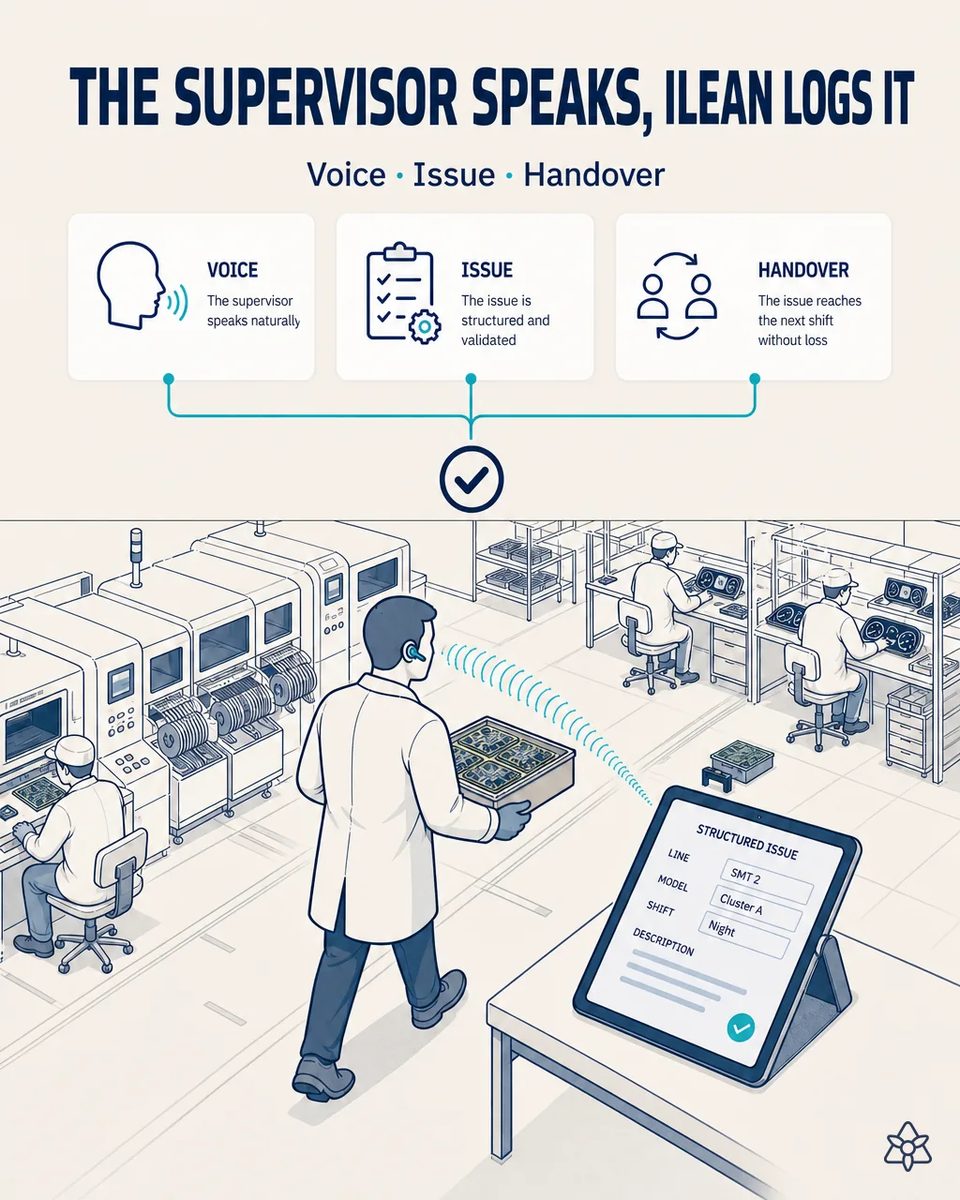
The supervisor sees every problem on the floor and has no hand free to log it.
The shift supervisor walks the aisle between SMT, test and final assembly all day. Gloves and ESD strap on, holding a fixture or a box of panels, there is no way to type. They know feeder 12 on line 2 has been failing since the changeover, that the line 4 tester throws false fails with one connector lot, that the new operator needs backup. All of it is lost in a verbal shift handover.
- The shift supervisor walks the aisle between SMT, functional test and final assembly all shift, with gloves and an ESD strap on, often carrying a fixture or a box of panels.
- They know that feeder 12 on line 2 has been mispicking since the changeover, that the line 4 tester throws false fails with one connector lot, that the new operator on final assembly needs backup.
- None of it gets typed: there is no free hand and no terminal nearby. It survives only in the supervisor's head, mixed with everything else that happened in eight hours.
- At shift change it is passed on verbally in five minutes, and half a shift of information is lost before the next one starts, so the same feeder fault is rediscovered tomorrow by someone who never heard about it.
Connect in voice mode — the supervisor speaks, iLEAN structures and coordinates.
With iLEAN Connect voice mode they just say it: log that feeder 12 on line 2 is mispicking since the changeover; tell maintenance. iLEAN structures it as an issue linked to line, model and shift, in English or Spanish. iLEAN replies through the earpiece: maintenance will be there in fifteen minutes. The supervisor stays in command; the AI listens, organizes and coordinates. It fits the IRIS architecture as the Connect piece of the iLEAN system.
This case does not pay for itself on a spreadsheet, and we do not pretend it does. What it does is make every other case smarter: the feeder that keeps failing and the tester with false fails stop being anecdotes and become issues with a date, a line, a model and a status that engineering can act on.
The verbal shift handover versus the dictated shift
| Aspect | Today | With iLEAN Connect |
|---|---|---|
| Feeder mispick after a changeover | Mentioned at handover, maybe | Logged with line, model and time |
| Tester false fails by connector lot | Known by one person | Recorded and visible to engineering |
| Calling maintenance | Walk to find someone | Dictated, with a reply in the earpiece |
| Handover between SMT and test shifts | Five verbal minutes | Every issue listed with its status |
| Language on the floor | Whatever the supervisor writes | English or Spanish, as spoken |
| Same feeder fault on several shifts | Rediscovered each time | Visible across shifts |
Before: a handover from memory and half a shift of information lost. After: every issue of the shift logged with its status, and recurring ones visible to engineering.
Impact estimate — to be validated with your numbers.
The block below is an estimate to be validated against your plant's actual data. We put it forward so the committee has an order of magnitude; we refine it during the assessment.
- No standalone payback: we treat it as strategic value and an enabling piece, and we do not put a number on it upfront because its return shows up in other cases.
- What it unlocks is a shift handover with 100% of issues logged, each one with its status, owner and the line and model it affects.
- It feeds the loss Pareto and every Kaizen with causes that today never reach paper, such as recurring feeder, nozzle or tester problems.
- How much that is worth in your plant is something we validate together with the operational excellence lead, on your own data, after the first weeks of dictated issues.
Strategic value · shift handover with 100% of issues logged. Hard to put a number on upfront, but it feeds every Kaizen and the loss Pareto. An estimate to be validated with the operational excellence lead.
And the fair question from the production manager
“Will it understand ‘feeder twelve, line two, mispicking since the changeover’ over the noise of an SMT floor?” — turning a short dictated sentence into line, equipment, symptom and shift is an anchored task, where the best models drop below 1.5% error [1]. The supervisor hears back what was logged, and the issue can be corrected by voice before it reaches maintenance or the handover. Feeder, nozzle and tester names are part of the vocabulary it is loaded with.
[1] OpenAI paper "Why Language Models Hallucinate", 2025 — on the reliability of AI in anchored tasks.
What people ask about voice logging for cockpit electronics supervisors
Does the earpiece work with ESD garments and gloves?
Yes. It needs no hands: the supervisor speaks and hears the reply. Nothing has to be touched while carrying panels or a test fixture, and it does not interfere with the ESD strap. The device is light enough to wear for a full shift.
Does it know our line names, feeder numbers and tester IDs?
Yes, it is loaded with your plant vocabulary at start-up: line names, feeder positions, tester and fixture IDs and the models in production. New terms are added as the plant changes, such as a new line or a new OEM model.
Can it notify maintenance or engineering directly?
Yes. When the supervisor says tell maintenance, the issue is routed to that team, and the reply, such as an arrival time of fifteen minutes, comes back through the earpiece. The supervisor never has to stop walking to chase the answer.
Does it record operators or conversations on the floor?
No. It only captures what the supervisor chooses to dictate after the wake word. There is no continuous listening and no location tracking of people on the line. Operators keep working exactly as they do today.
Why does this voice case carry no payback figure of its own?
Because its value appears in other cases: better loss Paretos and faster fixes for recurring feeder or tester faults. We prefer to say that openly rather than invent a number that nobody could defend.
More cases from this series
- The customer audit stops being a reconstruction: evidence organized by standardEvery model changeover and first article generates evidence organized by IATF 16949 and customer…
- Changeovers with no escapes and no material stops: four coordinated ringsAI agents coordinate plan, material, prep, release and shipping in 4 rings: fast changeovers with no…
- Every AOI reject travels to the MES and rework on its own, image includedEvery AOI reject travels to the MES and rework with its image and serial number. No more triple entry,…
- The chip distributor's alert reaches the planner with a proposed fixiLEAN reads semiconductor allocation and delay alerts in second zero, matches them against the MRP and…
- The hour-by-hour board stops being erased: losses by line and model in minutesOne photo of the hour-by-hour board and every SMT line's loss reasons reach the system structured. A…
- Humans in command: nothing enters the MES without two taps from a personNothing the AI captures enters the MES or ERP until a person has seen it and confirmed it with two taps.…
Tell us how your shift handover works today between SMT, test and final assembly.
We work on your plant's real data, not ours. Assessment with no commitment.
Request estimated ROI within 48h ‹ See all cases of cockpit electronics See automotive