Changeovers with no escapes and no material stops: four coordinated rings
In a cockpit electronics plant serving many customers, complexity is the core pain: dozens of variants with different specs, constant model changeovers and material that must arrive exactly right at SMT, test and final assembly. The agents read OEM and supplier alerts, cross them with the MRP and receiving, and propose a sequence with confirmed material. SMED AI launches offline prep for the next model, and the hour-by-hour board measures the real changeover.
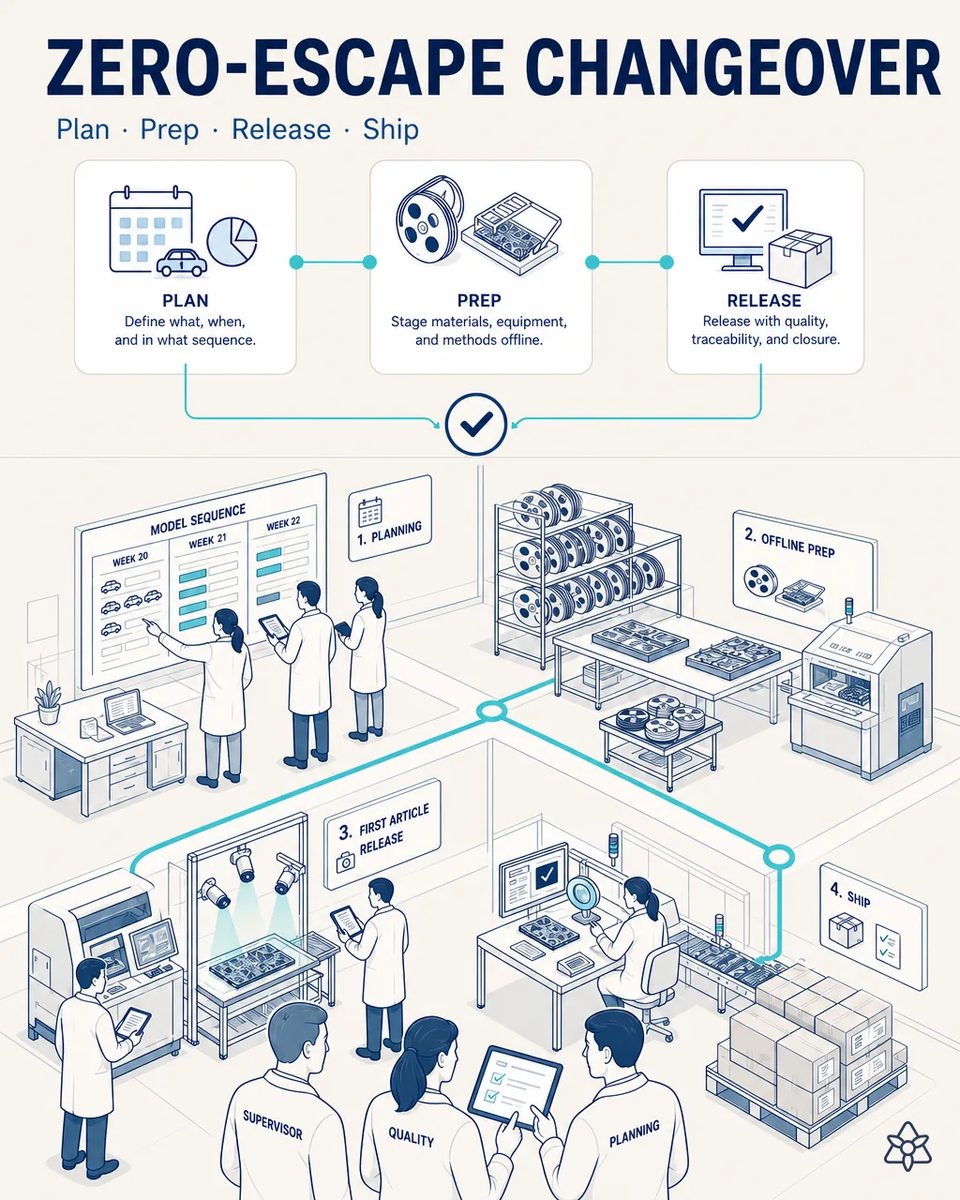
With dozens of variants and constant changeovers, coordination is where escapes are born.
In a cockpit electronics plant serving many customers, complexity is the core pain: dozens of variants with different specs, constant model changeovers and material that must arrive exactly right at SMT, test and final assembly. When coordination fails, two things happen: stoppages for missing material and escapes from model, software or label mix-ups. Every escape to the OEM means a complaint, an 8D and risk to supplier status.
- In a cockpit electronics plant serving many OEMs, complexity is the core pain: dozens of variants with different specs, constant model changeovers and material that must arrive exactly right at SMT, test and final assembly.
- When coordination fails, two things happen: stoppages for missing material and escapes from model, software or label mix-ups.
- Each control exists on its own — a sequence, a checklist, an AOI, a label printer — but nothing makes them agree with each other before the pallet leaves the plant.
- Every escape to the OEM means a complaint, an 8D and risk to supplier status, and a single one can cost more than months of improvement work on the lines.
Agents coordinating the four changeover rings — the eleven cases above, working as one.
The agents read OEM and supplier alerts, cross them with the MRP and receiving, and propose a sequence with confirmed material. SMED AI launches offline prep for the next model, and the hour-by-hour board measures the real changeover. Edge cameras and software verification hold the first article until OK plus sign-off. At the exit, AOI stitched to the MES, cosmetic inspection and an evidence pack per changeover, with the final label matched to the order. It fits the IRIS architecture as the Agents piece of the iLEAN system.
The agents propose and verify; supervisor, quality and planning decide and sign. If something does not match — material, software, fixture or label — the line stops before the first article, not at the customer. Each ring already exists in some form today; what is new is that they check each other.
How the four changeover rings close the gaps
| Ring | Which cases it draws on | What it closes |
|---|---|---|
| 1 · Plan | Shortage alert (3) + reel receiving (7) | A sequence proposed only with confirmed material |
| 2 · Prep | SMED AI + hour-by-hour board (1) | Offline prep of the next model and the real changeover time |
| 3 · Release | Changeover validation (10) + tablet (5) | First article held until OK on every point and sign-off |
| 4 · Ship | AOI and MES (8) + cosmetic inspection (9) | Final label matched to the order before the pallet leaves |
| Dossier per changeover | IATF evidence pack (11) | One file per changeover, ready for the OEM |
| Feedback to planning | Supervisor voice (4) + rework (6) | Recurring causes fed back into the next sequence |
The agents propose and verify; supervisor, quality and planning decide and sign. If something does not match, the line stops before the first article, not at the customer.
Impact estimate — to be validated with your numbers.
The block below is an estimate to be validated against your plant's actual data. We put it forward so the committee has an order of magnitude; we refine it during the assessment.
- Estimated payback 6-12 months, measured against the first escape avoided at the OEM and its 8D.
- An estimated 20-40% less changeover time from offline prep and sequences built only with confirmed material.
- +1-3 OEE points expected from fewer material stops and shorter changeovers on SMT, test and final assembly.
- And a target of zero mix-up escapes of model, software or label to the OEM, which is what protects supplier status in the next program award. An estimate to be validated with your changeover and escape data.
Payback 6-12 months · −20-40% changeover time, +1-3 OEE points, zero-escape target. An estimated twenty to forty percent less changeover time, one to three OEE points and a target of zero mix-up escapes. Payback of six to twelve months against the first escape avoided. An estimate to be validated.
And the fair question from the production manager
“Isn't this too much automation for something as critical as a changeover?” — the agents do not release anything: they propose sequences and verify points, and people sign. Each check they run, such as matching a label to an order or a software build to a model, is an anchored task, where the best models drop below 1.5% error [1]. And the rings cross-check: one disagreement is enough to hold the first article until a person resolves it.
[1] OpenAI paper "Why Language Models Hallucinate", 2025 — on the reliability of AI in anchored tasks.
What people ask about zero-escape changeovers in cockpit electronics
Do we need all twelve cases before the rings work?
No. Each ring is built in layers and each case pays on its own. Plants usually start with the hour-by-hour board and the changeover validation, then add rings as each one proves its value in your own numbers.
What does SMED AI do in the prep ring?
It launches the offline preparation of the next model, such as reels, fixtures and labels, while the current one is still running, so internal changeover time shrinks and nothing is searched for at the line. The hour-by-hour board then measures how long the real changeover took.
How is a label mix-up caught before shipping?
The final label is matched against the order and the model actually built, with the AOI and cosmetic records of that serial. A mismatch stops the pallet before it reaches the truck. That is the last ring, and the one closest to the OEM.
Who has the final word when an agent flags a mismatch?
Supervisor, quality or planning, depending on the ring. The agent explains what does not match and with which evidence, and the responsible person decides and signs. The decision is stored with the evidence for the changeover dossier.
Can we estimate the return before choosing where to start?
Yes. With your changeovers per week, last year's escapes and material stoppages, we estimate the return per ring and agree on the order of deployment with you. The first ring is usually live within weeks, not quarters.
More cases from this series
- The customer audit stops being a reconstruction: evidence organized by standardEvery model changeover and first article generates evidence organized by IATF 16949 and customer…
- Every AOI reject travels to the MES and rework on its own, image includedEvery AOI reject travels to the MES and rework with its image and serial number. No more triple entry,…
- The chip distributor's alert reaches the planner with a proposed fixiLEAN reads semiconductor allocation and delay alerts in second zero, matches them against the MRP and…
- The shift supervisor talks to the AI without breaking strideThe shift supervisor dictates issues while walking the lines; iLEAN structures them by line, model and…
- The hour-by-hour board stops being erased: losses by line and model in minutesOne photo of the hour-by-hour board and every SMT line's loss reasons reach the system structured. A…
- Humans in command: nothing enters the MES without two taps from a personNothing the AI captures enters the MES or ERP until a person has seen it and confirmed it with two taps.…
Tell us how many changeovers you run per week and what your last escape to the OEM cost.
We work on your plant's real data, not ours. Assessment with no commitment.
Request estimated ROI within 48h ‹ See all cases of cockpit electronics See automotive