The chip distributor's alert reaches the planner with a proposed fix
Mid-morning an email arrives from the semiconductor distributor: the microcontroller for a cluster goes on allocation and the shipment slips a week. The email lands in purchasing, who read it in the afternoon, when that model is already sequenced for the night shift. iLEAN Connect sits on copy in a dedicated mailbox. It reads the alert in second zero, extracts part number, quantity and dates, and matches them against MRP demand and stock.
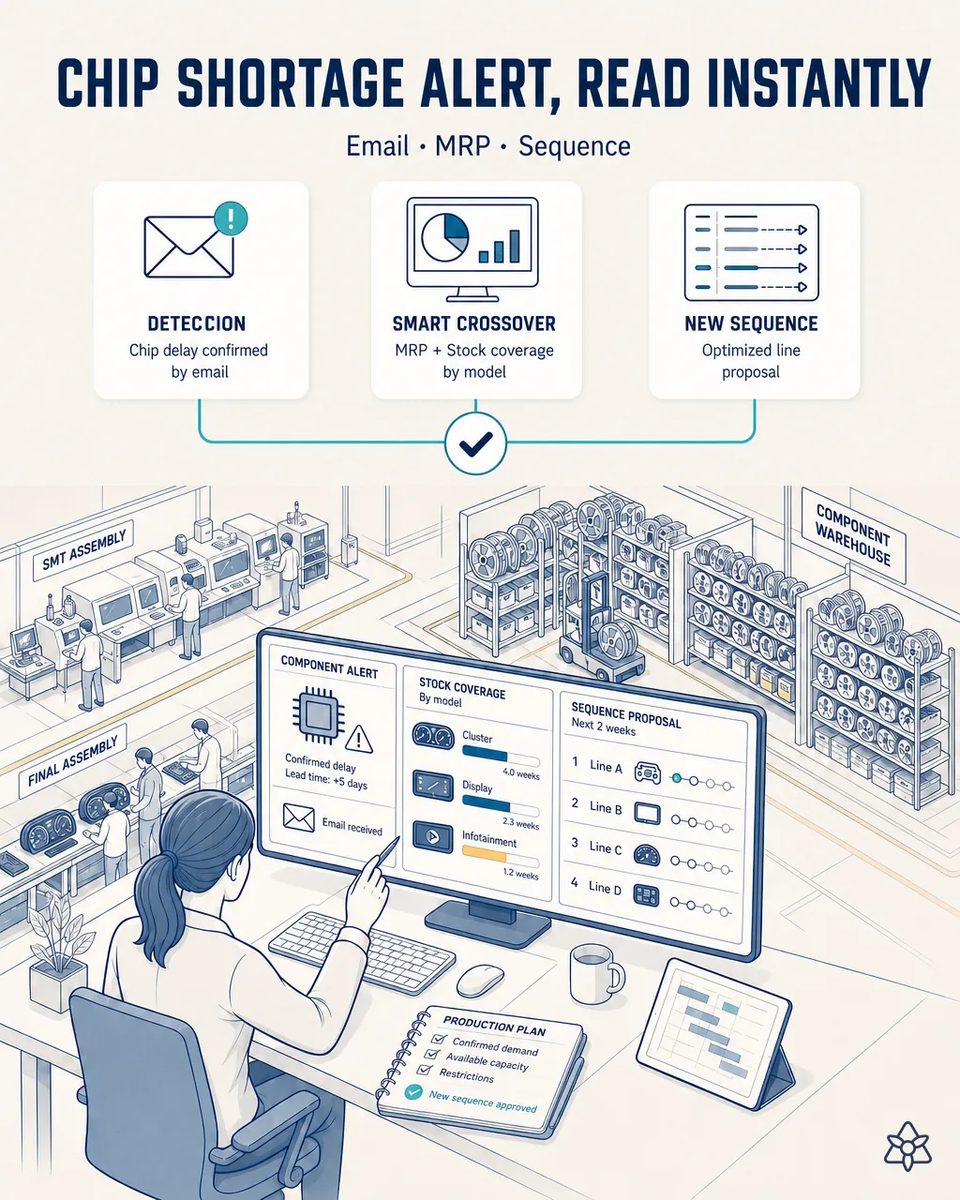
The allocation email arrives at ten and is read when the night sequence is already set.
Mid-morning an email arrives from the semiconductor distributor: the microcontroller for a cluster goes on allocation and the shipment slips a week. The email lands in purchasing, who read it in the afternoon, when that model is already sequenced for the night shift. With hundreds of components per product and multiple variants per customer, supply alerts and OEM schedule changes arrive by email to specific people. By the time they are read, the sequence is set and it breaks: a stoppage and an emergency changeover.
- Mid-morning the semiconductor distributor writes: the microcontroller for one cluster goes on allocation and the shipment slips a week.
- The email lands in one buyer's inbox, competing with quotes, confirmations and price updates, and is read in the afternoon, after the daily planning meeting has already closed the sequence.
- By then that model is sequenced for the night shift. With hundreds of components per product and several variants per OEM, one missing part breaks the plan for every line that shares it.
- The result is a line stoppage and an emergency changeover to whatever model has material, with all the first-article and mix-up risk an unprepared changeover brings.
Connect on a dedicated mailbox — the distributor alert is read and matched to the MRP in second zero.
iLEAN Connect sits on copy in a dedicated mailbox. It reads the alert in second zero, extracts part number, quantity and dates, and matches them against MRP demand and stock. The planner receives a concrete proposal: pull model B forward on line 3; model A is covered by warehouse stock. The planner accepts, adjusts or discards it. Humans in command. It fits the IRIS architecture as the Connect piece of the iLEAN system.
The planner does not get one more email: they get a proposal with the part number, the affected models and which line can be resequenced with material in stock. The decision stays with them, but it arrives hours earlier, while the night shift can still be prepared properly. A changeover planned with secured material is a normal changeover; an improvised one is where escapes are born.
The distributor email today versus the alert matched by iLEAN
| Aspect | Today | With iLEAN Connect |
|---|---|---|
| Time to read an allocation notice | Hours, depending on the inbox | Second zero |
| Affected cluster or display models | Worked out by hand | Listed from MRP demand |
| Stock coverage per model | Checked later, if at all | Shown with the alert |
| Resequence | Improvised at the line | Proposed to the planner |
| Night shift sequence | Breaks mid-shift | Adjusted before it starts |
| Changeover type | Emergency, unprepared | Planned, with material secured |
Before: hours of latency and improvised changeovers. After: alerts read in seconds and planned changeovers with material secured.
Impact estimate — to be validated with your numbers.
The block below is an estimate to be validated against your plant's actual data. We put it forward so the committee has an order of magnitude; we refine it during the assessment.
- Estimated payback 3-7 months, depending on how often critical alerts arrive from distributors and OEMs and how many models share each part.
- Fewer stoppages for missing material on SMT and final assembly, because the sequence is corrected before the shift starts.
- Fewer unplanned changeovers, which are the ones most likely to produce a model or software mix-up at first article.
- And latency between the distributor email and the planning decision drops from hours to seconds, whoever happens to be on holiday that week. An estimate to be validated against your last year of alerts.
Payback 3-7 months · fewer material stoppages and emergency changeovers. Fewer stoppages for missing material and fewer unplanned changeovers. Estimated payback of three to seven months depending on how often critical alerts arrive. An estimate to be validated.
And the fair question from the production manager
“What if it pulls the wrong part number out of a messy distributor email?” — extracting part number, quantity and dates from a supplier notice is an anchored task, where the best models drop below 1.5% error [1]. On top of that the part number is checked against your MRP master: if it does not exist there, the alert is flagged instead of matched, and the planner always accepts, adjusts or discards the proposal.
[1] OpenAI paper "Why Language Models Hallucinate", 2025 — on the reliability of AI in anchored tasks.
What people ask about semiconductor allocation alerts and resequencing
Does it read alerts from franchised distributors and brokers alike?
Yes. It works on the text of the email and its attachments, whatever the sender's format or language. What matters is that the dedicated mailbox is in copy on the supplier communication. Purchasing keeps working with its suppliers exactly as before.
Can it map a manufacturer part number to our internal part number?
Yes, using the approved manufacturer list in your master data. If a reference has no match, the alert is flagged for a buyer rather than guessed, so a wrong mapping never moves the plan. Once a buyer resolves it, that mapping is remembered for the next alert.
Does it also catch OEM schedule changes, not only supplier delays?
Yes. An OEM pulling volume forward on one variant is matched against the same MRP demand and stock, and the planner sees the effect on the sequence of every affected line. Pull-ins and push-outs are treated the same way as a supplier delay.
Will it change the production sequence on its own?
No. It proposes, for example pulling model B forward on line 3 while model A is covered by stock, and the planner accepts, adjusts or discards it. Nothing moves in the plan without that decision. Every accepted or discarded proposal is logged with who decided and when.
What if the shortage affects a part shared by cluster and infotainment?
That is where it helps most: it lists every model consuming that part, their coverage in weeks and which lines can absorb the change without breaking another customer's sequence. It also shows whether an approved alternate part has stock, so the buyer can act at the same time.
More cases from this series
- The customer audit stops being a reconstruction: evidence organized by standardEvery model changeover and first article generates evidence organized by IATF 16949 and customer…
- Changeovers with no escapes and no material stops: four coordinated ringsAI agents coordinate plan, material, prep, release and shipping in 4 rings: fast changeovers with no…
- Every AOI reject travels to the MES and rework on its own, image includedEvery AOI reject travels to the MES and rework with its image and serial number. No more triple entry,…
- The shift supervisor talks to the AI without breaking strideThe shift supervisor dictates issues while walking the lines; iLEAN structures them by line, model and…
- The hour-by-hour board stops being erased: losses by line and model in minutesOne photo of the hour-by-hour board and every SMT line's loss reasons reach the system structured. A…
- Humans in command: nothing enters the MES without two taps from a personNothing the AI captures enters the MES or ERP until a person has seen it and confirmed it with two taps.…
Tell us how many supplier alerts a week reach your buyers and how late they are read.
We work on your plant's real data, not ours. Assessment with no commitment.
Request estimated ROI within 48h ‹ See all cases of cockpit electronics See automotive