AI vision at display final inspection: the camera never tires, the inspector decides
Final cosmetic inspection of a display is one of the toughest jobs in the plant: hundreds of screens per shift, hunting for a tenth-of-a-millimeter particle under the optical bond, a bubble or a scratch on the glass. iLEAN Edge puts a camera at the inspection station and analyzes every part in milliseconds with a model trained on the plant's real boundary samples, without sending images to the cloud.
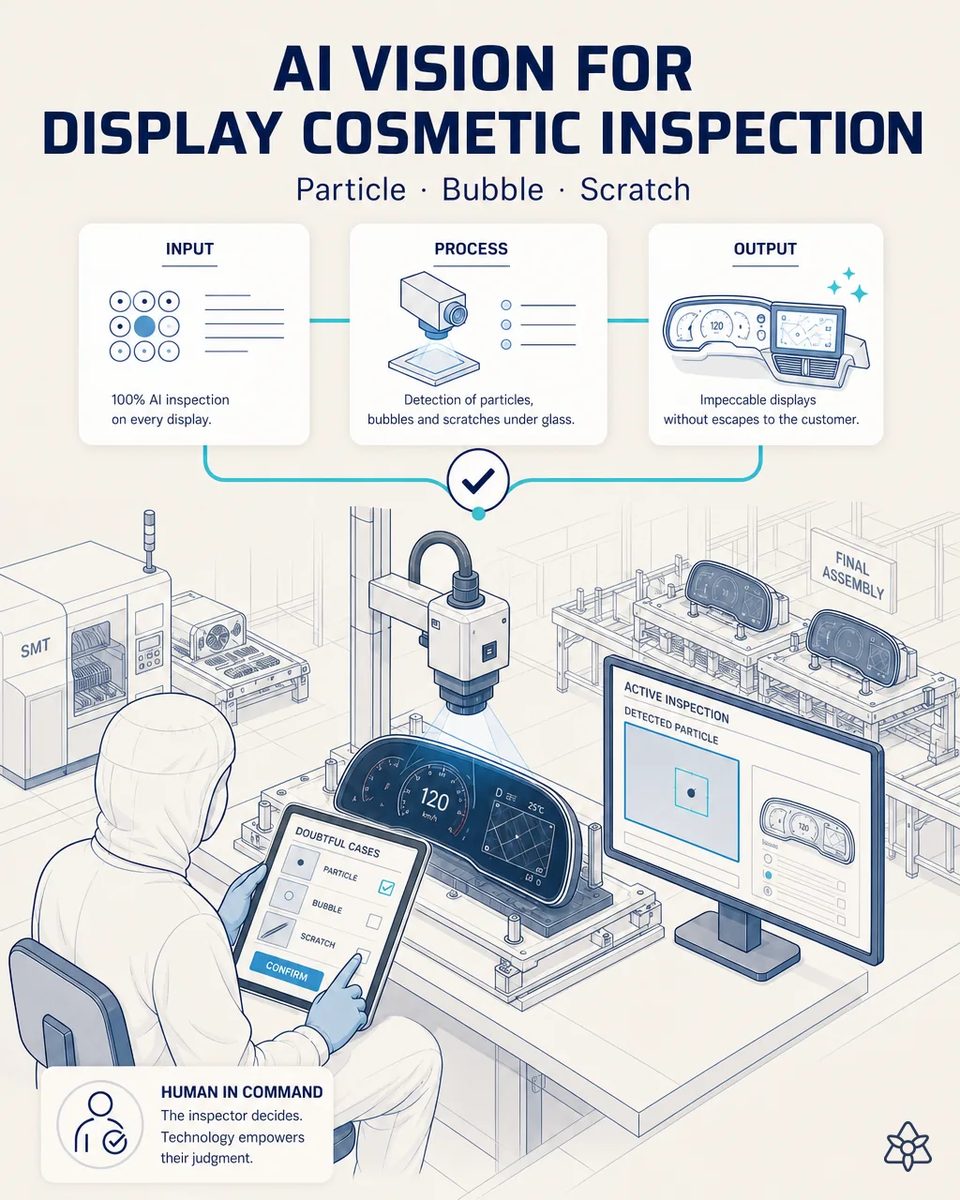
A tenth-of-a-millimeter particle under the bond, hundreds of times per shift.
Final cosmetic inspection of a display is one of the toughest jobs in the plant: hundreds of screens per shift, hunting for a tenth-of-a-millimeter particle under the optical bond, a bubble or a scratch on the glass. By the end of the shift eyes are tired and criteria vary from inspector to inspector. An escape reaches the OEM as a customer complaint, containment and an 8D.
- Final cosmetic inspection of a display is one of the toughest jobs in the plant: hundreds of screens per shift, hunting for a particle under the optical bond, a bubble or a scratch on the cover glass.
- By the end of the shift eyes are tired, and the boundary between acceptable and reject drifts from inspector to inspector and from day shift to night shift, especially on defects close to the limit of the boundary sample.
- Boundary samples exist, but applying them consistently at line rate over eight hours is beyond what any person can sustain, however experienced.
- An escape reaches the OEM as a customer complaint, with containment, sorting at the customer and an 8D that puts supplier status at stake for the next program award. The cost of one complaint usually exceeds the cost of the whole station.
Edge vision at the display inspection station — the camera classifies, the inspector decides doubtful parts.
iLEAN Edge puts a camera at the inspection station and analyzes every part in milliseconds with a model trained on the plant's real boundary samples, without sending images to the cloud. The camera classifies OK, NOK or doubtful and shows the inspector only the doubtful ones. The inspector decides, and every decision retrains the model. Humans in command. It fits the IRIS architecture as the Edge piece of the iLEAN system.
The camera does not get tired at hour seven and applies the same boundary to every display. The inspector stops looking at hundreds of good screens and spends their judgment on the doubtful ones, which is where human experience actually makes the difference. Every one of those decisions is stored with its image, so the criterion of the best inspector becomes the criterion of every shift.
Display inspection by eye versus inspection with iLEAN Edge
| Aspect | Today | With iLEAN Edge |
|---|---|---|
| Particle under the optical bond | Depends on the hour and the eyes | Checked on every display |
| Bubble and cover glass scratch | Judged against boundary samples | Classified OK, NOK or doubtful |
| Criteria across shifts | Vary by inspector | Stable and documented |
| Evidence per display | A pass stamp | An image per part |
| Inspector's attention | Spread over every screen | Focused on doubtful parts |
| Images and the cloud | — | Processed locally, never sent out |
Before: criteria varying across inspectors and shifts. After: stable criteria, documented with an image per part, and far fewer cosmetic escapes.
Impact estimate — to be validated with your numbers.
The block below is an estimate to be validated against your plant's actual data. We put it forward so the committee has an order of magnitude; we refine it during the assessment.
- Estimated payback 5-12 months, depending on display volume and the cost of each complaint, containment and sorting action.
- An estimated 30-60% reduction in cosmetic escapes to the customer, with fewer containment and sorting actions at the OEM.
- Stable criteria across inspectors and shifts, documented with an image of every display shipped and its serial number, so disputes with the OEM are settled with evidence.
- And when the OEM asks about a serial number, the cosmetic evidence is already there instead of a stamp on a traveler. An estimate to be validated with your complaint history and display volume.
Payback 5-12 months · −30-60% cosmetic escapes to the customer. An estimated thirty to sixty percent reduction in cosmetic escapes to the customer. Payback of five to twelve months depending on volume and complaint cost. An estimate to be validated.
And the fair question from the production manager
“What if the camera rejects good displays and we end up reinspecting everything?” — classifying against your own boundary samples, at a fixed station with controlled lighting, is close to an anchored task, where the best models drop below 1.5% error [1]. Borderline displays are not rejected automatically: they go to the inspector as doubtful, and every decision the inspector takes retrains the model. Images never leave the plant.
[1] OpenAI paper "Why Language Models Hallucinate", 2025 — on the reliability of AI in anchored tasks.
What people ask about AI vision for display cosmetic defects
Which defects does it look for after optical bonding?
Particles trapped under the bond, bubbles, scratches and marks on the cover glass, as defined in your cosmetic specification and boundary samples. New defect types can be added as they appear, for example a new mura or a coating mark.
How are the accept and reject limits set?
From your own boundary samples and the OEM cosmetic standard for each display. The model learns where your plant draws the line, not a generic threshold from another product. When the OEM revises its standard, the boundary samples are updated and the model retrained.
Does it keep up with the display line takt?
Yes. Inference runs locally at the station in milliseconds per part, so it does not depend on the plant network or the cloud, and it never becomes the bottleneck of the line. The inspector only sees the doubtful displays on the tablet.
Do display images leave the plant?
No. Images are processed and stored on the edge device and your systems. That matters when the product belongs to an OEM program under confidentiality. Only what you choose to share, such as defect statistics, leaves the station.
Does it work on different display sizes and cover lens shapes?
Yes, by switching the model to the active variant. Mixed display families on one line are normal in a cockpit electronics plant, from small clusters to wide curved panels. Each variant has its own boundary samples and its own trained model.
More cases from this series
- The customer audit stops being a reconstruction: evidence organized by standardEvery model changeover and first article generates evidence organized by IATF 16949 and customer…
- Changeovers with no escapes and no material stops: four coordinated ringsAI agents coordinate plan, material, prep, release and shipping in 4 rings: fast changeovers with no…
- Every AOI reject travels to the MES and rework on its own, image includedEvery AOI reject travels to the MES and rework with its image and serial number. No more triple entry,…
- The chip distributor's alert reaches the planner with a proposed fixiLEAN reads semiconductor allocation and delay alerts in second zero, matches them against the MRP and…
- The shift supervisor talks to the AI without breaking strideThe shift supervisor dictates issues while walking the lines; iLEAN structures them by line, model and…
- The hour-by-hour board stops being erased: losses by line and model in minutesOne photo of the hour-by-hour board and every SMT line's loss reasons reach the system structured. A…
Tell us how many displays you inspect per shift and how many cosmetic complaints you received last year.
We work on your plant's real data, not ours. Assessment with no commitment.
Request estimated ROI within 48h ‹ See all cases of cockpit electronics See automotive