Rework records flow from Excel to the ERP on their own, with fewer licenses
The rework area keeps its log in a shared Excel file: which serial number came in, which defect it had, which component was replaced and whether it passed retest. It is the best source for defect analysis. iLEAN Connect observes the shared folder, not the people: when the file is saved, it reads the new rows, interprets them and prepares the ERP record.
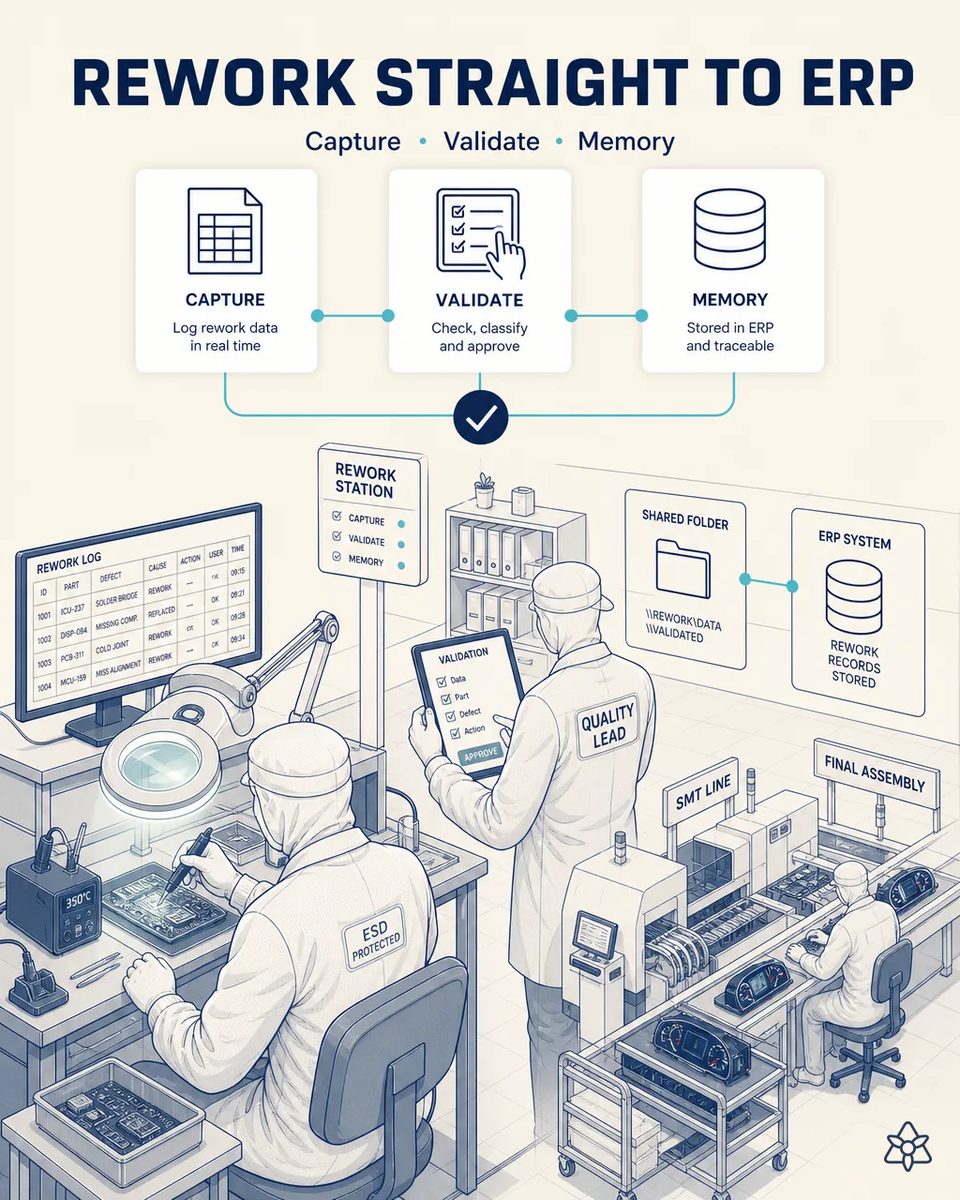
The best defect data in the plant lives in a spreadsheet outside the ERP.
The rework area keeps its log in a shared Excel file: which serial number came in, which defect it had, which component was replaced and whether it passed retest. It is the best source for defect analysis. But it lives outside the ERP and the MES. Someone copies it by hand into the quality module every week, days late and with errors. Paretos and 8Ds are built on incomplete data.
- The rework area keeps its log in a shared Excel file: serial number, defect, component replaced and retest result for every cluster or display board that comes back from test.
- It is the best source for defect analysis in the plant, but it lives outside the ERP and the MES, in a format only the rework team fully understands.
- Someone copies it by hand into the quality module every week, days late and with errors, using a license bought only for that.
- So Paretos and 8D reports are built on incomplete data, and the solder bridge that repeats on one board program is seen weeks after it started, when several lots have already been built and shipped with the same issue.
Connect watching the rework folder — the file is read on save, the technician works as before.
iLEAN Connect observes the shared folder, not the people: when the file is saved, it reads the new rows, interprets them and prepares the ERP record. The quality lead sees the summary and confirms with one tap; iLEAN posts it to the ERP through the API. The technician keeps working exactly as before. It fits the IRIS architecture as the Connect piece of the iLEAN system.
The rework technician keeps their spreadsheet and their soldering station. What disappears is the weekly copy and the license used only for it: the quality lead confirms each record and iLEAN posts it to the ERP through the API, the same day the board was repaired. For the first time, the rework bench becomes the early-warning system it always could have been.
The rework spreadsheet today versus the spreadsheet posted by iLEAN
| Aspect | Today | With iLEAN Connect |
|---|---|---|
| Delay from rework to ERP | Days, copied weekly | Second zero after confirmation |
| Weekly transcription hours | Several, every week | Zero |
| Replaced component per serial | In Excel only | In the ERP quality module |
| Defect Pareto for an 8D | Built on partial data | Built on every rework record |
| ERP quality licenses | One per person who types | One, the lead who validates |
| Technician's spreadsheet | Theirs | Still theirs, unchanged |
Today every technician or inspector who logs into the ERP only to record rework uses a license. With Connect only the validating owner needs one: from N licenses down to one, a typical fifty to eighty percent cut in the quality module.
Impact estimate — to be validated with your numbers.
The block below is an estimate to be validated against your plant's actual data. We put it forward so the committee has an order of magnitude; we refine it during the assessment.
- Estimated payback 4-9 months.
- 50-80% fewer ERP quality-module licenses: from one per technician or inspector who logs in only to record rework, down to the one owner who validates. Recurring every year.
- Lag between rework and ERP drops from days to second zero, and weekly transcription hours to zero, freeing quality time for actual analysis of the defects.
- And 8Ds and defect Paretos start from every reworked serial number, not from the part someone had time to copy before the weekly review. An estimate to be validated with your ERP invoice and rework volume.
Payback 4-9 months · −50-80% ERP quality-module licenses. Days of lag down to second zero, weekly hours of transcription down to zero, plus recurring license savings. Estimated payback of four to nine months. An estimate to be validated.
And the fair question from the production manager
“Our rework sheet has free-text defect descriptions and merged cells — can it really parse that?” — interpreting rows with serial, defect, replaced component and retest result is an anchored task, where the best models drop below 1.5% error [1]. It does not depend on fixed column positions, and the quality lead confirms each record before it is posted to the ERP.
[1] OpenAI paper "Why Language Models Hallucinate", 2025 — on the reliability of AI in anchored tasks.
What people ask about moving rework records into the ERP
Do rework technicians have to change their Excel template?
No. iLEAN reads the file as it is today, including free-text defect descriptions and local abbreviations. Asking rework to change its sheet is the quickest way to lose the data altogether. If the sheet changes over time, iLEAN adapts to the new columns.
Does it monitor the rework bench or only the shared file?
Only the file. It reacts when the shared spreadsheet is saved and reads the new or changed rows. Nobody at the rework bench is observed, timed or asked to do anything differently. The technician only notices that nobody asks for the weekly copy anymore.
How is a reworked board matched to its original production record?
Through the serial number, which is the common thread between rework, MES and ERP. The record is posted against that serial in the quality module, next to its production history. That link is what lets quality see which lot, line or program the defect came from.
How much can licenses really drop?
It depends on your ERP contract, so we frame it as an estimate to validate against your invoice. The logic: anyone who logs in only to type rework stops needing a named license. The validating owner keeps theirs; the rest of the team keeps their spreadsheet.
Can it flag a defect that repeats on one board program?
Yes. With every record in the system, the same defect on the same component and program shows up as a trend within days, instead of at the weekly review or in the next customer complaint. The process engineer can act on the paste, the stencil or the placement program while the lot is still in the plant.
More cases from this series
- The customer audit stops being a reconstruction: evidence organized by standardEvery model changeover and first article generates evidence organized by IATF 16949 and customer…
- Changeovers with no escapes and no material stops: four coordinated ringsAI agents coordinate plan, material, prep, release and shipping in 4 rings: fast changeovers with no…
- Every AOI reject travels to the MES and rework on its own, image includedEvery AOI reject travels to the MES and rework with its image and serial number. No more triple entry,…
- The chip distributor's alert reaches the planner with a proposed fixiLEAN reads semiconductor allocation and delay alerts in second zero, matches them against the MRP and…
- The shift supervisor talks to the AI without breaking strideThe shift supervisor dictates issues while walking the lines; iLEAN structures them by line, model and…
- The hour-by-hour board stops being erased: losses by line and model in minutesOne photo of the hour-by-hour board and every SMT line's loss reasons reach the system structured. A…
Tell us how your rework log reaches the ERP and how many licenses that takes.
We work on your plant's real data, not ours. Assessment with no commitment.
Request estimated ROI within 48h ‹ See all cases of cockpit electronics See automotive