The real reflow profile, lot by lot, without touching the oven
The reflow oven on an SMT line has often been in the plant for ten or fifteen years with its original PC, kept off the network for cybersecurity. Replacing or integrating it means revalidating the process and often getting customer approval. With iLEAN Connect, an external camera in front of the screen is enough. iLEAN reads every view, structures the profile per zone and crosses it with the MES to know which panels were inside the oven at each moment. The oven's validated software is never touched.
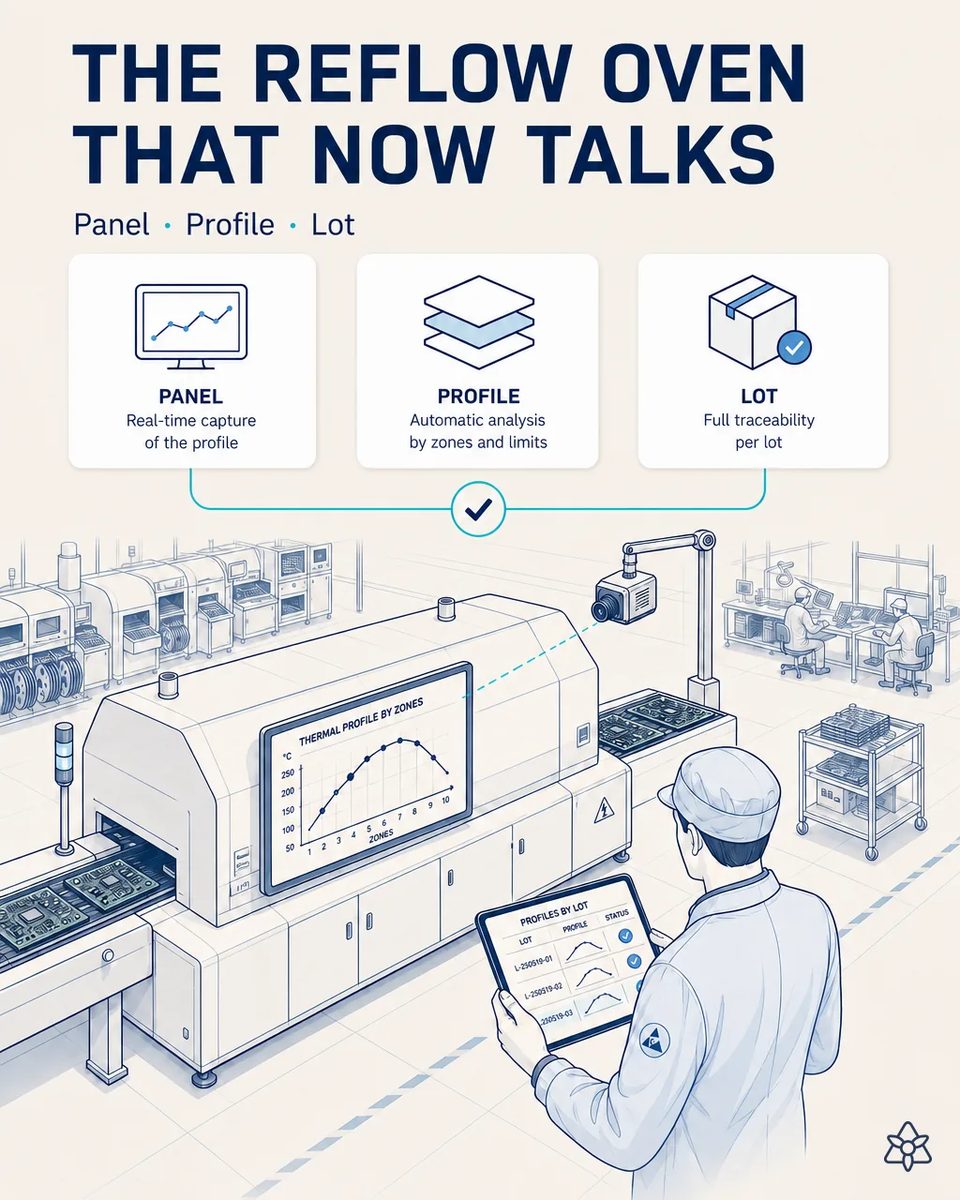
The screen shows exactly what explains a void, and nobody keeps it.
The reflow oven on an SMT line has often been in the plant for ten or fifteen years with its original PC, kept off the network for cybersecurity. Replacing or integrating it means revalidating the process and often getting customer approval. Its screen shows the thermal profile per zone, conveyor speed, nitrogen and alarms: exactly what explains a void, a bridge or a tombstone. But that data is not stored, and when the defect shows up nobody can correlate it.
- The reflow oven on many SMT lines has been in the plant ten or fifteen years with its original PC, kept off the network for cybersecurity and by decision of the oven maker.
- Replacing or integrating it means revalidating the process and, in automotive, often going back to the customer for approval of the change.
- Its screen shows zone temperatures, conveyor speed, nitrogen level and alarms: the variables behind a void, a bridge or a tombstone on a cluster or controller board.
- None of it is stored. When the defect appears at AOI, X-ray or functional test, the process engineer cannot say what the oven was doing when that panel passed through the tunnel. The root-cause analysis turns into days of guessing between paste, placement and profile.
Connect reading the reflow screen from outside — the oven software stays as validated.
With iLEAN Connect, an external camera in front of the screen is enough. iLEAN reads every view, structures the profile per zone and crosses it with the MES to know which panels were inside the oven at each moment. The oven's validated software is never touched. The process engineer checks the real profile of any lot and decides the adjustments. The AI reads and organizes; the technical decision stays human. It fits the IRIS architecture as the Connect piece of the iLEAN system.
The camera looks at the screen, not inside the machine: no driver, no port, no change to the qualified recipe. That is what lets a quality department say yes to digitizing the oven without opening a revalidation file or a customer change request. And the profile history it builds is exactly what an 8D on a solder defect asks for and today cannot be produced.
The silent reflow oven versus the oven read per lot
| Aspect | Today | With iLEAN Connect |
|---|---|---|
| Zone profile per lot | Visible only on the screen | Stored and linked to the PCB lot |
| Nitrogen and conveyor speed | Not recorded | Read on every view |
| Void or tombstone root cause | Days of guessing | Minutes with the real profile |
| Oven software | Validated and isolated | Untouched, still isolated |
| Which panels were inside | Reconstructed by hand | Crossed with the MES timestamps |
| Budget for a new reflow oven | Pushed by lack of data | Avoided |
Before: an invisible thermal profile and root-cause analysis that takes days. After: the real profile per lot in central memory and analysis in minutes, with no process revalidation.
Impact estimate — to be validated with your numbers.
The block below is an estimate to be validated against your plant's actual data. We put it forward so the committee has an order of magnitude; we refine it during the assessment.
- Estimated payback 4-9 months, an estimate to be validated with your solder-defect history.
- An estimated 20-40% less time analyzing solder defects, because the profile of the suspect lot is one query away instead of a reconstruction.
- Replacement CAPEX avoided: the oven keeps running with its validated software and becomes traceable lot by lot.
- And no process revalidation or customer approval to request, since nothing on the oven, its recipe or its network isolation changes. The quality department keeps its validation file closed.
Payback 4-9 months · −20-40% solder-defect analysis time. An estimated twenty to forty percent less time analyzing solder defects, and replacement CAPEX avoided. Payback of four to nine months. An estimate to be validated.
And the fair question from the production manager
“A camera reading digits off an old oven screen — is that good enough for a customer 8D?” — the screen layout is fixed and every value has an expected physical range, so this is an anchored task, where the best models drop below 1.5% error [1]. A reading outside the possible range for a zone is discarded, not stored, and the process engineer always decides on the profile adjustment.
[1] OpenAI paper "Why Language Models Hallucinate", 2025 — on the reliability of AI in anchored tasks.
What people ask about reading the reflow oven screen
Does the reflow recipe or oven qualification change?
No. Nothing is installed on the oven PC and no cable is connected to it. The camera is mounted outside, so the qualified process and the customer approval stay exactly as they are today. Cybersecurity is not affected either, because the oven PC stays off the network.
Can it link the profile to a specific PCB panel?
Yes, by crossing the reading timestamps with the MES record of when each panel entered and left the oven. That gives the profile each lot actually saw, not the nominal recipe. When a lot fails at AOI or X-ray, that profile is the first thing the process engineer opens.
What if the screen cycles through several views?
iLEAN recognizes each view, such as zone temperatures, conveyor or alarms, and stores it in its own field. The camera simply reads whatever is shown at each moment, without anyone changing the display. Alarms are stored with their time, so a nitrogen drop can be tied to the panels inside.
Does it help with voids under BGA or QFN parts?
It gives the process data that X-ray alone cannot: the real soak and peak per zone for that lot. The engineer then correlates both and decides the profile adjustment with evidence. Over months, the history shows which zone drifts before voids start to rise.
Is this only for reflow, or for other old machines on the line?
The same approach works on wave or selective soldering, conformal coating or curing ovens. The reflow oven is usually first because it explains most solder defects on cockpit boards. Each new machine reuses the same camera mount and central memory.
More cases from this series
- The customer audit stops being a reconstruction: evidence organized by standardEvery model changeover and first article generates evidence organized by IATF 16949 and customer…
- Changeovers with no escapes and no material stops: four coordinated ringsAI agents coordinate plan, material, prep, release and shipping in 4 rings: fast changeovers with no…
- Every AOI reject travels to the MES and rework on its own, image includedEvery AOI reject travels to the MES and rework with its image and serial number. No more triple entry,…
- The chip distributor's alert reaches the planner with a proposed fixiLEAN reads semiconductor allocation and delay alerts in second zero, matches them against the MRP and…
- The shift supervisor talks to the AI without breaking strideThe shift supervisor dictates issues while walking the lines; iLEAN structures them by line, model and…
- The hour-by-hour board stops being erased: losses by line and model in minutesOne photo of the hour-by-hour board and every SMT line's loss reasons reach the system structured. A…
Tell us how old your reflow ovens are and how you trace solder defects today.
We work on your plant's real data, not ours. Assessment with no commitment.
Request estimated ROI within 48h ‹ See all cases of cockpit electronics See automotive