The audit dossier that builds itself
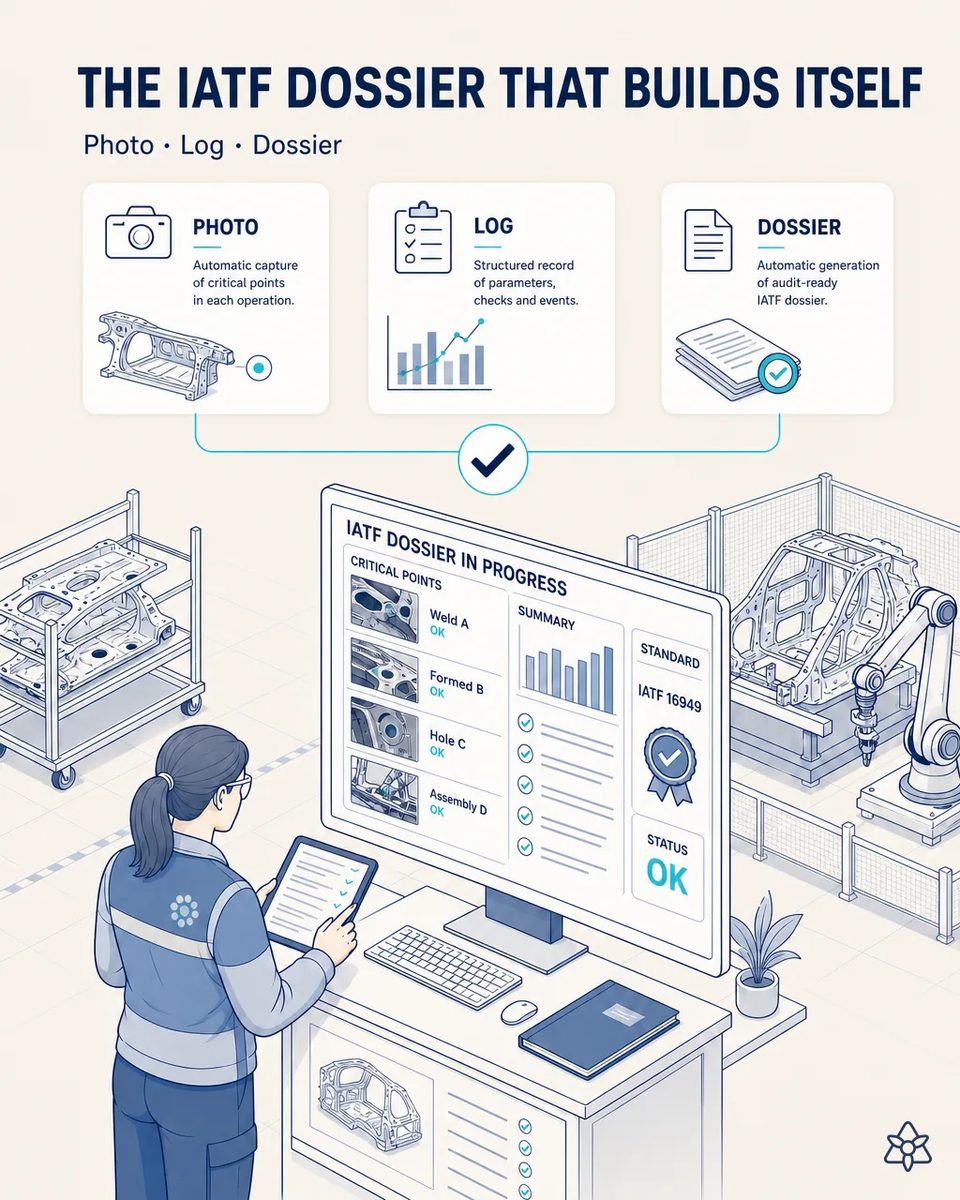
Ahead of an IATF 16949 audit or a PPAP review, someone spends weeks rebuilding traceability. With iLEAN Edge + Agents, every critical change automatically generates its auditable dossier, organized by standard.
The cost of the audit is not the audit.
Audits demand evidence that's rebuilt manually today, risking nonconformity from incomplete documentation — on the very standard that keeps you a homologated supplier.
- The evidence exists, but it is scattered across paper, spreadsheets, the MES and people's memory. That is the honest diagnosis of almost any certified structural parts plant.
- The cost is the weeks of rebuilding beforehand, repeated for every customer with audit rights, on top of the certification body's own visit.
- A nonconformity from incomplete documentation is the cheapest kind to avoid and the most expensive kind to receive: it lands on the very standard that keeps you a homologated supplier.
- And in the worst case — a field investigation on a crash-relevant part — the clock runs against you from the first minute, with the customer waiting for a traceability answer that today has to be assembled from four different places while the line keeps running.
Edge captures at the moment; Agents organizes it by certifying standard.
Edge captures photo + parameters for every critical change; Agents organizes the dossier by certifying standard and makes it downloadable from the web for the auditor.
Every critical change leaves its dossier closed at the moment it happens, with the photo and the parameters that were true at that minute. Anything rebuilt afterwards inherits the gaps of whatever nobody wrote down — and it is precisely in that assembly, weeks later and against the clock, that the documentation nonconformities appear.
Today's preparation versus the permanent dossier
| Aspect | Today | With iLEAN |
|---|---|---|
| Preparing for an audit | Weeks of rebuilding | Hours of review |
| For each OEM with audit rights | Repeated in full | The same evidence, another view |
| Where the evidence lives | Paper, spreadsheets, MES, memory | One downloadable package |
| Documentation nonconformity | Found during the audit | Detected when the gap occurs |
| PPAP submission | Assembled by hand | Indexed as it is generated |
| Field investigation | The clock against you | The dossier already exists |
From weeks of pre-audit rebuilding to zero. Documentation nonconformity risk eliminated.
Impact estimate — to be validated with your numbers.
The block below is an estimate to be validated against your plant's actual data. We put it forward so the committee has an order of magnitude; we refine it during the assessment.
- Estimated payback 6-12 months, counting only the preparation time recovered.
- From weeks of pre-audit rebuilding down to zero, and that saving repeats for the certification body and for every customer with audit rights.
- Documentation nonconformity risk eliminated, which is what protects Tier 1 supplier homologation.
- And in a field investigation on a structural part the dossier already exists and can be filtered in minutes, instead of being built from four different places with the clock running and the customer waiting.
Estimated payback 6-12 months; protects Tier 1 supplier homologation. Estimate to validate.
And the fair question from the production manager
“Isn't this just another document manager?” — the difference is direction. A document manager stores what somebody decides to upload afterwards, and inherits the same gaps. Here the dossier closes the instant the critical change happens, and Agents reorganizes it for whichever standard asks: IATF 16949, a PPAP submission or a specific OEM's scheme. Indexing an evidence item against a clause of a known standard is an anchored task, where the best models drop below 1.5% error [1], and the quality manager reviews the package before any auditor sees it.
[1] OpenAI paper "Why Language Models Hallucinate", 2025 — on the reliability of AI in anchored tasks.
What people ask about the evidence pack
Does it serve the certification body and the customers at once?
Yes, and that is the point. The evidence is the same; what changes is the scheme it is indexed against. That reindexing is exactly the work repeated in full for every auditor today, by the same handful of people, several times a year.
What counts as a critical change?
A die change, a welding program change, a coil change mid-batch, a tooling intervention or a process parameter adjustment. The list is agreed with your quality team and matches what the control plan already declares as significant.
Does it warn when evidence is missing?
Yes, and it is the function with the most value: it flags that a critical event generated no evidence when it should have, in the days after it happened, rather than leaving the gap to surface on the auditor's day with nothing left to do about it.
Does the auditor get access to our systems?
No. They open a view scoped to the period and the scope of their audit, filter and download what they need. Nothing else in the plant is reachable from there, and every access is itself recorded.
What about the history from before deployment?
It stays where it is, in the folders and cabinets it lives in today. The dossier builds from day one forward, and bringing in older history is optional and decided case by case, usually only for the part numbers still in production.
More cases from this series
- Zero nonconformity on structural partsFour coordinated rings — ERP, robot, Edge and evidence pack — stop the line before an out-of-spec part…
- Batch startup without paperPhotograph the work order and the dimension sheet at startup: the batch exists in the system at zero…
- The coil delivery note that enters itselfPhotograph the delivery note and the heat-number label: iLEAN extracts the data and pushes it to the ERP…
- The delay alert that arrives in timeiLEAN reads the coil supplier's email at zero latency and cross-checks active work orders before the…
- The connected welding robotConnect stitches the robotic welding cell to the ERP via API: the correct program travels automatically,…
- Hands-free voice on the lineWith a headset and Connect's voice mode, the line supervisor logs incidents while walking between…
Tell us how many customers have the right to audit you and what each visit costs.
We work on your plant's real data, not ours. Assessment with no commitment.
Request estimated ROI within 48h ‹ See all cases of body structural assembly See automotive