The die change that validates itself
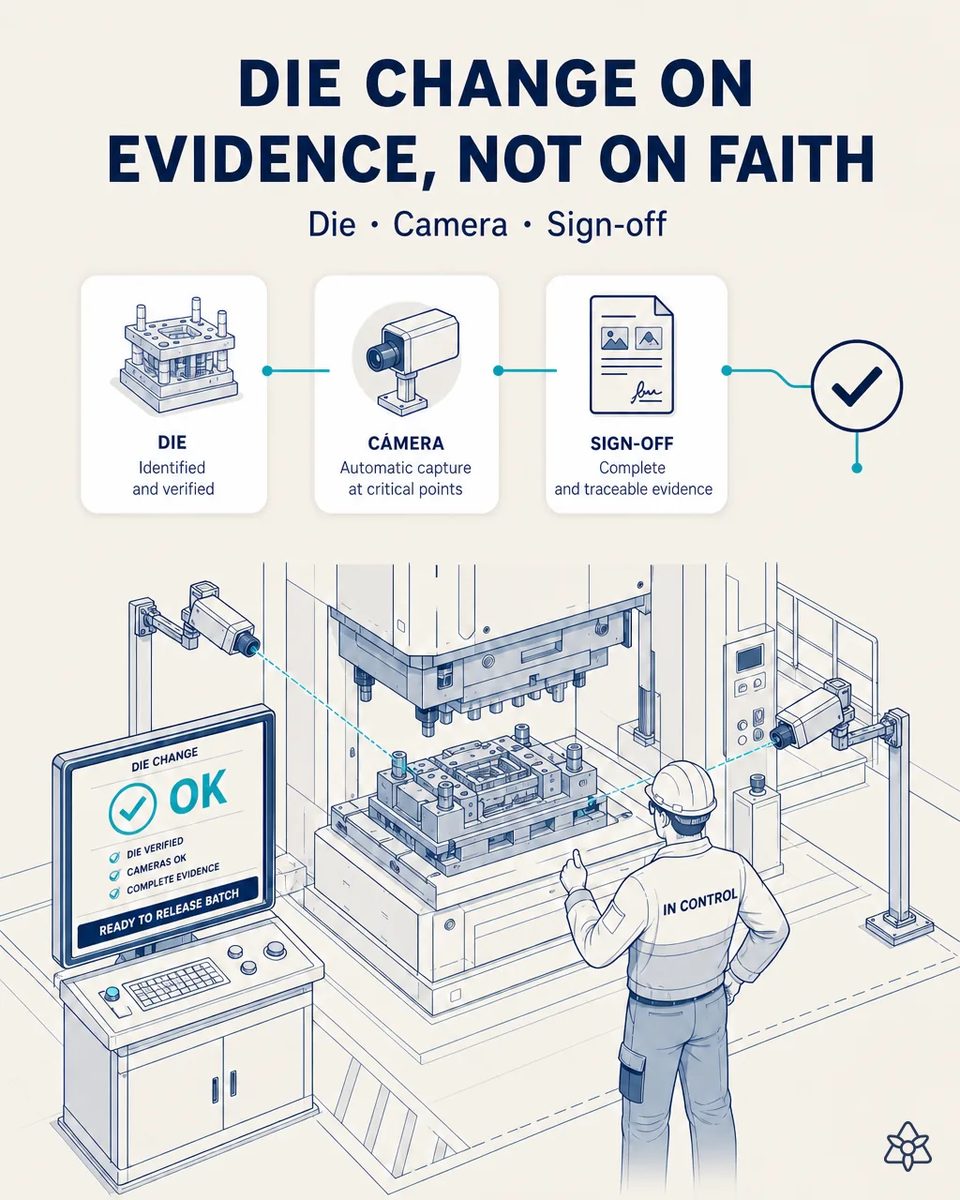
Every part-number change requires mounting the correct die and validating the first piece before releasing the batch. With iLEAN Edge, fixed cameras at critical points compare the real setup with the reference, and JIDOKA AI blocks release if something's off.
The checklist is well designed. What fails is how it gets signed.
The 'it's set up right, go ahead' responsibility rests on a human sign-off with no visual evidence, and a wrong setup can mean a whole out-of-spec batch.
- Every part-number change means mounting the correct die, setting it, and validating the first piece before the batch is released.
- If the press starts with the previous revision's die insert, with a shim that was not refitted or with a sensor left bypassed from the last intervention, the whole batch is born out of spec.
- The checklist exists and is well designed. What fails is when and how it is signed: under pressure, because the changeover sits on the shift's critical path, and with no objective evidence behind the box.
- When something goes wrong afterwards, the investigation runs into a ticked box and no proof. It is not bad faith and nobody in the plant thinks it is: a signature is simply not a measurement, and a setter under pressure signs what they are confident about rather than what they verified point by point.
Edge with JIDOKA AI — the batch is not released without conformity and a sign-off.
Edge + JIDOKA AI: cameras with CNNs trained to recognize the correct die/tooling and validate first-piece geometry. Batch release is blocked until OK + sign-off.
The camera does not decide alone: it checks each critical point against its reference image and the supervisor signs on that evidence. What changes is not who decides, but what they decide on — and what remains on file afterwards, which is a set of images of the actual setup instead of a name and a date next to a tick.
Today's changeover versus the validated changeover
| Aspect | Today | With iLEAN Edge |
|---|---|---|
| Signing the setup checklist | A ticked box | Reference images checked point by point |
| Wrong or obsolete die insert | Found after the batch | Detected before release |
| First-piece geometry | Signed off by eye | Validated against the reference |
| Batch release | On the setter's word | Blocked until OK plus sign-off |
| The investigation afterwards | A ticked box and no proof | The evidence of every critical point |
| More changeovers per week | More accumulated exposure | The same verification every time |
From blind sign-off with mis-setup risk to sign-off based on visual evidence at every critical point.
Impact estimate — to be validated with your numbers.
The block below is an estimate to be validated against your plant's actual data. We put it forward so the committee has an order of magnitude; we refine it during the assessment.
- Estimated payback tied to your changeover frequency, not to a fixed figure: the brief deliberately leaves it open because it depends on how many die changes you run.
- What it protects against is concrete: a whole batch of out-of-spec structural parts from a setup nobody could verify.
- Start by counting the die changes per month and the cost of the last batch that had to be sorted.
- And the blind sign-off becomes a sign-off on visual evidence at every critical point.
Payback depends on changeover frequency; protects against whole out-of-spec batches. Estimate to validate.
And the fair question from the production manager
“What if the camera blocks the press for no reason?” — that is the right objection, because the changeover sits on the shift's critical path. Conformity is checked against the reference state for that specific die and, in case of doubt, the system does not block silently: it escalates to the supervisor, who signs on the evidence. Recognizing a die against its own reference image is an anchored task, where the best models drop below 1.5% error [1], and even then the system stops on a verifiable discrepancy, never on model uncertainty.
[1] OpenAI paper "Why Language Models Hallucinate", 2025 — on the reliability of AI in anchored tasks.
What people ask about validating the die change
What exactly gets checked?
The die identity and revision, the inserts and shims, the sensors and guards in their correct state, and the first-piece geometry. The points are defined at commissioning with your tooling team, from the setup errors you have actually had, not from a generic list.
Does it make the changeover longer?
The check takes seconds. What lengthens a changeover today is the margin people add for lack of evidence, and the changeover sits squarely on the shift's critical path, which is why that margin is expensive.
Can it be skipped when we are behind?
An exception can be defined with a supervisor sign-off, and it is recorded as an exception. What cannot happen is releasing a batch with no trace of who decided to skip the check.
Does it work with an obsolete die revision?
That is the most expensive failure and the one that most justifies the case: the die identity and revision are compared against what the active work order requires, so a batch formed with the previous revision stops being possible by construction.
Is the first piece still measured on the CMM?
Yes. Edge validates the setup and the first-piece geometry against the reference at the press, in seconds; the dimensional check on the measuring machine stays exactly as your control plan defines it. One does not replace the other, it removes the wait before it.
More cases from this series
- Zero nonconformity on structural partsFour coordinated rings — ERP, robot, Edge and evidence pack — stop the line before an out-of-spec part…
- Batch startup without paperPhotograph the work order and the dimension sheet at startup: the batch exists in the system at zero…
- The coil delivery note that enters itselfPhotograph the delivery note and the heat-number label: iLEAN extracts the data and pushes it to the ERP…
- The delay alert that arrives in timeiLEAN reads the coil supplier's email at zero latency and cross-checks active work orders before the…
- The connected welding robotConnect stitches the robotic welding cell to the ERP via API: the correct program travels automatically,…
- Hands-free voice on the lineWith a headset and Connect's voice mode, the line supervisor logs incidents while walking between…
Tell us how many die changes you run in a month.
We work on your plant's real data, not ours. Assessment with no commitment.
Request estimated ROI within 48h ‹ See all cases of body structural assembly See automotive