The vintage press that now talks
The plant's oldest hot-forming press has a proprietary panel, lives off-network, and shows vital data nobody correlates today. With iLEAN Connect, an external camera pointed at the panel digitizes the process curve without touching the original PLC.
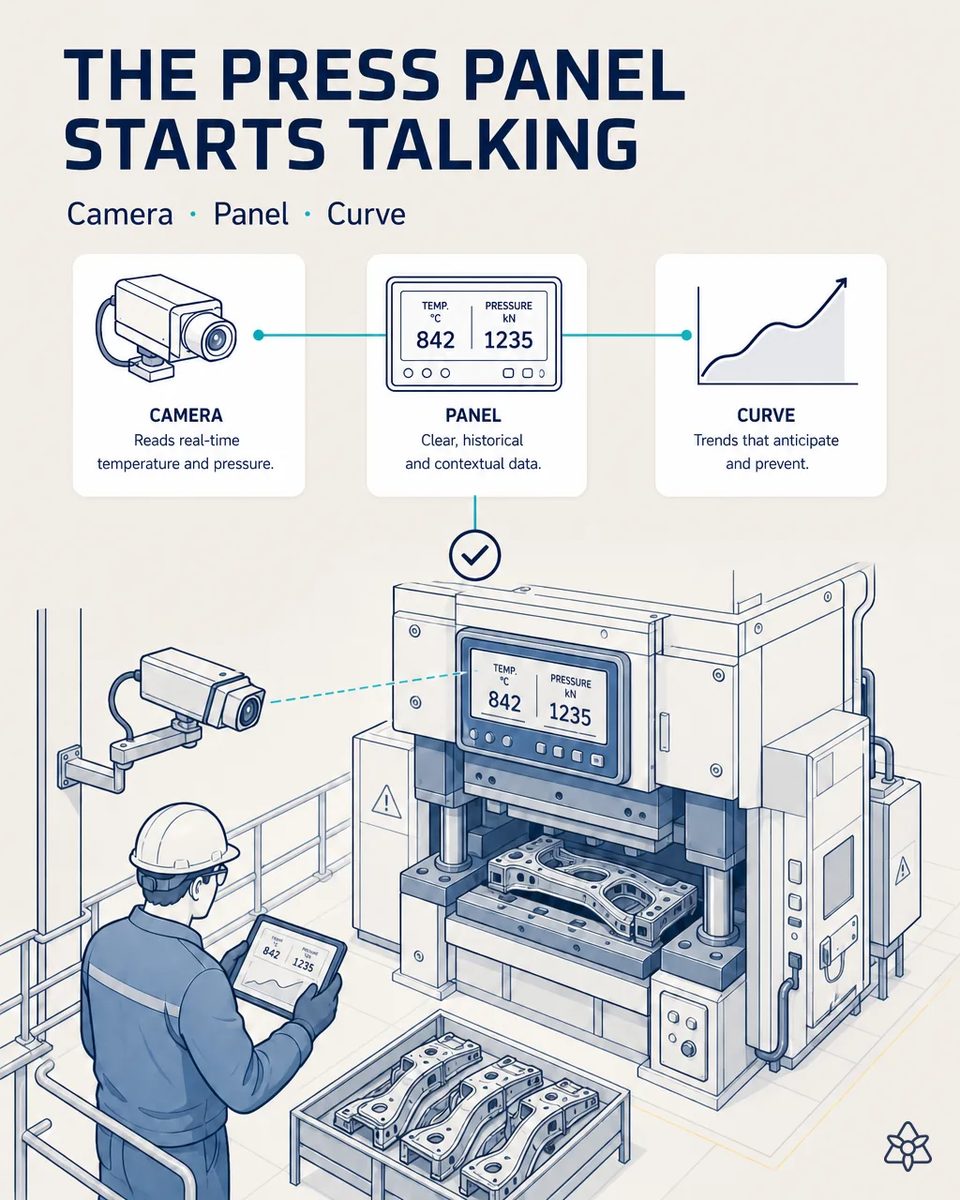
The line's most critical asset leaves no trace of how it ran.
This machine is the line's critical asset. Its panel shows temperature, pressure and cycle data that would be gold for correlating process with dimensional nonconformity, but the data dies every cycle when the screen rotates.
- The oldest hot forming press is the line's critical asset: what comes out of it conditions every welding cell downstream and every dimension the customer measures.
- Its panel shows furnace temperature, forming force and cycle time in real time, and the manufacturer left it off the network with a proprietary control nobody will touch.
- That data dies every cycle, the moment the screen rotates to the next part.
- So the question that always comes up in an 8D cannot be answered: do this week's out-of-tolerance parts concentrate in one temperature band, one coil, one shift or one press stroke rate? Nobody knows, because the only record of how the press ran is what somebody remembers and what the shift report happened to capture in a single line.
Connect in photo mode on the panel — solved from outside, not inside.
Connect photo mode over the panel: a fixed industrial camera plus OCR with a grounded LLM reads each frame, structures the process curve per part and cross-references it with the active ERP work order.
It does not integrate with the press control, does not touch its safety logic and opens no ports. Nothing is installed on the machine and nothing changes in how the setter operates it; the camera simply reads the screen a human could read, cycle after cycle, without getting tired or looking away. On a machine this critical, that is the difference between a case maintenance approves in a week and a project that never leaves the meeting room.
Today's press versus the press being read
| Aspect | Today | With iLEAN Connect |
|---|---|---|
| The forming curve | Visible and volatile | Digitized part by part |
| Process to dimension correlation | Impossible | Root cause in minutes |
| What survives an out-of-tolerance part | A note on the shift report | Temperature, force, cycle and coil |
| The original PLC | — | Untouched, not revalidated |
| Replacement CAPEX of EUR300-500K | In the investment plan | Deferrable indefinitely |
| Drift before scrap appears | Detected when parts fail | Visible as a trend |
From zero process-defect correlation to root-cause analysis per part in minutes. Machine replacement becomes postponable indefinitely.
Impact estimate — to be validated with your numbers.
The block below is an estimate to be validated against your plant's actual data. We put it forward so the committee has an order of magnitude; we refine it during the assessment.
- Estimated payback 5-10 months.
- Avoided replacement CAPEX above EUR300-500K for a press that stops being the reason to invest.
- From zero process-to-defect correlation to root-cause analysis per part in minutes.
- And drift becomes visible as a trend over days, before it turns into a batch of out-of-tolerance parts that has to be sorted piece by piece or scrapped outright.
Estimated payback 5-10 months, avoiding replacement CAPEX above EUR300-500K. Estimate to validate.
And the fair question from the production manager
“Does a camera reading a panel hold up as evidence in front of the customer?” — here the task is anchored: a fixed screen, fields in known positions and physical ranges you already know, where the best models drop below 1.5% error [1]. And the system discards any frame whose value falls outside the possible range instead of accepting it, which is exactly what would invalidate a series in an 8D.
[1] OpenAI paper "Why Language Models Hallucinate", 2025 — on the reliability of AI in anchored tasks.
What people ask about reading the press panel
Does the press have to be revalidated?
No, and that is the whole point. Nothing is installed on the machine, no port is opened and its control is not touched, so neither its validation nor its safety certification is affected. The camera is an observer bolted to a wall bracket, nothing more.
What exactly does it capture?
Whatever the panel shows: furnace temperature, forming force, cycle time and the counters. The reading is structured as a curve per part, not stored as a screenshot, which is what makes it comparable between batches and between shifts.
How is a part tied to its curve?
By crossing the timestamp with the active work order and the press cycle. That is what turns a series of readings into the manufacturing history of a specific structural part, and what lets you answer which coil and which temperature band a suspect part came from.
Is it worth it if we already plan to replace the press?
It is often what lets you not replace it. A press that produces good parts but reports nothing is usually replaced for its blindness, not for its mechanics, and that is an investment decision worth revisiting once the data exists.
Does the same approach work on other isolated machines?
Yes, the pattern is identical for any panel that displays and forgets: blanking lines, furnaces, presses of any generation. You start with the hot forming press because that is where the dimensions of the whole structure are decided.
More cases from this series
- Zero nonconformity on structural partsFour coordinated rings — ERP, robot, Edge and evidence pack — stop the line before an out-of-spec part…
- Batch startup without paperPhotograph the work order and the dimension sheet at startup: the batch exists in the system at zero…
- The coil delivery note that enters itselfPhotograph the delivery note and the heat-number label: iLEAN extracts the data and pushes it to the ERP…
- The delay alert that arrives in timeiLEAN reads the coil supplier's email at zero latency and cross-checks active work orders before the…
- The connected welding robotConnect stitches the robotic welding cell to the ERP via API: the correct program travels automatically,…
- Hands-free voice on the lineWith a headset and Connect's voice mode, the line supervisor logs incidents while walking between…
Tell us whether you can tie an out-of-tolerance part to its forming curve today.
We work on your plant's real data, not ours. Assessment with no commitment.
Request estimated ROI within 48h ‹ See all cases of body structural assembly See automotive