Metrology connected to the ERP
The quality manager fills in a spreadsheet every shift with dimensions measured on the CMM that the ERP never sees. With iLEAN Connect, the spreadsheet is absorbed in real time and, after validation, automatically pushed to the ERP.
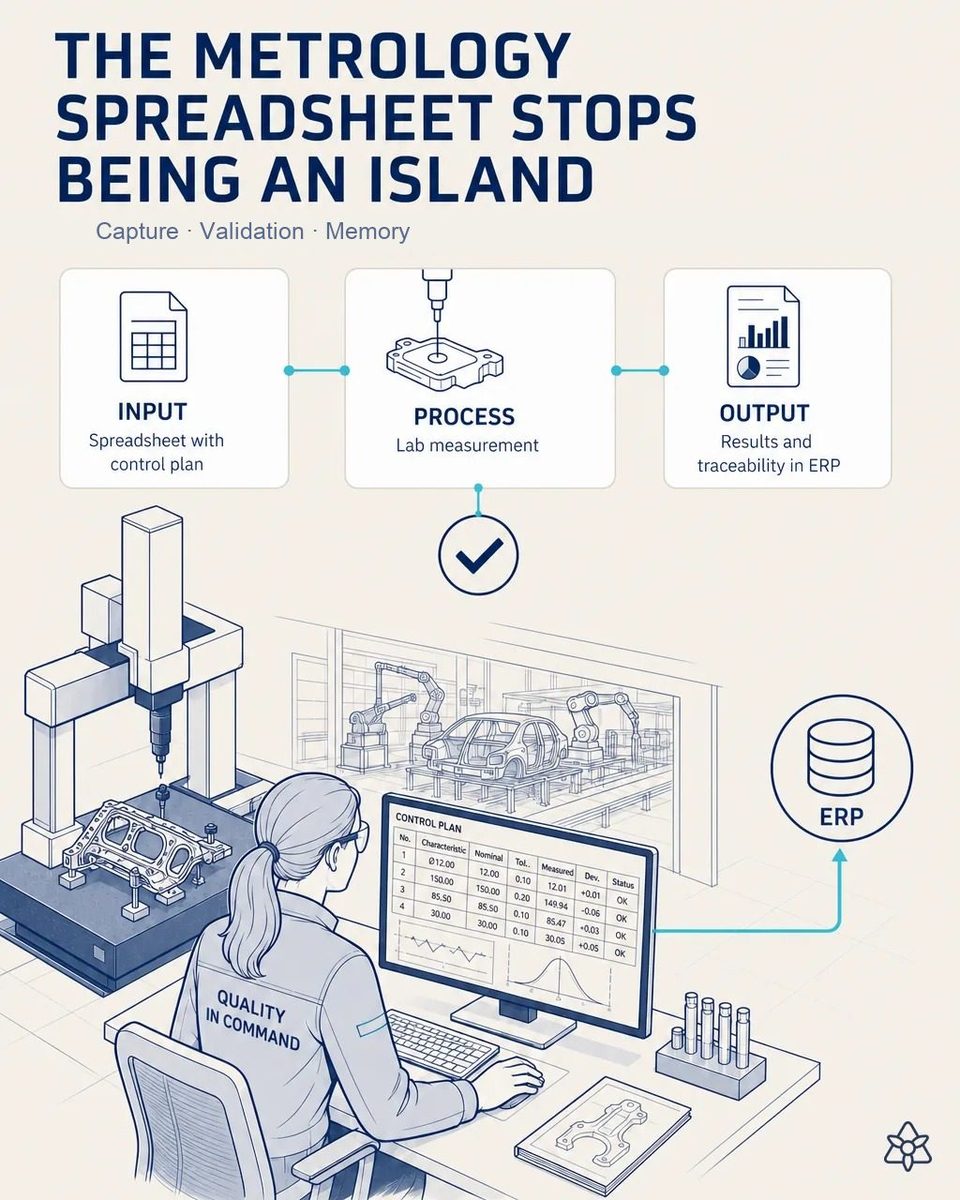
Two parallel worlds, and a technician copying cells between them.
Two parallel worlds: the real spreadsheet with live data, and the official ERP with data transcribed weeks late by someone spending hours a month copy-pasting.
- The spreadsheet holds the live data: the dimensions measured on the coordinate measuring machine, the control plan characteristics, the deviations per batch and the capability history the OEM asks for at every review.
- The official ERP holds a transcribed, incomplete and out-of-date version. The practical gap runs to weeks, and everybody on the floor knows which of the two to trust.
- Transcription errors surface at the worst possible moment: preparing a PPAP submission or answering a claim on a structural dimension.
- And hours a month of an expensive metrology technician go into copy and paste instead of into measuring, which is the one thing only they can do. It is also the least defensible line in the department's budget, because everybody already knows the transcription adds nothing except a second chance to make a mistake.
Connect listens inward — to the file, not to the person.
Connect listens inward: it watches the shared folder, reads the delta when the file is saved, parses it with a grounded LLM, validates on screen and pushes to the ERP via API.
The capability indices the customer asks for at each review stop being rebuilt: they are in the system, up to date, on the day they are asked for. That turns an afternoon's work into a query, and it removes the quiet risk of presenting an OEM with figures that were transcribed by hand from a sheet somebody had already corrected.
Today's metrology lab versus the connected lab
| Aspect | Today | With iLEAN Connect |
|---|---|---|
| Gap between real data and ERP | Weeks | Second zero |
| Manual transcription | Hours a month, minimum | Zero |
| Capability for an OEM review | Rebuilt by hand | Ready in the system |
| Copy-paste errors | Surface during a PPAP | Eliminated |
| Spreadsheet format | Has to be respected | Tolerated as it is, even as it changes |
| Quality and lab ERP licenses | Several named users | One, the supervisor who validates |
From weeks of lag to zero. From hours a month transcribing to zero.
Impact estimate — to be validated against your actual invoice.
The block below is an estimate to be validated against your plant's actual data. We put it forward so the committee has an order of magnitude; we refine it during the assessment.
- 💰 CFO angle: the ERP bills per named user. If several metrology and quality people log in purely to enter results, those are licenses you stop paying: a typical 50-80% reduction, recurring every year.
- Estimated payback 4-9 months.
- Hours a month of an expensive technician recovered, and given back to measuring.
- And from a gap of weeks between the dimension measured on the machine and the figure the ERP shows, down to second zero, with both worlds finally saying the same thing.
CFO angle: typical 50-80% reduction in quality/lab-module ERP licenses. Estimated payback 4-9 months. Estimate to validate.
And the fair question from the production manager
“Several people have been editing that sheet for years — does it really hold up?” — that is the anticipated case. Parsing does not depend on fixed cell positions: it interprets columns, units, merged cells and margin notes without asking the lab to standardize anything. It is an anchored task, where the best models drop below 1.5% error [1], and the quality supervisor validates before the push.
[1] OpenAI paper "Why Language Models Hallucinate", 2025 — on the reliability of AI in anchored tasks.
What people ask about connecting the metrology sheet
Do we have to standardize the spreadsheet first?
No, and it is better not to. Asking the lab to change the sheet it has used for years is the fastest way to a system nobody uses. iLEAN reads the one that exists, in the format it has today, including the columns somebody added three years ago.
Does it cover characteristics measured on a fixture rather than the CMM?
Yes. What matters is that the result gets written into the sheet; the measuring method does not change how it is read or pushed. Gauges, fixtures and the measuring machine all end up in the same history by part number.
Can the licenses really be reduced?
It depends on your contract, which is why it is framed as an estimate to validate against last year's invoice. The logic is simple: anyone logging into the ERP purely to type results stops needing a named seat, and that saving repeats every year.
Does it help with a PPAP submission?
It is one of the biggest time savers, because the dimensional results and the capability study of a submission are exactly what gets rebuilt by hand against the clock today, usually by the person who can least afford the days.
Does it watch the folder or the person?
The folder. The file is read when it is saved, the delta is parsed, and there is no record of who opens what or how long they spend in it. That distinction is what keeps the lab comfortable with the case.
More cases from this series
- Zero nonconformity on structural partsFour coordinated rings — ERP, robot, Edge and evidence pack — stop the line before an out-of-spec part…
- Batch startup without paperPhotograph the work order and the dimension sheet at startup: the batch exists in the system at zero…
- The coil delivery note that enters itselfPhotograph the delivery note and the heat-number label: iLEAN extracts the data and pushes it to the ERP…
- The delay alert that arrives in timeiLEAN reads the coil supplier's email at zero latency and cross-checks active work orders before the…
- The connected welding robotConnect stitches the robotic welding cell to the ERP via API: the correct program travels automatically,…
- Hands-free voice on the lineWith a headset and Connect's voice mode, the line supervisor logs incidents while walking between…
Tell us how many people log into the ERP purely to type metrology results.
We work on your plant's real data, not ours. Assessment with no commitment.
Request estimated ROI within 48h ‹ See all cases of body structural assembly See automotive