The fabric delivery note gets digitized with one photo
The receiving lead photographs the delivery note and each roll's labels instead of typing roll by roll into the ERP. iLEAN Connect extracts dye lot, yardage and supplier, and after one validation tap inserts it directly into the ERP.
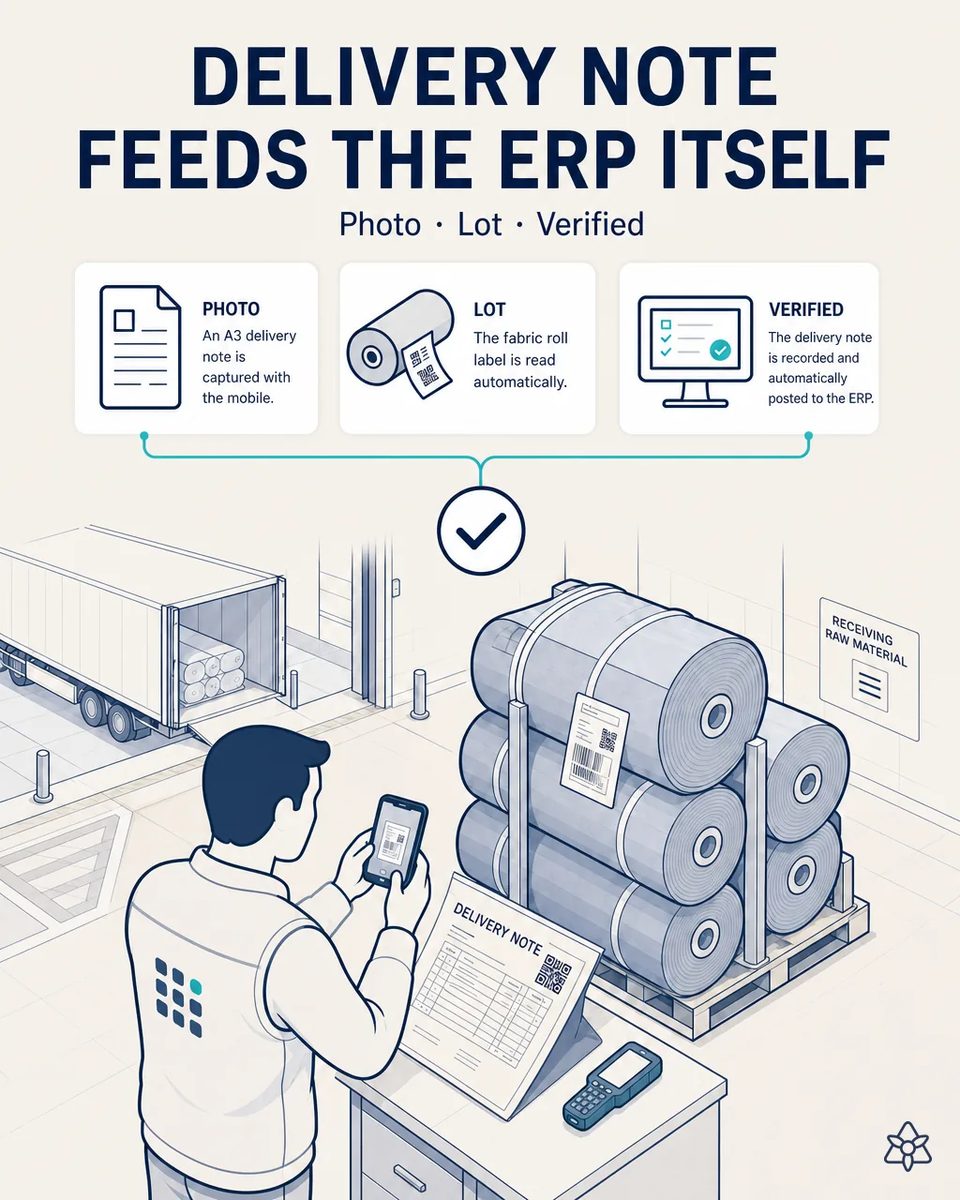
The truck waits while the dye lots are typed one roll at a time.
the truck waits, racking up demurrage, while the receiving lead types 10-20 lines into the ERP. Rushing it means dye-lot errors that surface weeks later in an untraceable color-matching problem.
- The receiving lead types 10-20 lines per delivery into the ERP: roll, yardage, supplier, dye lot. The truck waits and demurrage adds up. On a busy day, the next truck waits behind it.
- Rushing it is where the errors come from: a transposed lot number looks harmless at the dock. It is the least visible error in the plant and one of the most expensive later on.
- Weeks later it surfaces as a color-matching problem nobody can trace, because the roll's lot in the ERP is not the lot that was spread.
- And without the right lot on each roll, the chain from roll to bundle to garment breaks at its very first link. Every traceability promise made to a customer program depends on that first link.
Connect in photo-to-analog mode — the supplier's paperwork, read as it comes.
Connect photo-to-analog mode recognizes the supplier's delivery-note layout and each roll's GS1-128/QR/barcode label, with no change required from the supplier. One-tap validation on the industrial tablet.
No supplier has to change its delivery note or its labels. The receiving lead photographs what arrived, validates with one tap, and the roll enters the ERP with the lot that will later follow it into every bundle. Traceability that starts wrong at the dock cannot be repaired further down the line.
Typed receiving versus photographed receiving
| Aspect | Today, typed | With iLEAN Connect |
|---|---|---|
| Truck unload time | About 1 hour | About 10 minutes |
| Dye lot per roll | Typed, sometimes transposed | Read from the roll label |
| Hidden lot errors | Surface weeks later at color matching | Zero |
| Roll-to-bundle-to-garment traceability | Broken at receiving | Complete via photo and GS1 |
| Receiving-module licenses | One per typist | Only the validator |
| Supplier's paperwork | — | Unchanged |
1-hour truck unload → 10 minutes. Hidden dye-lot errors → zero. Roll-to-bundle-to-garment traceability → complete via photo and GS1.
Impact estimate — to be validated with your own receiving data.
The block below is an estimate to be validated against your plant's actual data. We put it forward so the committee has an order of magnitude; we refine it during the assessment.
- Estimated payback 3-8 months.
- CFO angle: typical 50-70% reduction in receiving-module licenses. Only the person who validates needs one, not everyone who used to type.
- Truck unload from about an hour to 10 minutes, and the demurrage that came with it. The dock is freed for the next truck instead of being blocked by a keyboard.
- Hidden dye-lot errors to zero, with roll-to-bundle-to-garment traceability complete.
CFO angle — typical 50-70% reduction in receiving-module licenses, estimated 3-8 month payback. *Estimate to validate*.
And the fair question from the production manager
“What if it reads the wrong dye lot off a roll label?” — reading a GS1-128 or QR label and a delivery note with a known supplier layout is an anchored task, where the best models drop below 1.5% error [1]. On top of that, the code and the printed text are cross-checked against each other and against the delivery note, and the receiving lead confirms with one tap before the ERP is touched. A roll whose lot cannot be read with confidence is never entered by default.
[1] OpenAI paper "Why Language Models Hallucinate", 2025 — on the reliability of AI in anchored tasks.
What people ask about photographing fabric receiving
Does each fabric mill need to change its delivery note?
No. Each supplier's layout is recognized as it is today; a new supplier is learned from its first deliveries. Delivery notes in other languages or with handwritten corrections are read too, and flagged when a field is unclear.
What if a roll label has no barcode?
The printed text is read instead. Where there is a GS1-128, QR or barcode, it is read too and cross-checked with the text. When the two disagree, the roll is flagged for the receiving lead instead of being entered with a guess.
Does it capture the shade as well as the lot?
Yes, when the supplier prints it. Shade and dye lot are the fields that decide which rolls can be spread together for one order. Getting them right at receiving is what makes color matching in cutting a decision rather than a gamble.
How does the roll's lot reach the garment?
The lot entered at receiving is the one carried by the cutting order and the bundle ticket, so a color complaint can be traced back to the roll. That chain is what a customer program asks for when a whole order comes back with a shade complaint.
What does the receiving lead still do?
Photograph the delivery note and the roll labels, check the summary and tap to confirm. The typing is what disappears. The physical checks of the delivery stay exactly as your receiving procedure defines them.
More cases from this series
- The audit dossier organizes itselfEvery critical changeover generates its own auditable dossier. Agents organizes it by standard.…
- The flagship system against size-color mix-upsConnect + Edge + Agents coordinated protect every shipment against mislabeled size/color mixes. Zero…
- The bundle ticket enters the system with one photoOne photo of the bundle ticket at the cutting table gets it into the central system instantly. Zero lost…
- Digitize your vintage cutter without touching the panelAn external camera reads the automatic cutter's panel without touching it. Cutting history digitized…
- The efficiency spreadsheet stops living apart from the ERPConnect absorbs the line-efficiency spreadsheet and syncs it to the ERP. Up to 80% savings on…
- The fabric supplier's alert arrives on timeiLEAN reads the fabric supplier's email instantly and cross-references active cutting orders. Zero…
Tell us how long a fabric truck waits at your dock today.
We work on your plant's real data, not ours. Assessment with no commitment.
Request estimated ROI within 48h ‹ See all cases of workwear See apparel