The flagship system against size-color mix-ups
One mislabeled shipment can destroy a customer program's trust and cost the entire contract. The iLEAN flagship system coordinates Connect, Edge and Agents in verification rings that cross-check each other before the box ever leaves the plant.
A mixed shipment is never a single mistake.
shipments with mixed-up size/color or wrong specification are this sub-sector's biggest reputational and contractual risk when serving large customer programs.
- A shipment with mixed-up size or color, or the wrong spec, is this sub-sector's biggest reputational and contractual risk when serving large customer programs.
- It rarely comes from one failure: a bundle guessed after its ticket was lost, a spec retyped at the coder, a leftover bundle after a changeover. Each one is small and each one is already covered by some control.
- Each link passes its own check, and together they put a size L in a carton labeled XL.
- On a corporate or government uniform program, one mislabeled shipment can cost the program's trust and the whole contract. And the penalty is usually written into the program agreement long before anyone reads it on the floor.
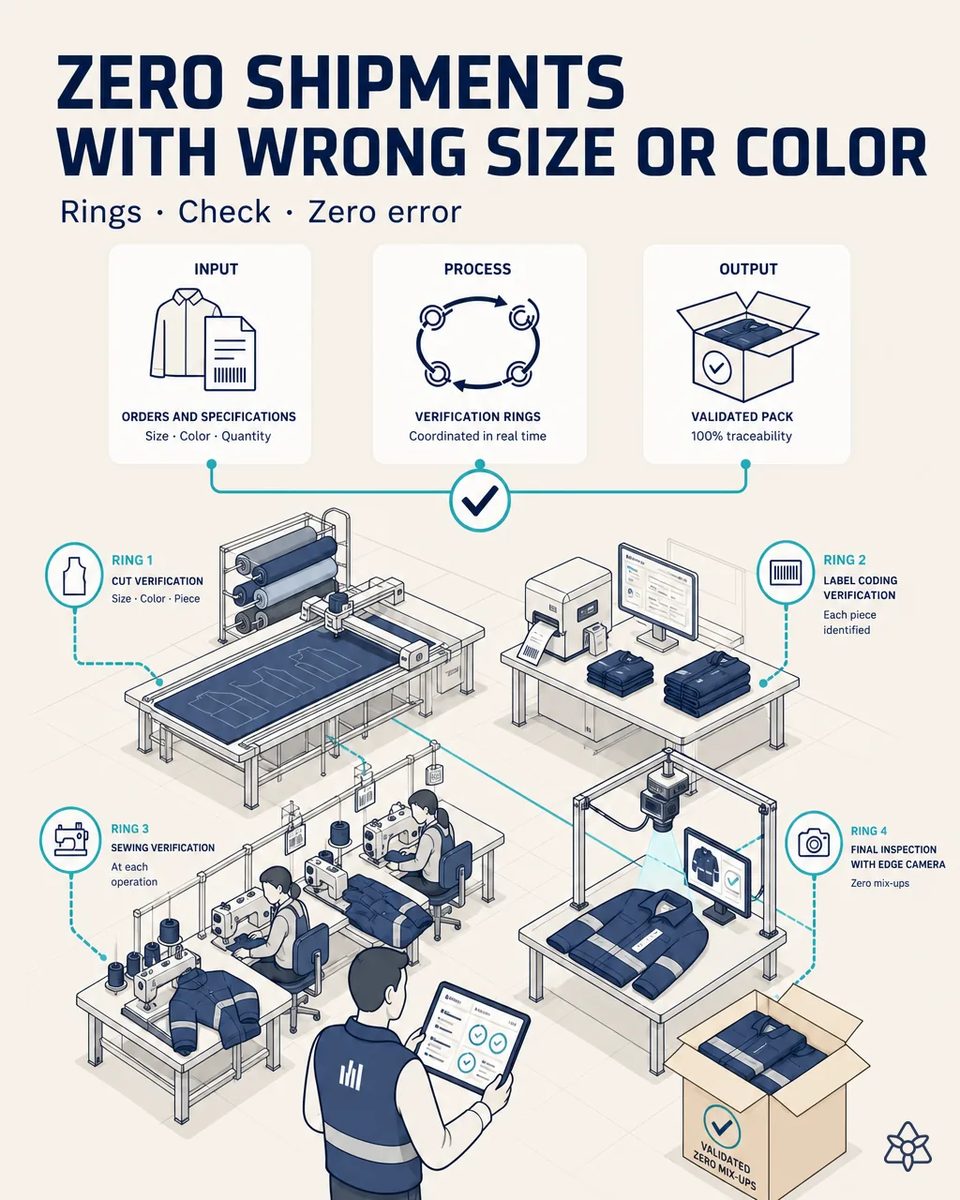
Four rings that cross-check — the cases above, orchestrated.
Ring 1 (ERP) sets the spec; Ring 2 (coder) prints with zero typing via API; Ring 3 (Edge) cross-checks the print against the plan and JIDOKA AI blocks it if it doesn't match; Ring 4 (evidence pack) rides with every box. SMED AI keeps changeover speed up.
No single ring solves it; each exists today in some form and the mix-up still escapes. Adding more inspection at the end does not fix it either. The strength is the cross-check: when the ERP, the label and the camera stop agreeing, the carton stays, and SMED AI keeps changeovers fast while it does. Each ring is a case you can deploy and pay back on its own; the flagship is what they add up to.
The four rings, and what each one closes in workwear sewing
| Ring | Which cases it draws on | What it closes |
|---|---|---|
| 1 · ERP | Bundle ticket (1) + fabric receiving (7) | The spec and the dye lot each order is built from |
| 2 · Coder | Label coder (8) | Size-color-lot labels printed with zero typing |
| 3 · Edge | Sewing defects (9) + changeover (10) | The print checked against the plan; JIDOKA AI blocks on mismatch |
| 4 · Evidence pack | Audit dossier (11) | Proof that rides with every box |
| Validation layer | Tablet validation (5) | A person behind every value in the ERP |
| Changeover speed in workwear sewing | SMED AI | Short runs without losing cadence |
incidents/year with return or program penalty risk → zero. Discrepancies caught on the line, not at the customer.
Impact estimate — to be validated with quality and plant management.
The block below is an estimate to be validated against your plant's actual data. We put it forward so the committee has an order of magnitude; we refine it during the assessment.
- Estimated payback 6-12 months, measured against the first incident avoided.
- Protection against contractual penalties and against losing an entire customer program. That is the risk that keeps a plant manager awake, not the cost of one return.
- Incidents per year with return or program-penalty risk: to zero. Each one avoided is measured against what the last one cost.
- Discrepancies caught on the line, not at the customer. And every carton leaves with the evidence of what was checked, ready if the customer ever asks.
protection against contractual penalties and losing an entire program, estimated 6-12 month payback against the first incident avoided. *Estimate to validate* with quality and plant management.
And the fair question from the production manager
“Do we have to deploy all twelve cases to get this?” — no, and planning it that way is the surest way never to start. The rings are built in layers and each case pays on its own. And JIDOKA AI stops on a verifiable discrepancy between sources — checking the printed label against the plan is an anchored comparison, where the best models drop below 1.5% error [1] — never on model uncertainty, which is escalated to a person.
[1] OpenAI paper "Why Language Models Hallucinate", 2025 — on the reliability of AI in anchored tasks.
What people ask about the zero mix-up system
Where do we start in workwear sewing?
With the case with fewest dependencies, usually the bundle ticket at cutting, plus tablet validation. Each layer has to pay on its own before the next one. That way the system grows with demonstrated value, not with a single large bet.
What does the cross-check catch that each control misses in workwear sewing?
The chain: a lost ticket guessed right on size but wrong on shade passes its own check, and only shows when the label and the camera disagree. No single control can see that; only the comparison between sources can.
What if a ring flags a false discrepancy in workwear sewing?
JIDOKA AI stops on a verifiable mismatch between sources. When the doubt is the model's, the carton goes to a person instead of being blocked silently. Every stop is logged with its reason, which is how false alarms get tuned out over time.
Does it replace our ERP in workwear sewing?
No. Ring 1 rests on the ERP being the truth for the spec; iLEAN cross-checks the floor against it. The ERP keeps its role; what changes is that the floor can no longer quietly disagree with it.
Does it slow down short runs?
That is what SMED AI is for: changeovers stay fast while every ring keeps checking, which matters most on made-to-order uniform programs. A verification that slowed every changeover would be switched off within a month, so speed is part of the design.
More cases from this series
- The audit dossier organizes itselfEvery critical changeover generates its own auditable dossier. Agents organizes it by standard.…
- The bundle ticket enters the system with one photoOne photo of the bundle ticket at the cutting table gets it into the central system instantly. Zero lost…
- Digitize your vintage cutter without touching the panelAn external camera reads the automatic cutter's panel without touching it. Cutting history digitized…
- The efficiency spreadsheet stops living apart from the ERPConnect absorbs the line-efficiency spreadsheet and syncs it to the ERP. Up to 80% savings on…
- The fabric delivery note gets digitized with one photoOne photo of the delivery note and roll labels digitizes fabric receiving. Full dye-lot-to-garment…
- The fabric supplier's alert arrives on timeiLEAN reads the fabric supplier's email instantly and cross-references active cutting orders. Zero…
Tell us what a mixed shipment would cost you on your largest customer program.
We work on your plant's real data, not ours. Assessment with no commitment.
Request estimated ROI within 48h ‹ See all cases of workwear See apparel