The fabric supplier's alert arrives on time
Mid-morning, an email arrives from the fabric supplier warning of a delay or a dye-lot change. It lands in an inbox that gets read hours later, once a spreading plan is already set. With iLEAN Connect, the system reads the email instantly, cross-references active cutting orders, and alerts with the concrete action to take.
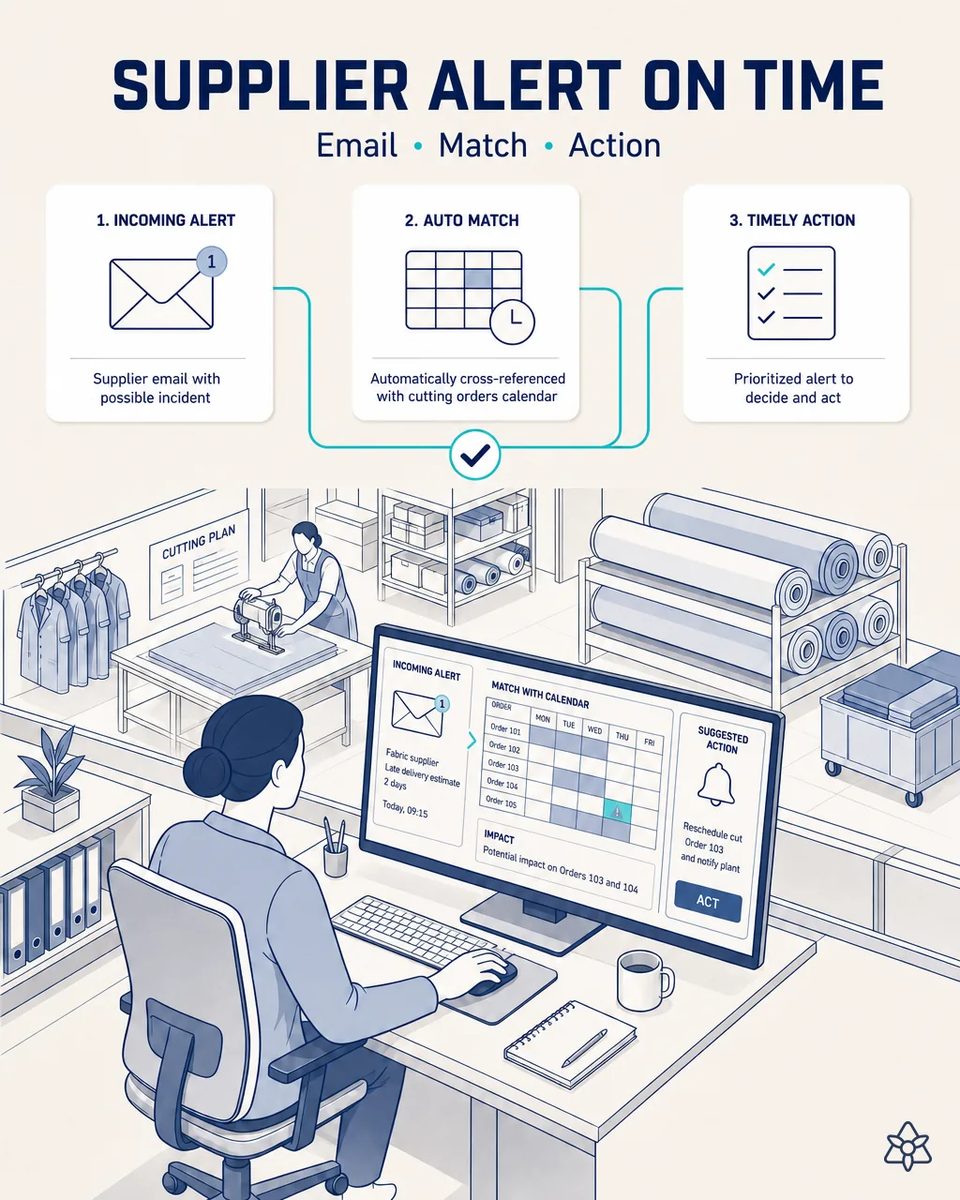
The warning that changes the cutting plan lands in an inbox nobody watches.
critical alerts from fabric suppliers reach people who can't watch their inbox in real time. By the time they're read, spreading or cutting plans are already committed — or executed with an incompatible dye lot that breaks color matching.
- Mid-morning, the fabric supplier emails a delay, a short shipment or a dye-lot change on rolls already promised to an order.
- It lands in the inbox of someone on the floor or in purchasing who cannot read email in real time, and it gets opened hours later. Often after the morning cutting plan has already been printed and handed to the spreader.
- By then the spreading plan is committed — or worse, already executed with a dye lot that breaks color matching across the order.
- A shade mismatch on a corporate uniform program is not a rework: it is a customer complaint and garments that cannot ship together. And in high-visibility garments, the shade also has to stay inside the color range the EN ISO 20471 certificate was issued for.
Connect in chaotic-sources mode — a mailbox on silent copy, 24/7.
Connect chaotic-sources mode — a mailbox on silent copy 24/7. An LLM extracts intent, entities (supplier, roll, lot, dates) and cross-references the ERP, returning a concrete action to the right role.
Reading the email sooner is only half of it. The value is the cross-check: which cutting orders use that roll or that lot, and who has to move before the fabric is spread. An alert without that cross-check is just a faster email, and a faster email still gets read late.
The supplier email today versus the cross-referenced alert
| Aspect | Today, in the inbox | With iLEAN Connect |
|---|---|---|
| When it is read in workwear sewing | 2-4 hours later | Seconds after it arrives |
| Which orders it affects | Worked out by hand | Cross-referenced with active cutting orders |
| Dye-lot change | Found at color matching | Caught before spreading |
| Who receives it in workwear sewing | Whoever it was addressed to | The role that has to act |
| What arrives in workwear sewing | One more email | A concrete action with its scope |
| Who decides in workwear sewing | The recipient | The planner — iLEAN proposes |
2-4 hours of human latency → seconds. Risk of mixing incompatible dye lots in one order → caught before the fabric is spread.
Impact estimate — to be validated with your planning team.
The block below is an estimate to be validated against your plant's actual data. We put it forward so the committee has an order of magnitude; we refine it during the assessment.
- Estimated payback 3-7 months.
- Cutting-table downtime avoided when a delay is caught in time to resequence orders. A cutting table waiting for fabric that is not coming is the most expensive idle hour of the cutting room.
- Customer complaints avoided from bad color matching across dye lots in one order.
- Human latency goes from 2-4 hours to seconds.
avoided cutting-table downtime from missed information and customer complaints from bad color matching, estimated 3-7 month payback. *Estimate to validate*.
And the fair question from the production manager
“What if it misreads which lot or roll the supplier means?” — extracting supplier, roll, lot and dates from an email and matching them against the ERP is an anchored task: the entities have to exist in your own records, and in that kind of task the best models drop below 1.5% error [1]. When the match is ambiguous, the alert says so and the planner decides; iLEAN never changes a spreading plan on its own. Every alert keeps the original email attached, so the planner can read the source in one click.
[1] OpenAI paper "Why Language Models Hallucinate", 2025 — on the reliability of AI in anchored tasks.
What people ask about fabric supplier alerts
Does the supplier have to send emails in a specific format?
No. It reads them as they arrive today, in natural language, with or without attachments. Nothing is asked of the fabric mill. The supplier keeps writing to the same people; the silent copy is set up on your side.
Does it read the shade or dye-lot information in attachments?
Yes, packing lists and lot certificates attached as PDF or spreadsheet are read along with the email body. That is often where the new lot number or the shade code is, not in the text of the message.
Who gets the alert?
The role that has to act: the cutting room lead for a lay at risk, purchasing for a short shipment, planning for a delay that moves an order. Each one sees the action that concerns them, not a forwarded email to interpret.
Does it read our personal inboxes?
No. It works on a dedicated address that receives a silent copy of supplier mail, defined with you at commissioning. Who receives a copy and which suppliers are covered is your decision, and it can be changed at any time. Personal messages never enter the system.
What if several orders share the affected lot?
The alert lists all of them with their cutting dates, so the decision on which to protect first is made with the full picture. Orders for a customer program with a delivery penalty can be flagged so they appear first.
More cases from this series
- The audit dossier organizes itselfEvery critical changeover generates its own auditable dossier. Agents organizes it by standard.…
- The flagship system against size-color mix-upsConnect + Edge + Agents coordinated protect every shipment against mislabeled size/color mixes. Zero…
- The bundle ticket enters the system with one photoOne photo of the bundle ticket at the cutting table gets it into the central system instantly. Zero lost…
- Digitize your vintage cutter without touching the panelAn external camera reads the automatic cutter's panel without touching it. Cutting history digitized…
- The efficiency spreadsheet stops living apart from the ERPConnect absorbs the line-efficiency spreadsheet and syncs it to the ERP. Up to 80% savings on…
- The fabric delivery note gets digitized with one photoOne photo of the delivery note and roll labels digitizes fabric receiving. Full dye-lot-to-garment…
Tell us how long it takes today for a supplier's dye-lot change to reach your cutting room.
We work on your plant's real data, not ours. Assessment with no commitment.
Request estimated ROI within 48h ‹ See all cases of workwear See apparel