The audit dossier organizes itself
The day the WRAP auditor arrives, someone today spends weeks rebuilding traceability. With iLEAN Edge + Agents, every critical changeover automatically generates an auditable dossier with before/after photos, decision logs and sign-offs.
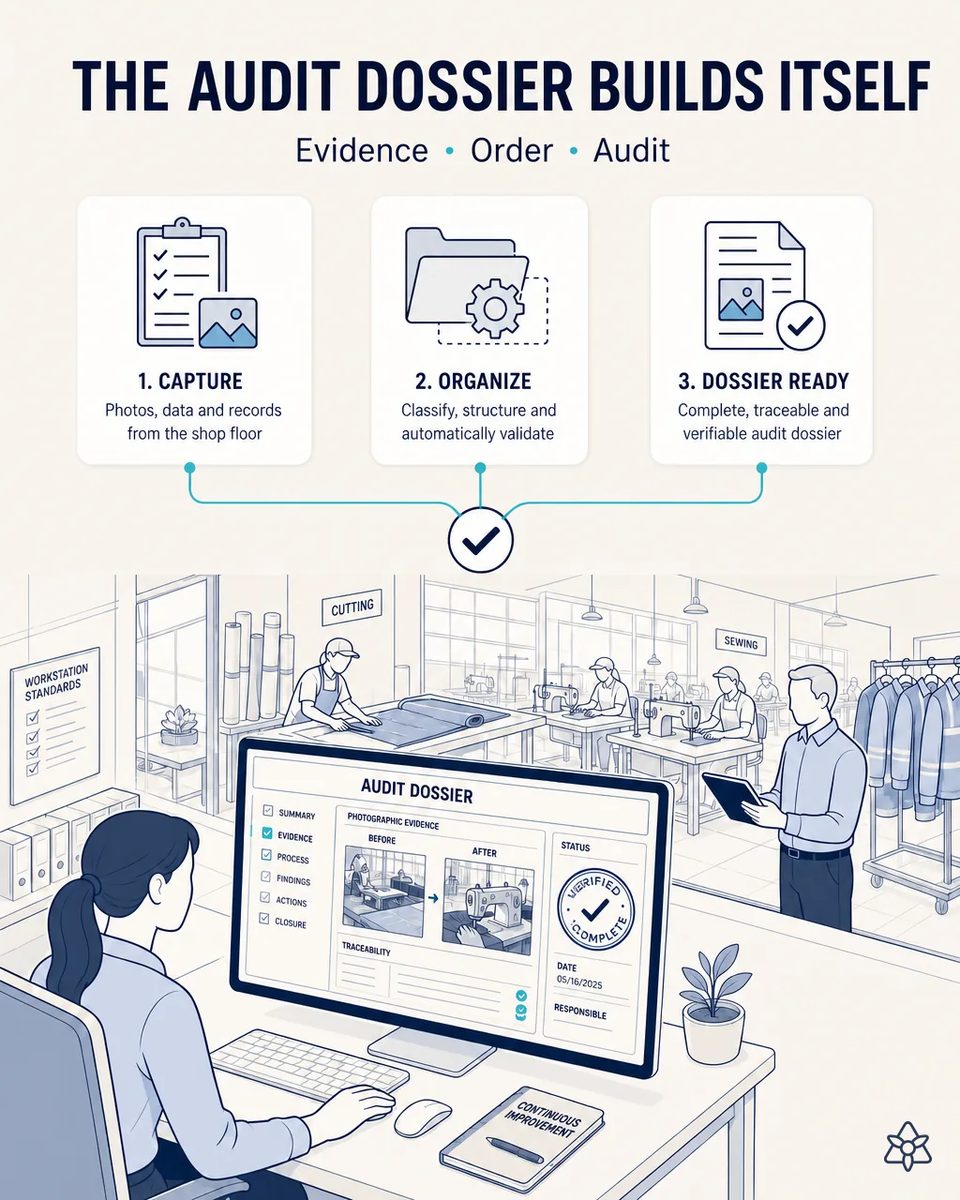
The cost of the audit is the weeks before it.
WRAP and customer-program audits require evidence that today gets rebuilt manually, risking non-conformities from documentation gaps.
- WRAP and customer-program audits ask for evidence of how the plant works: changeovers, traceability, records, sign-offs. The audit asks what happened months ago, and the plant has to prove it.
- The evidence exists, but it is scattered across paper, sign-off sheets, photos on personal phones, spreadsheets, the ERP and people's memory. Some of it is in the head of someone who has since changed shift or left.
- So someone spends weeks rebuilding traceability before the auditor arrives, and repeats it for every program that audits. The audit itself takes a couple of days; the rebuilding before it takes weeks.
- Whatever nobody wrote down at the time shows up as a gap, and documentation gaps are where non-conformities come from.
Edge captures, Agents organizes by standard.
Edge captures photo + data per changeover/bundle; Agents organizes it by certifying standard and generates a period-structured dossier. Zero post-hoc human work.
Every critical changeover leaves its dossier closed at the moment it happens, on the line and on the shift where it happened, with before/after photos, the decision log and the sign-offs. Agents only reorders that evidence for whichever standard or customer program asks. The work of the week before the audit simply stops existing. Nothing is assembled the week before, so there is nothing to forget the week before.
Pre-audit rebuilding versus the standing dossier
| Aspect | Today | With iLEAN Agents |
|---|---|---|
| Pre-audit preparation in workwear sewing | Weeks of rebuilding | Zero post-hoc work |
| Each customer-program audit | Rebuilt again | Same evidence, another index |
| Changeover evidence | A signed sheet | Before/after photos and sign-offs |
| Documentation gap in workwear sewing | Found by the auditor | Flagged when it occurs |
| Where the evidence lives | Paper, spreadsheets, ERP, memory | One dossier per period |
| Certification | Defended audit by audit | Protected continuously |
weeks of pre-audit rebuilding → zero. Documentation-gap non-conformity risk → eliminated.
Impact estimate — to be validated with your audit calendar.
The block below is an estimate to be validated against your plant's actual data. We put it forward so the committee has an order of magnitude; we refine it during the assessment.
- Estimated payback 6-12 months. Counting the rebuilding time saved and the non-conformities avoided.
- Weeks of pre-audit rebuilding go to zero. The quality team spends that time on improvement instead of archaeology.
- Documentation-gap non-conformity risk eliminated, because the gap is flagged when it happens. The plant fixes it while the people involved still remember what happened. The dossier is reviewed continuously, not discovered incomplete in front of the auditor.
- And continuous protection of the WRAP certification and the customer programs that require it.
continuous protection of the certification and the customer programs that require it, estimated 6-12 month payback. *Estimate to validate*.
And the fair question from the production manager
“Isn't this just a document manager?” — no: a document manager stores what someone uploads after the fact, with the same gaps. Here Edge captures at the moment of the changeover, not days later from memory, and classifying each piece of evidence against the clauses of a known standard is an anchored task, where the best models drop below 1.5% error [1]. And the quality lead reviews and signs the dossier before any auditor sees it. Agents assembles; a person answers for what is presented.
[1] OpenAI paper "Why Language Models Hallucinate", 2025 — on the reliability of AI in anchored tasks.
What people ask about the WRAP evidence pack
Does it cover WRAP and customer-program audits at once?
Yes: the evidence is the same, only the scheme it is indexed against changes. That is exactly the work rebuilt in full for each auditor today. A WRAP auditor and a customer-program auditor see the same changeover, indexed under the clause each one cares about.
What goes into each changeover's record?
Before/after photos from Edge, the decision log, who signed off and when, linked to the order and the line. For high-visibility garments, the EN ISO 20471 test references of the fabric lot can be attached as well. Nothing has to be rebuilt afterwards because it was all captured at the moment.
Does the auditor get into our systems in workwear sewing?
No. They receive a view or a download scoped to the period and the standard of their audit. What they see is decided by the quality lead, and their access is logged.
Does it warn us about missing evidence?
Yes, and it is the most valuable part: a critical changeover without its record is flagged when it happens, not on audit day. That leaves time to close the gap while it is still fixable, not while the auditor is waiting.
What about evidence from before deployment in workwear sewing?
It stays where it is. The dossier builds from day one forward; bringing in older records is optional. Most plants find that one full audit cycle with the dossier is enough to see the difference.
More cases from this series
- The flagship system against size-color mix-upsConnect + Edge + Agents coordinated protect every shipment against mislabeled size/color mixes. Zero…
- The bundle ticket enters the system with one photoOne photo of the bundle ticket at the cutting table gets it into the central system instantly. Zero lost…
- Digitize your vintage cutter without touching the panelAn external camera reads the automatic cutter's panel without touching it. Cutting history digitized…
- The efficiency spreadsheet stops living apart from the ERPConnect absorbs the line-efficiency spreadsheet and syncs it to the ERP. Up to 80% savings on…
- The fabric delivery note gets digitized with one photoOne photo of the delivery note and roll labels digitizes fabric receiving. Full dye-lot-to-garment…
- The fabric supplier's alert arrives on timeiLEAN reads the fabric supplier's email instantly and cross-references active cutting orders. Zero…
Tell us how many audits your plant faces a year and how long each one takes to prepare.
We work on your plant's real data, not ours. Assessment with no commitment.
Request estimated ROI within 48h ‹ See all cases of workwear See apparel