Digitize your vintage cutter without touching the panel
The automatic spreader-cutter that lays and cuts the fabric lay is usually over a decade old, and its panel shows vital data that vanishes the moment the screen rotates. Replacing it costs hundreds of thousands of dollars. With iLEAN Connect, one external camera pointed at the panel is enough — the machine stays exactly what it is, but the plant now has every cut's history digitized in central memory.
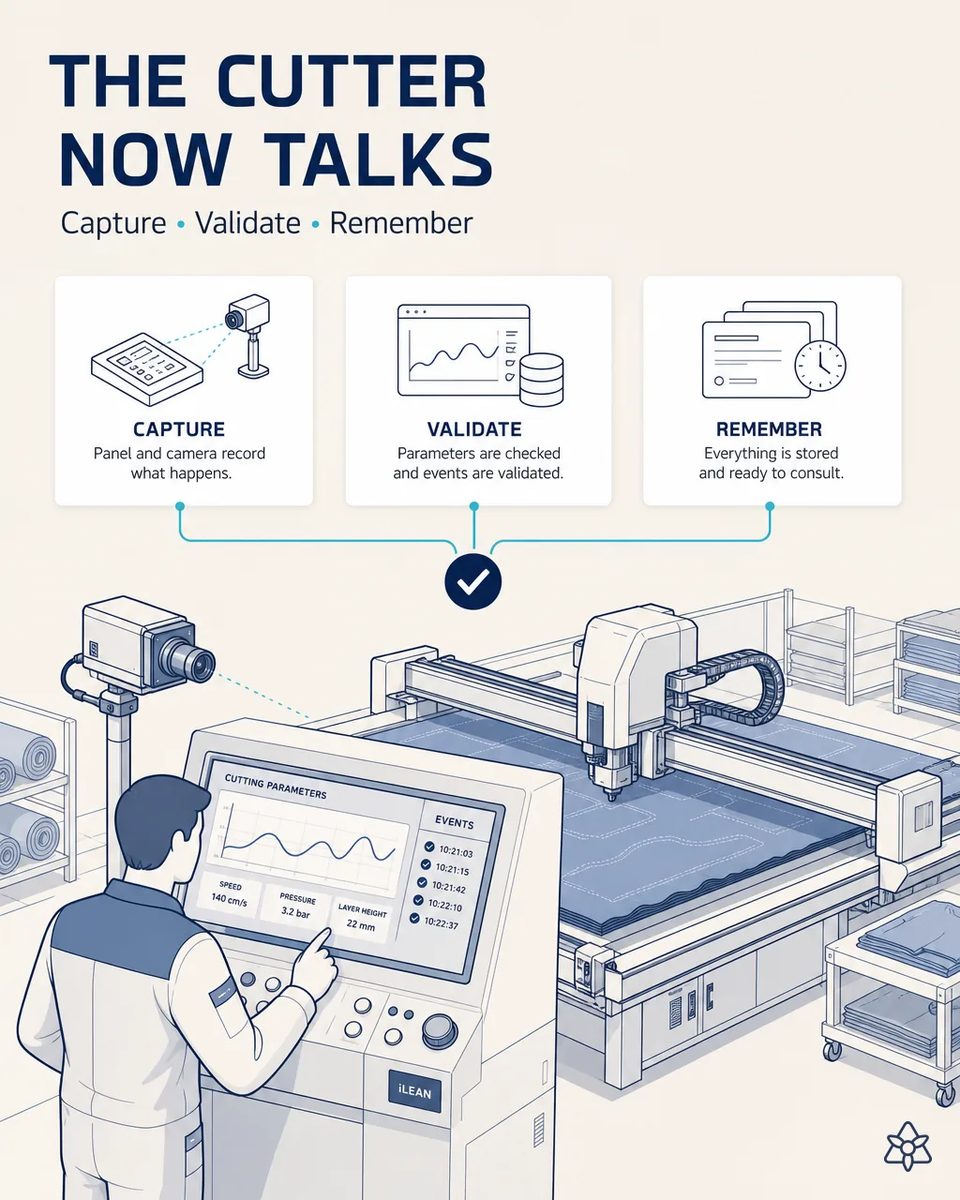
The most expensive asset in the cutting room leaves no record.
the cutter is the most expensive asset in the cutting room and the one that determines real fabric yield. Today nobody correlates cutting parameters with fabric waste because the panel's data dies every time the screen rotates.
- The automatic spreader-cutter lays and cuts the fabric lay, and it decides the real fabric yield. In most workwear plants it is over a decade old. It still cuts well, which is exactly why nobody can justify replacing it.
- Its panel shows the data that matter — cutting speed, pressure, lay height, events — and that data vanishes every time the screen rotates. The operator sees it for a few seconds; the plant never sees it at all.
- So nobody can correlate cutting parameters with fabric waste: the marker efficiency is declared, the real yield is argued about afterwards. On coverall and work shirt fabrics, a point of yield lost per order adds up to rolls a month.
- Replacing the machine just to get the data out costs hundreds of thousands of dollars, so the question stays unanswered order after order. Meanwhile the same waste repeats on every coverall and work shirt order that goes through the machine.
Connect in photo-on-panel mode — the cutter stays exactly what it is.
Connect photo-on-panel mode. A fixed industrial camera reads the screen every few seconds; OCR with an anchored LLM interprets every frame and structures the cutting history by production order, cross-referenced against the declared yield percentage.
It does not integrate with the cutter's controller, opens no ports and installs nothing on the machine. A camera reads what the operator already sees, and the plant gets every cut's history structured by production order. The machine that decides how much fabric you consume finally explains itself.
Today's cutter versus the cutter being read
| Aspect | Today | With iLEAN Connect |
|---|---|---|
| Cutting parameters | On screen, then gone | Digitized per cut |
| Link to the production order | None | Structured by order |
| Declared vs. real yield | Argued about | Cross-referenced per order |
| Root cause of fabric waste | Impossible to trace | Analysis in minutes |
| The cutter's controller | — | Untouched |
| Replacement CAPEX in workwear sewing | In next year's plan | Indefinitely deferrable |
zero correlation between cutting parameters and fabric waste → root-cause yield analysis per order in minutes. Cutter replacement indefinitely deferrable.
Impact estimate — to be validated with your average yield and its dispersion.
The block below is an estimate to be validated against your plant's actual data. We put it forward so the committee has an order of magnitude; we refine it during the assessment.
- Estimated payback 5-10 months.
- Avoided machine-replacement CAPEX: the cutter keeps working and the data comes out from outside. The replacement budget can go to something the plant actually lacks.
- Reduced fabric waste through the parameter-to-waste correlation that cannot be made today.
- Root-cause yield analysis per order goes from impossible to minutes. And the conversation with the fabric supplier about width or shrinkage starts from data, not from impressions.
estimated 5-10 month payback, avoided machine-replacement CAPEX, reduced fabric waste through parameter-to-waste correlation. *Estimate to validate*.
And the fair question from the production manager
“Can a camera reading a screen be trusted for yield analysis?” — here the task is anchored: fixed panel, fields in known positions and physically expected ranges, where the best models drop below 1.5% error [1]. And any reading that falls outside the possible range for speed, pressure or lay height is discarded instead of accepted, so it never pollutes the cutting history. A doubtful reading is marked as such, never silently filled in.
[1] OpenAI paper "Why Language Models Hallucinate", 2025 — on the reliability of AI in anchored tasks.
What people ask about reading the cutter panel
Do we need the cutter manufacturer's involvement?
No. Nothing is installed on the machine and its software is not touched, so warranty and service contracts are unaffected. The camera is mounted on its own post and can be moved to another machine without leaving a trace.
How often does the camera read the panel?
Every few seconds, which is enough to follow every lay through spreading and cutting without missing a parameter change. A change of speed or pressure halfway through a lay is captured with its time, so it can be tied to the pieces cut after it.
Can it tell which production order each cut belongs to?
Yes: the reading is cross-referenced with the active cutting order, which is what makes per-order yield analysis possible. That is the link that lets you compare the marker efficiency you planned with the fabric you actually consumed.
What if the panel rotates through several screens?
Each screen is learned at commissioning, including the alarm and event screens that only appear when something goes wrong, and the reading of each one is assembled into the same cut record. Events and alarms are captured too, because a stop in the middle of a lay often explains a yield loss nobody can account for.
Does it work on other old machines in the plant?
The pattern is the same for any machine with a readable panel. You start with the cutter because that is where fabric yield is decided. Older sewing equipment with a counter or a display can follow the same pattern later.
More cases from this series
- The audit dossier organizes itselfEvery critical changeover generates its own auditable dossier. Agents organizes it by standard.…
- The flagship system against size-color mix-upsConnect + Edge + Agents coordinated protect every shipment against mislabeled size/color mixes. Zero…
- The bundle ticket enters the system with one photoOne photo of the bundle ticket at the cutting table gets it into the central system instantly. Zero lost…
- The efficiency spreadsheet stops living apart from the ERPConnect absorbs the line-efficiency spreadsheet and syncs it to the ERP. Up to 80% savings on…
- The fabric delivery note gets digitized with one photoOne photo of the delivery note and roll labels digitizes fabric receiving. Full dye-lot-to-garment…
- The fabric supplier's alert arrives on timeiLEAN reads the fabric supplier's email instantly and cross-references active cutting orders. Zero…
Tell us how old your automatic cutter is and whether you can explain fabric waste by order.
We work on your plant's real data, not ours. Assessment with no commitment.
Request estimated ROI within 48h ‹ See all cases of workwear See apparel