Zero remakes: four rings and a method that holds
A high-volume optical plant's capital pain is double and is one and the same: that the lens leaving is not the one the prescription asked for, and that the method preventing it unravels while new people enter at ramp-up pace. The system coordinates the previous eleven pieces into four cross-checked verification rings: if they do not match, the pair does not leave the plant.
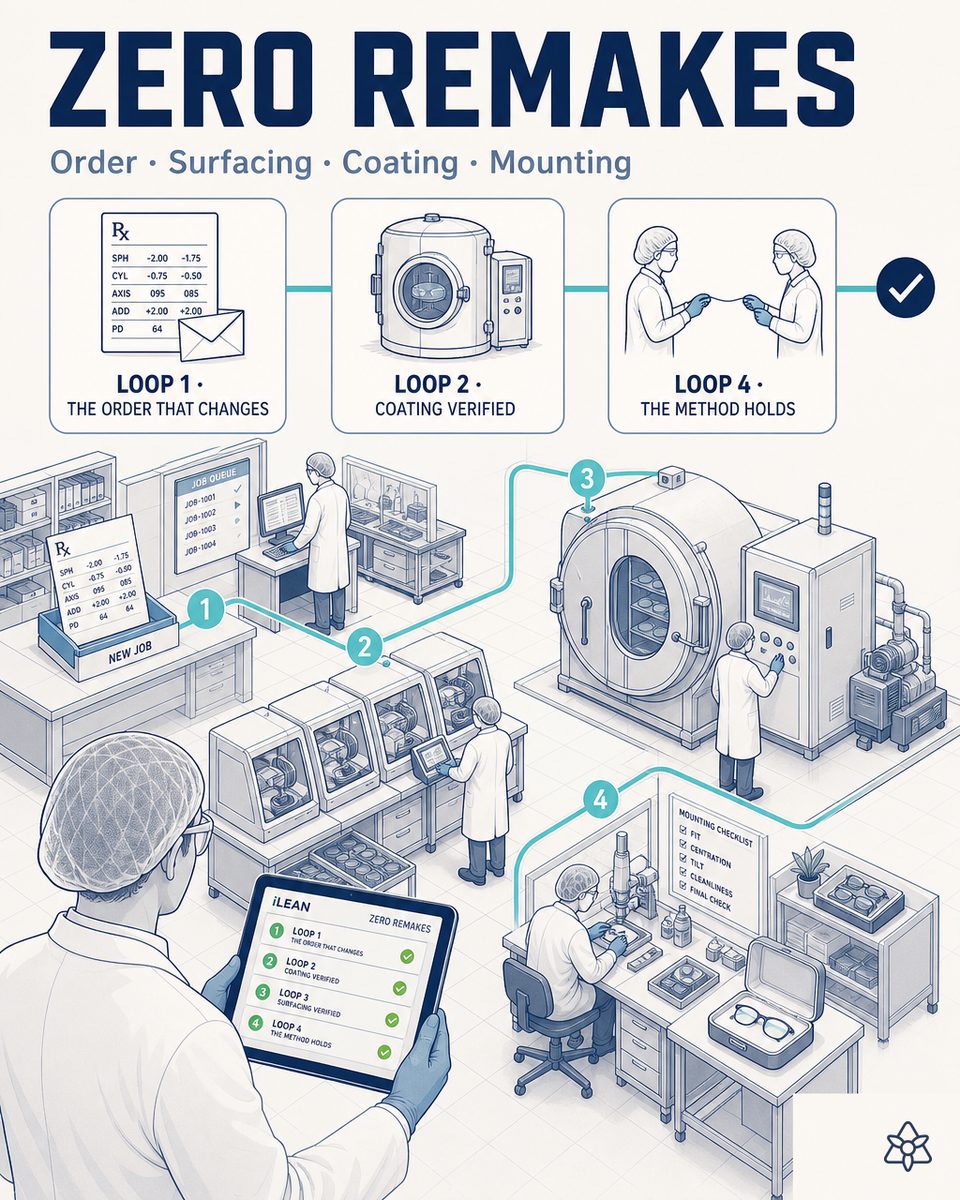
A remake is not recovered, and it rises from causes living in different places.
In an optical plant, the remake rate is the metric summarizing the process's health — and it has a property that makes it different from other sectors' scrap:
- A remake is not recovered — the prescription lens is scrap, with no way back. And it also consumes double the capacity exactly when the plant is fighting to reach it: the capacity already spent and the capacity about to be spent again.
- It rises from causes living in different places — a prescription change that arrived late, typing at the edger, a drifted vacuum load, a different cosmetic criterion on the night shift. That is why no isolated action brings it down sustainably: one cause is attacked and another rises.
- And in ramp-up there is a second effect — new people enter every month. The method has to be actively sustained or it regresses to the mean, however good last quarter's improvement was.
That is why optical plants improve in leaps and then relapse: the problem is not a lack of actions, it is that the causes are not cross-checked with each other and nobody sustains the method while the workforce grows.
Four rings that cross-check — and a method thread that does not let it unravel.
The flagship is not one more case: it is the coordination of the previous eleven into four rings that check each other, plus a transversal thread sustaining the method. Each ring contributes part of the truth; the value appears when they cross, because a discrepancy between two rings is an alert before it is a remake.
Order, surfacing, optical verification and mounted pair. If the four do not match, the pair does not leave the plant. And above them, the method thread: Agents does not report that there was a failure, it reports that a station is drifting from standard work on a specific shift and that there are people without a valid certification for that operation.
The four rings, and the thread running through them:
- Ring 1 · Order — the system defines the target prescription and Connect guarantees that any external change enters in seconds and stops the job while it is still reversible. Without this ring, everything verified later is verified against a target that may be stale.
- Ring 2 · Surfacing — what the generator and the polisher actually executed, plus the vacuum load's curve read from the panel. It is the difference between what was asked for and what the plant really did.
- Ring 3 · Optical verification — power, axis, prism and addition measured, plus the Edge camera's cosmetic judgment. Out of tolerance, JIDOKA AI stops the job before mounting, the last point where stopping is still cheap.
- Ring 4 · Mounted pair — the prescription stitched to the mounting machines and the pair's complete evidence pack. What goes out the door carries its own evidence behind it.
- SMED AI and the method thread — SMED AI accelerates the critical preparations so the rings are not paid for in productivity. And every deviation is crossed with the skills matrix and the GEMBA observations: Agents proposes the specific micro-training, and a person approves it.
Remake attacked by isolated actions vs. four cross-checked rings with a method thread
| Aspect | Without coordination | With the iLEAN flagship |
|---|---|---|
| Where the remake is detected | At the optician or the end user | At the station, with the cause identified |
| Cross-checking causes across areas | Does not exist — each attacked separately | Automatic and continuous across the four rings |
| An out-of-tolerance job | Continues to mounting | JIDOKA AI stops it before mounting |
| Standard work drift | Discovered in the monthly indicator | Detected in the shift it happens |
| Certification of who executes | Checked after the fact, if at all | Crossed in the moment, with micro-training proposed |
| Sustainment in ramp-up | The method regresses to the mean | It holds while new people enter |
Impact estimate for your plant — to be validated with your own numbers.
The block below is an estimate to be validated against your plant's actual data. We put it forward so the committee has an order of magnitude; we refine it during the assessment.
- High-volume optical plant in ramp-up, with a remake rate that does not drop sustainably and a workforce growing every month.
- Phased deployment: start with the shortest-payback Connect cases, raise rings 1 and 2, incorporate optical verification and Edge inspection, and close with the mounted pair and the evidence pack.
- Each percentage point of remake in a high-volume plant is a huge number of remade lenses per year; the case is defended with the plant's own remake cause history, not an external figure.
- Estimated payback between 6 and 12 months. Estimate to be validated with quality and with whoever signs the financial alignment.
- The return that does not fit in the spreadsheet is the capacity recovered: every pair not remade returns double the capacity exactly when the plant is fighting to reach it.
And the fair question from plant management
"Isn't this too much project to start with?" — you do not start here. The flagship is the destination, not the first step: you get there in phases, starting with the shortest-payback Connect cases, which finance the next ones. And on the reliability of the whole: everything the AI does in these four rings is an anchored task — reading a known data point, comparing against a defined tolerance, cross-checking two records — where the best models brought the error below 1.5% [1], with a person signing every critical decision and approving every training action.
[1] OpenAI paper "Why Language Models Hallucinate", 2025 — on the reliability of AI in anchored tasks.
What people ask about the flagship deployment in an optical plant
Do all twelve cases have to be deployed at once?
No, and it would not be advisable. The flagship describes the destination, not the starting point. The usual sequence starts with the Connect cases — shift report, vacuum chamber panel, prescription change, laboratory sheets, receiving and mounting — because they have the shortest payback and demand no vision hardware investment: between three and nine months each. That return finances the next phase, the Edge rings of cosmetic inspection and preparation validation. The evidence pack closes at the end, when there are already recorded events to order. Each phase delivers value on its own even if the plant decided to stop there.
What exactly does it mean that the rings "cross-check"?
That each ring's information serves to check the others'. A concrete example: if ring 3 measures a power out of tolerance, ring 2 can say what the generator and the polisher actually executed and how the vacuum load's curve went, and ring 1 whether the target prescription was still current or a change had arrived that nobody applied. None of the three data points explains anything separately; crossed, they point at the cause. And in reverse: if ring 4 detects that what the edger executed does not match the released prescription, the pair stops before leaving the plant.
What is the "method thread" and why is it different from the rings?
The four rings check the product; the method thread watches how the work is being done. It is the difference between reporting that there was a failure and reporting that a specific station is drifting from standard work on a specific shift — and that there are people without a valid certification for that operation. That cross-reference is made with the skills matrix Connect keeps alive and with the observations the supervisor dictates on the GEMBA walk. Agents then proposes the specific micro-training for that person and that operation, and a person approves it. Without that thread, in a ramping plant the method regresses to the mean even if the rings work.
Why does no isolated action bring the remake rate down sustainably?
Because the remake rises from causes living in different places that do not talk to each other: a prescription change that arrived late by email, typing at the edger in a special job, a vacuum load that drifted with nobody watching, a different cosmetic criterion on the night shift. When one of them is attacked with a project, that one drops — and the global indicator barely moves, because another rises. Only when the four are verified in a crossed, continuous way does an improvement appear that holds, because there is no longer one cause compensating for another in the shadows.
How is the business case built?
With the plant's own remake cause history, not an external figure. The plant already knows its remake rate and, in most cases, has some cause classification even if coarse. From there the calculation is direct: each percentage point of remake in a high-volume plant is a huge number of remade lenses per year, with their substrate, their surfacing, their coating and the capacity slot they occupy twice. The estimated 6-to-12-month payback comes from that exercise, and it is an estimate to be validated jointly with quality and with whoever signs the financial alignment — because the number that convinces the committee has to come from their own data.
More cases from this series
- The medical device audit, always readyImpact test, coating tests, optical verification and operator competence: the batch dossier assembles…
- Reading the AR chamber’s panel without touching the machineAn external camera reads the anti-reflective chamber’s panel and digitizes each load’s curve without…
- Receiving semi-finished lenses and monomer, with a photoA photo of the delivery note and the pallet labels: batch, quantity and expiry enter the ERP with one…
- Mounting without typing: the prescription travels from the job to the machineTracer, edger and laser marking stitched to the lab management system and the ERP: zero typing of axis…
- The GEMBA walk that enters the system by talkingThe supervisor dictates through an earpiece what they see while walking; iLEAN structures it with line,…
- The test laboratory’s Excel reaches the ERP on its owniLEAN reads the test sheet when it is saved, structures it and feeds it into the ERP after human…
What is your remake rate and what does each point cost you?
We work on your plant's real data, not ours. We walk your flow and put numbers on each ring with quality and finance. Assessment with no commitment.
See how we would apply it in your plant — session with quality and finance ‹ See all 12 eyewear cases See apparel, footwear & accessories