The GEMBA walk that enters the system by talking
The shift supervisor and the continuous improvement manager spend the day walking between molding, surfacing, coatings, mounting and shipping, hands busy. What they see — a centration out of standard, a tinting tank running slow, a person two hours straight at inspection who should rotate — enters no system. With Connect in voice mode they dictate it while walking and the observation structures itself.
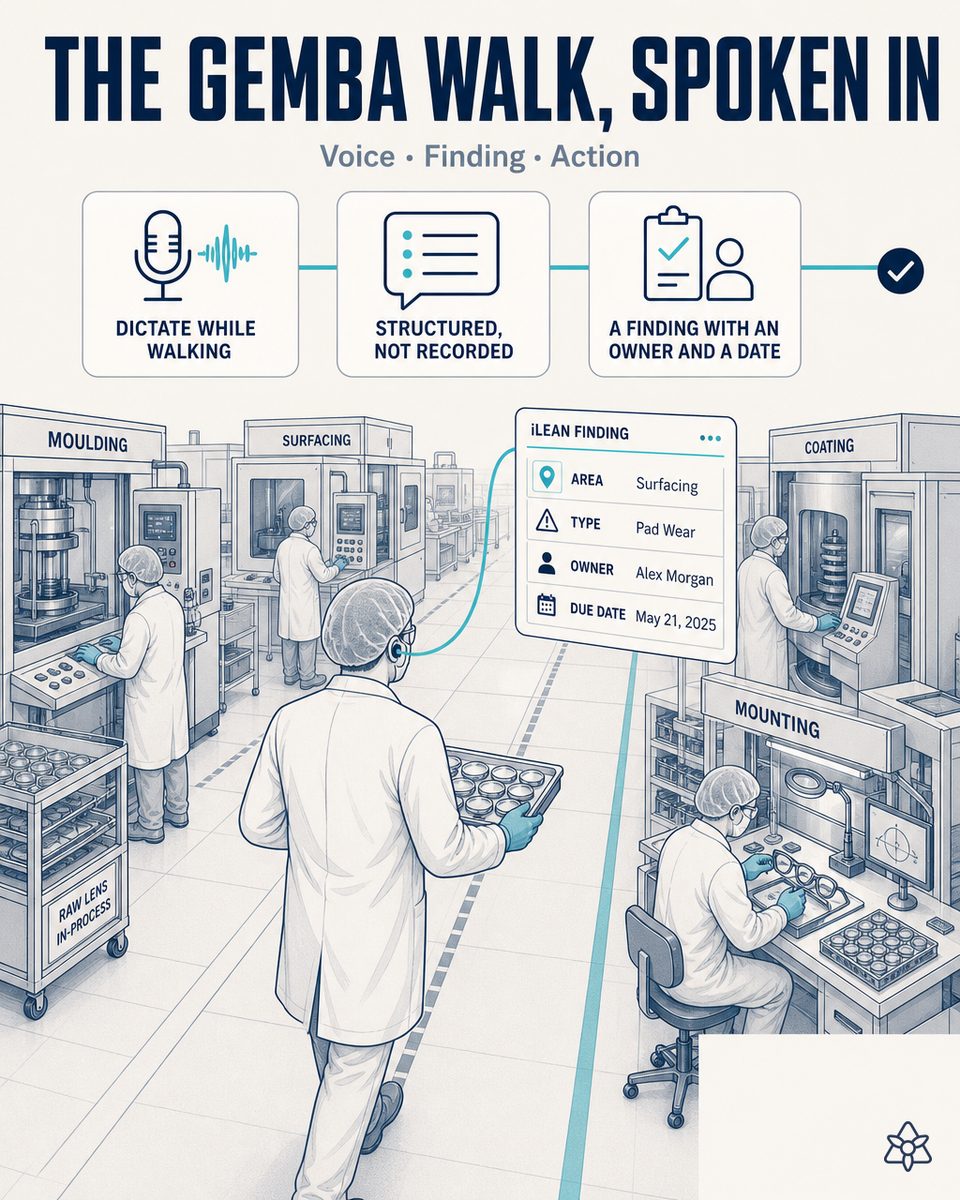
Daily Management produces the plant's most valuable information — and it is the only kind that is not stored.
In an optical plant, the GEMBA walk is where you truly see how the method is going: whether centration is being done as the standard dictates, whether a tinting tank is taking longer than it should, whether someone has been two hours straight at cosmetic inspection and should rotate. And it is exactly what reaches nowhere:
- It is shared aloud and evaporates — the observation is told at the next morning's meeting, already turned into a general impression. The concrete detail — which station, which shift, which machine, at what time — has been lost along the way.
- Recording it would require stopping — going back to the office, opening a form and typing. On a real shift that never happens, and it is not a discipline problem: the system was asking for something incompatible with walking the plant.
- In a ramping plant, losing that is losing the method — when the standard is being built at the same time as production runs, the GEMBA observation is the method. Without a record, continuous improvement is prioritized by whatever made the most noise, not by what repeats most.
The result is a plant where the most valuable information is produced every day and evaporates every evening, and where the continuous improvement system depends on three people's memory instead of having data of its own.
Connect in voice mode — dictate while walking and have it structured, not recorded.
The difference between recording and capturing is structure. A loose voice memo is a file nobody reopens; what is needed is that dictation becoming a typed observation tied to the line, station and shift where it was said. That is Connect in earpiece mode.
The supervisor dictates it while walking, with a wake word and without taking anything out of a pocket. iLEAN structures it as a typed observation — standard work deviation, training need, machine incident, Kaizen idea —, ties it to the active line, station and shift and returns support by voice in seconds, cross-referencing with the skills matrix.
How Connect operates in voice mode in an optical plant:
- Truly hands-free — a Bluetooth earpiece with a wake word. No stopping, no pulling out the phone, no removing anything. The cost of recording something drops to nearly zero, which is the only way it gets recorded.
- A typed observation, not loose text — the model classifies what was dictated: standard work deviation, training need, machine incident or Kaizen idea. That is what later allows counting, grouping and seeing patterns.
- Tied to the active context — the system knows which line, station and shift are running, so "centration on line 2 is being done out of standard" lands tied to its place and its time on its own.
- Cross-reference with the skills matrix — when the observation points to training, iLEAN checks against the certification of whoever was at that station and returns the answer by voice in seconds, without the supervisor having to look it up.
- It feeds the sustainment tracker on its own — the observations feed the Kaizen follow-up that today is maintained by hand. Continuous improvement stops depending on someone remembering and transcribing.
A GEMBA that evaporates vs. a GEMBA that enters the system
| Aspect | Without the earpiece | With iLEAN Connect voice |
|---|---|---|
| Cost of recording an observation | High: stop, return to the office, type | Nearly zero: dictate it while walking |
| What survives the shift | A general impression at the meeting | The typed observation with line, station, shift and time |
| Typing | Does not exist | Standard work, training, machine or Kaizen idea |
| Cross-reference with the skills matrix | Manual, if it occurs to someone | Automatic, with a voice answer in seconds |
| Kaizen sustainment tracker | Maintained by hand | Fed on its own with real observations |
| Detection of slow patterns | Practically impossible | Automatic counting and grouping |
Impact estimate for your plant — to be validated with your own numbers.
The block below is an estimate to be validated against your plant's actual data. We put it forward so the committee has an order of magnitude; we refine it during the assessment.
- Optical plant with shift supervisors and continuous improvement walking the GEMBA most of the day, hands busy and with no practical access to a keyboard.
- Connect voice pilot with an earpiece for one or two roles, anchored to the active line and station context. First value expected within a few weeks: the volume of what surfaces always surprises.
- It is the hardest piece to monetize directly, and we do not hide it. Its value is the continuous improvement system gaining data of its own instead of depending on people's memory. Estimate to be validated against each plant's improvement plan.
- The honest way to size it is empirical: one month of earpiece with one supervisor, and counting which observations surfaced that were not recorded before and how many were recurring.
- A side benefit in a ramping plant: when the method is being built at the same time as production runs, having the GEMBA recorded is what allows sustaining what is improved instead of rediscovering it every quarter.
And the fair question from the works council
"Is this an open microphone over the people?" — no. The earpiece activates with a wake word and captures what the supervisor decides to dictate, just as if they wrote it in a notebook; it does not listen continuously and does not record conversations with anyone. What is stored are process observations tied to line, station and shift — verification of the method, never control over the person. And reliability plays on anchored ground: structuring a short dictation against a known context is the class of task where the best models brought the error below 1.5% [1], with human review before anything counts.
[1] OpenAI paper "Why Language Models Hallucinate", 2025 — on the reliability of AI in anchored tasks.
What people ask about the GEMBA walk earpiece
Is the earpiece listening the whole shift?
No. It activates with a wake word and captures only what the supervisor decides to dictate, the same way as if they noted it in their notebook. There is no continuous listening, conversations with operators are not recorded and the plant's ambience is not taped. What stays in the system are process observations — what was observed, on which line, at which station and at what time — because the goal is verifying how the method is being applied, never checking up on the person. Worth making clear with the works council before the pilot, and it holds up technically: outside the wake word nothing is transcribed or sent.
How is it different from recording a voice memo on the phone?
In structure and in context. A voice memo is a file that has to be listened to again, transcribed and classified — and that in practice nobody reopens. Connect turns the dictation into a typed observation: standard work deviation, training need, machine incident or Kaizen idea, and above all tied to the active context — which line, which station and which shift were running. That is what later allows counting how often something repeats, grouping it by station or cross-referencing it with the remake rate. An audio file allows none of that.
What does this have to do with the skills matrix?
A lot, and it tends to be the immediate return that hooks the supervisor. When the observation points to a training issue — a centration not being done as the standard dictates, a cosmetic inspection with a criterion different from the morning shift's — iLEAN automatically checks against the certification of whoever was at that station and returns the answer through the earpiece itself in seconds. In a ramping plant, where new people enter continuously, that query is the difference between correcting the wrong person and detecting that that station has a real training gap.
How does this feed the Kaizen sustainment tracker?
Directly, and without anyone transcribing. Today that tracker is maintained by hand: someone remembers what was agreed, checks whether it holds and notes it. With Connect, every dictated observation enters already typed, dated and tied, so the follow-up stops depending on memory: you can see whether a standard deviation keeps appearing weeks after the corrective action, or whether a Kaizen idea collected at the GEMBA ever got implemented. Continuous improvement gains data of its own instead of living off meeting minutes.
How is it justified to management if it has no clear payback?
By presenting it as what it is: an enabling piece, not a case with a return of its own — and we say so in the brief and here. Its value is that the programs that do have numbers — remake reduction, method stabilization, the training plan — stop feeding on recollections. The honest way to size it is empirical: one month of earpiece with one supervisor and counting how many observations surfaced that were not recorded before and how many were recurring. That figure, placed next to the cost of the remakes those recurrences caused, is the business case — and it comes from the plant itself, not from an external estimate.
More cases from this series
- The medical device audit, always readyImpact test, coating tests, optical verification and operator competence: the batch dossier assembles…
- Reading the AR chamber’s panel without touching the machineAn external camera reads the anti-reflective chamber’s panel and digitizes each load’s curve without…
- Receiving semi-finished lenses and monomer, with a photoA photo of the delivery note and the pallet labels: batch, quantity and expiry enter the ERP with one…
- Mounting without typing: the prescription travels from the job to the machineTracer, edger and laser marking stitched to the lab management system and the ERP: zero typing of axis…
- The test laboratory’s Excel reaches the ERP on its owniLEAN reads the test sheet when it is saved, structures it and feeds it into the ERP after human…
- Catching the prescription change before the lockoutiLEAN reads the email that changes or cancels a prescription, locates the job in transit and stops it…
How much of what you see at the GEMBA survives the shift?
We work on your plant's real data, not ours. A short pilot with one supervisor is enough to see the volume of what is lost today. Assessment with no commitment.
See how we would apply it in your plant — pilot with one supervisor ‹ See all 12 eyewear cases See apparel, footwear & accessories