Receiving semi-finished lenses and monomer, with a photo
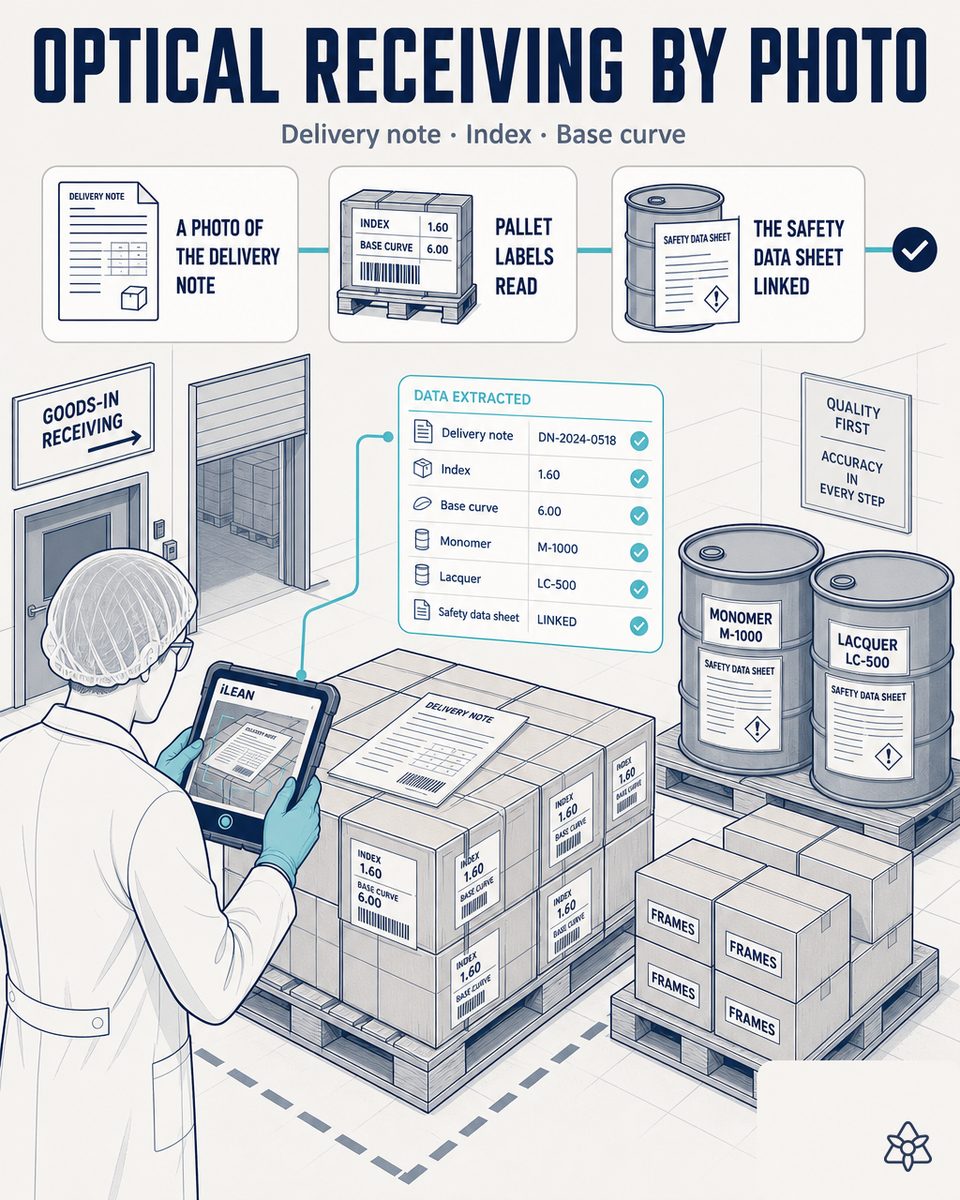
Pallets of semi-finished lenses by index and base curve arrive, monomer and lacquer drums with a safety data sheet, frame boxes for the distribution center. The receiving manager has to sign and, on top of that, type line by line into the ERP. With Connect a photo of the delivery note and another of the labels is enough: everything is extracted, validated with one tap and enters the ERP.
Receiving ties the whole plant's traceability — and it is the one with the least time to do it well.
At an optical plant's dock, very different material is received in the same shift: semi-finished lenses classified by index and base curve, chemicals with their safety data sheet and expiry, and frames for distribution. And the circuit has a structural tension:
- Either delay, or haste — either the carrier waits and charges, or typing happens in a hurry and the batches end up badly tied. Both options cost, one in visible money and the other in invisible money.
- The badly tied batch reappears weeks later — when a series with a polymerization defect has to be traced back to its monomer batch, and the trail leads nowhere. By then it is no longer a warehouse problem.
- And there is a fiscal layer on top — in a plant under a manufacturing-for-export customs regime, a material-to-batch inventory mismatch is not a warehouse matter: it is an auditable fiscal problem.
In the end receiving works because someone sustains it with craft and haste, not because the system accompanies it. And that craft is recorded nowhere.
Connect in photo-the-analog mode — the delivery note as it comes, and the labels as they are.
The necessary information is already printed: on the delivery note and the pallet labels. What is missing is the path from that paper to the ERP without passing through a keyboard. Connect covers it with vision, without demanding the supplier change anything and without redesigning the dock's circuit.
A photo of the delivery note, whatever its format. A photo of the pallet labels, reading barcode, QR or plain text. For chemicals, it associates the safety data sheet and the expiry. A summary on the tablet, one-tap validation and a feed into the ERP via API with the batch tied.
How Connect operates at an optical plant's receiving:
- The delivery note, asking nothing of the supplier — vision recognizes the delivery note's tabular structure as it arrives, with whatever layout each supplier brings. No templates to maintain and no conversations to have with anyone outside.
- Labels in any encoding — barcode, QR or printed plain text. Whatever is on the pallet is read with the tablet's camera, with no dedicated scanner.
- Chemicals, with their sheet and their expiry — for monomer and lacquer, Connect associates the safety data sheet and the expiry date with the received batch, which is what later needs to be at hand and today lives in a filing cabinet.
- One-tap validation — the manager reviews the summary and confirms. Lines with a doubtful reading appear highlighted and are the only ones demanding attention.
- The batch tied from the photo — the ERP feed enters with the batch linked to the material, so backward traceability exists from minute one and customs inventory reconciliation stops being a manual exercise.
Typed receiving vs. receiving with Connect photo
| Aspect | Delivery note typed line by line | With iLEAN Connect photo |
|---|---|---|
| Truck time at the dock | 45 minutes waiting | A few minutes |
| The supplier's delivery note format | Normalized by the person, by hand | Interpreted as it arrives |
| Tied batches | Badly tied out of haste, resurfaces weeks later | Complete traceability from the photo |
| Chemicals' safety sheet and expiry | In a filing cabinet, apart from the batch | Associated with the batch at receiving |
| Material-to-batch customs inventory | Mismatches that are a fiscal problem | Automatic reconciliation |
| Receiving module licenses | One per person who types | One: the validator's |
Impact estimate for your plant — to be validated with your own numbers.
The block below is an estimate to be validated against your plant's actual data. We put it forward so the committee has an order of magnitude; we refine it during the assessment.
- Optical plant with daily receiving of semi-finished lenses by index and base curve, chemicals with a safety sheet and frames for distribution, and several suppliers with different formats.
- Connect photo pilot at the dock with an ERP feed via API after one-tap validation. Without asking suppliers for changes or redesigning the circuit. First value expected within a few weeks.
- Direct financial angle — the receiving and warehouse module typically demands 2-3 active licenses; with Connect only the manager validates, without the rest entering the ERP. Typical reduction of 50-70% in that module's licenses, plus the bulk capture module usually sold separately.
- Estimated payback between 3 and 8 months. Estimate to be validated.
- The lever that is not in the spreadsheet: the monomer batch tied from day one. When a series with a polymerization defect has to be traced, either the trail is there or it is not — and if the plant operates under a customs regime, the mismatch is auditable.
And the fair question from the warehouse manager
"What if it misreads a batch and my inventory goes off?" — hallucination is a problem of free generation, not of anchored tasks. Reading a batch printed on a label and mapping it to a known field is an anchored task, and there the best models brought the error below 1.5% [1]. On top of that there are two nets underneath: doubtful lines arrive highlighted and nothing is fed in without a person confirming. The practical result is fewer errors than typing in a hurry with the truck waiting.
[1] OpenAI paper "Why Language Models Hallucinate", 2025 — on the reliability of AI in anchored tasks.
What people ask about typing-free receiving in an optical plant
Do we have to ask the supplier to change its delivery note?
No, and it is a design condition. Asking the semi-finished lens, monomer or frame suppliers to adopt a specific format does not work in practice: each has its system and its templates, and the one serving you the least volume is the one least likely to change. Connect's vision interprets the delivery note as it arrives, with whatever layout it brings, and the same with the pallet labels, whether barcode, QR or plain text. The adapting is done by the system, not the supplier or the person at the dock.
What changes for chemicals like monomer or lacquer?
The safety data sheet and the expiry stay associated with the batch at the moment of receiving it, not in a separate filing cabinet. Today that documentation exists but lives disconnected from the material that entered: when it is needed — an inspection, a handling query, an expiry review — it has to be hunted down. With Connect the monomer batch enters the ERP already linked to its sheet and its date, so the question "what do we have in the plant expiring this month and what documentation does it carry?" becomes a query instead of a walk around the warehouse.
Why does the monomer batch matter so much?
Because it is the link sustaining downstream traceability in lens manufacturing. When a polymerization defect appears in a series, the inevitable question is which batch it came from. If at receiving someone typed in a hurry and that batch was badly tied, the investigation stops there and works by elimination. Closing traceability at the moment of receiving costs a few seconds; reconstructing it weeks later, with product already on the market, costs much more and is sometimes not possible.
What does this have to do with the customs regime?
In a plant operating under a manufacturing-for-export customs regime, the inventory has to reconcile material to batch, not just in total. A mismatch is not solved with a warehouse adjustment: it is an auditable fiscal matter, with its file and its deadlines. Receiving is exactly where that reconciliation is won or lost, because it is where material enters the system. By tying the batch from the very photo of the delivery note and the label, reconciliation stops depending on someone having typed well in a hurry and becomes automatic.
How does this translate into ERP licenses?
By counting how many people need access to the receiving and warehouse module today only to book goods in. Typically 2 or 3 active licenses. With Connect the entry happens via API and only the manager validates, so the rest no longer need access: the usual reduction is between 50 and 70%. To that is usually added the bulk capture module, which many ERPs sell separately and which stops being needed. It is a recurring, easy-to-audit saving, because it comes from the number of contracted users versus those who really need to operate the module.
More cases from this series
- The medical device audit, always readyImpact test, coating tests, optical verification and operator competence: the batch dossier assembles…
- Reading the AR chamber’s panel without touching the machineAn external camera reads the anti-reflective chamber’s panel and digitizes each load’s curve without…
- Mounting without typing: the prescription travels from the job to the machineTracer, edger and laser marking stitched to the lab management system and the ERP: zero typing of axis…
- The GEMBA walk that enters the system by talkingThe supervisor dictates through an earpiece what they see while walking; iLEAN structures it with line,…
- The test laboratory’s Excel reaches the ERP on its owniLEAN reads the test sheet when it is saved, structures it and feeds it into the ERP after human…
- Catching the prescription change before the lockoutiLEAN reads the email that changes or cancels a prescription, locates the job in transit and stops it…
How much time does your receiving lose typing delivery notes?
We work on your plant's real data, not ours. We look at your real delivery notes and labels and calculate the case with you. Assessment with no commitment.
See how we would apply it in your plant — demo at your dock ‹ See all 12 eyewear cases See apparel, footwear & accessories