Catching the prescription change before the lockout
The order entered fine, but an email arrives: wrong addition, changed frame, canceled pair. That email waits in an inbox while the job gets blocked, surfaced, polished, hard-coated and enters the vacuum chamber — and each station turns a cheap change into expensive scrap, because on a prescription lens there is no going back. Connect reads the email at second zero, locates the job and acts according to where it is.
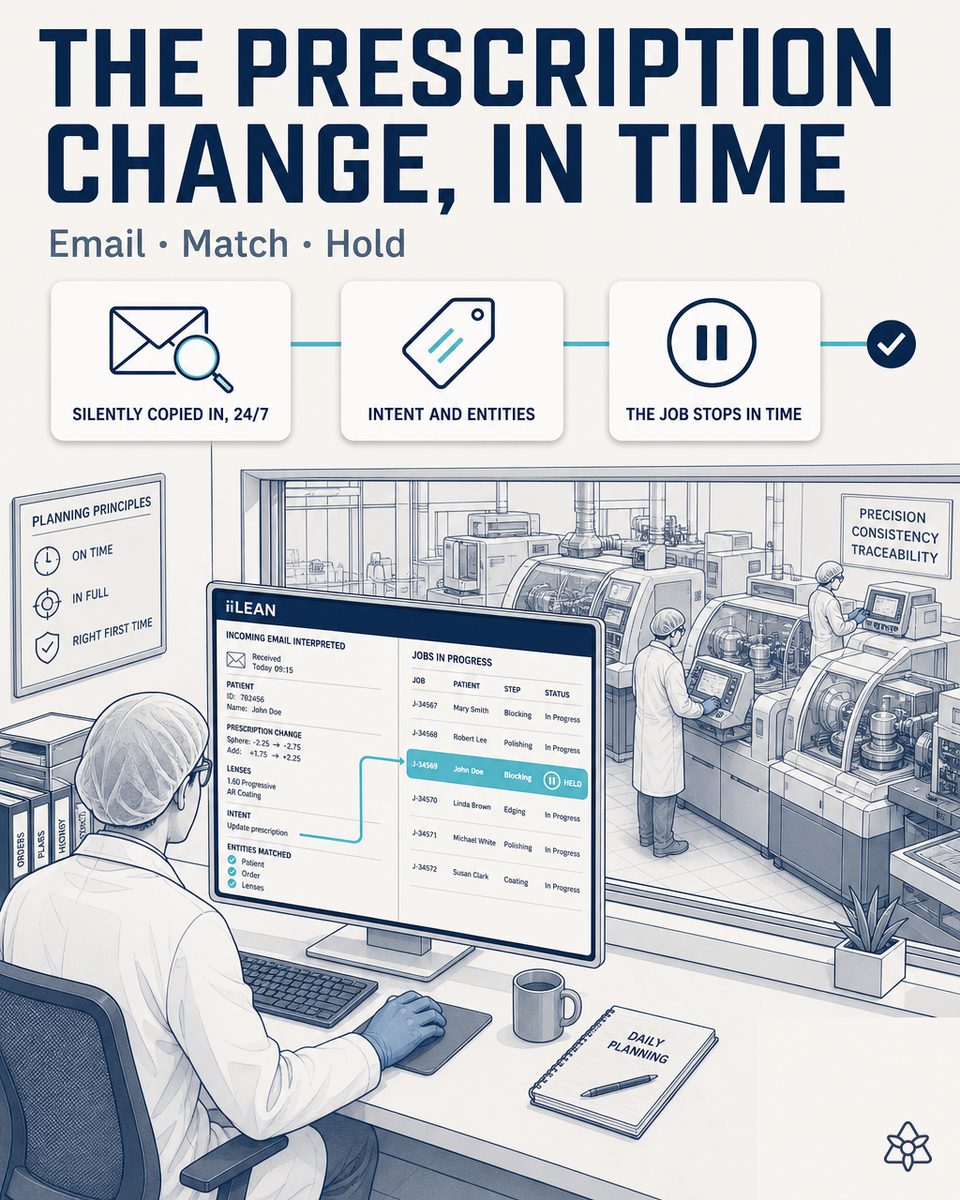
The notice that invalidates the job races a clock of minutes — and arrives through a channel of hours.
The notices that knock down a job in progress — a mistaken addition, a frame the user changes, a canceled pair — arrive through human, asynchronous channels. The line, meanwhile, advances at a pace of minutes:
- Human latency of hours against a line of minutes — between the customer changing their mind and the plant finding out, two, three or four hours pass. In that stretch the job has crossed exactly the stations that accumulate the most added value.
- Each station makes the same error more expensive — stopping a job before blocking costs almost nothing. Stopping it after surfacing, polishing, hard coating or the vacuum chamber costs the whole lens. And in prescription there is no reprocessing: it is remade.
- Or worse than the scrap — the pair ships knowing it is no longer the one the user ordered, because the notice appeared when the box was already closed.
Nobody is at fault: the manager cannot watch an inbox while walking the plant, and the email does not know a clock is running. The cost of that latency appears in no report — it dilutes into the remake indicator.
Connect in chaotic-sources mode — silently copied, reading 24/7.
An optical plant's critical information does not always arrive through the lab system: it arrives by email or messaging. Connect does not try to change that habit — it gets copied on a dedicated mailbox and reads everything, without asking anyone to forward anything or change channels.
Connect reads the email at second zero, extracts intent — modification, cancellation, urgency — and entities — order reference, new prescription, new frame —, and cross-references them with the job's real state in the lab system. If it has not yet been blocked, it stops it and notifies. If it is already surfaced, it notifies with the real cost of the change.
How Connect operates on order modification notices:
- A dedicated mailbox silently copied — the customer or the optician keeps writing where they write. Connect receives a copy and works on what arrives, with no new portal and without asking anyone outside to change anything.
- Intent and entities, not keywords — the model tells a modification from a cancellation and from a routine query, and extracts what matters: order reference, new prescription, new frame, urgency.
- Cross-reference with the job's real state — the notice is only worth something compared against where the lens is right now. Connect locates the job in the lab system and calculates the real impact, not the theoretical one.
- It acts by station — if the job has not yet been blocked, it stops it: a reversible, cheap action. If it is already surfaced or coated, it does not decide alone — it notifies with the real cost so a person chooses.
- Humans in command — iLEAN executes the reversible and leaves to a person the decision that costs money. That boundary is by design, not a configuration option.
A notice in an inbox vs. a notice read and cross-referenced by Connect
| Aspect | A human inbox | With iLEAN Connect copied in |
|---|---|---|
| Notice → action latency | 2-4 h of human latency | Seconds |
| Where the change is caught | At mounting, or at shipping | Before blocking, while it is still cheap |
| Cost of the change | The whole lens — there is no reprocessing | Nearly zero if stopped in time |
| Shipped pairs that are no longer what was ordered | Happens | Eliminated: the notice arrives before the box |
| Decision on an already-surfaced job | Taken late and in a rush | Taken by a person, with the real cost in front |
| The customer's channel | You have to ask them to change | They keep writing where they write |
Impact estimate for your plant — to be validated with your own numbers.
The block below is an estimate to be validated against your plant's actual data. We put it forward so the committee has an order of magnitude; we refine it during the assessment.
- Optical plant with a relevant volume of order modifications and cancellations arriving by email or messaging to specific people.
- Connect pilot on a copied dedicated mailbox, with the cross-reference against the job's state in the lab system. That system is not touched except on human confirmation. First value expected within a few weeks.
- Indicative payback between 3 and 7 months depending on the volume of order modifications. Estimate to be validated.
- The saving is measured almost directly: count how many jobs a month are remade today because a notice arrived late and what each of those pairs is worth.
- The lever that does not fit in the spreadsheet: the pair that does not ship wrong. A user receiving a prescription that was no longer theirs is not solved with a credit note.
And the fair question from the laboratory manager
"What if the AI misreads an email and stops a job that was fine?" — stopping before blocking is a reversible action: it is released and continues, and the cost of having been wrong is seconds. The irreversible — discarding an already-surfaced lens — is not decided by the system, it is signed by a person with the cost in front of them. On the reading itself, hallucination is a problem of free generation, not of anchored tasks: extracting reference and prescription from an email and cross-referencing them with the job in progress is where the best models brought the error below 1.5% [1]. And if the notice arrives ambiguous, it gets flagged instead of resolving itself.
[1] OpenAI paper "Why Language Models Hallucinate", 2025 — on the reliability of AI in anchored tasks.
What people ask about catching the prescription change in time
Do we have to ask the customer or the optician to change how they notify us?
No, and it is the design's starting point. Asking whoever sends the order to use a different portal or a specific format does not work in practice — the one bringing you the least volume is the one least likely to change. Connect gets silently copied on a dedicated mailbox and works on what arrives as it arrives: prose emails, screenshots, forwarded threads, business messaging. Nobody outside the plant learns there is a system reading, and nobody inside has to forward anything anywhere.
Can the system stop a job on its own?
Only when stopping is reversible and cheap, which is the case before blocking: the job is held, a notice goes out and, if it turns out the notice did not apply, it is released and continues its route. The cost of being wrong there is counted in seconds. What the system never does is take the expensive decision: if the job is already surfaced, polished or coated, Connect discards nothing — it presents the notice with the lens's real state and the cost of the change, and a person decides whether it is remade, finished or negotiated with the customer. It is the humans-in-command boundary applied at the exact point where it stops being reversible.
How does Connect know which station the lens is at?
By cross-referencing the notice with the job's real state in the lab system, which is what knows whether that job is pending blocking, on the polisher, in hard coating, inside the vacuum chamber or already at mounting. That query is what turns an email into a concrete action: the same message means "stop it, it costs nothing" if the job has not entered blocking, and "this is already worth a lens, you decide" if it left coating twenty minutes ago. Without that cross-reference, a notice is just one more important email in an inbox.
What if the email is ambiguous or does not identify the order well?
It gets flagged as ambiguous instead of resolving on its own. If the message does not make clear which reference is affected, or gives a prescription that matches no job in transit, the system presents it as doubtful data, showing what it did understand and what it did not, for a person to complete. A notice saying "this seems to affect order X, confirm it" is preferable to a confident stop built on a weak reading — above all when the alternative to stopping is letting a lens that is no longer usable run on.
How is this case's return measured?
With a figure the plant already has, even if it does not always look at it this way: how many jobs a month are remade because a notice arrived late. Each of those pairs has a known cost — substrate, surfacing time, coating, mounting and the slot it occupies in the plan. If that figure drops, the return follows on its own, and it shows in the same remake indicator already being reported. Add what cannot be averaged: the pair that does not reach the user with the wrong prescription, which is a commercial problem and not only a cost one.
More cases from this series
- The medical device audit, always readyImpact test, coating tests, optical verification and operator competence: the batch dossier assembles…
- Reading the AR chamber’s panel without touching the machineAn external camera reads the anti-reflective chamber’s panel and digitizes each load’s curve without…
- Receiving semi-finished lenses and monomer, with a photoA photo of the delivery note and the pallet labels: batch, quantity and expiry enter the ERP with one…
- Mounting without typing: the prescription travels from the job to the machineTracer, edger and laser marking stitched to the lab management system and the ERP: zero typing of axis…
- The GEMBA walk that enters the system by talkingThe supervisor dictates through an earpiece what they see while walking; iLEAN structures it with line,…
- The test laboratory’s Excel reaches the ERP on its owniLEAN reads the test sheet when it is saved, structures it and feeds it into the ERP after human…
How many jobs a month get remade because a notice arrived late?
We work on your plant's real data, not ours. We show you the reading working on your own notices. Assessment with no commitment.
See how we would apply it in your plant — demo on your notices ‹ See all 12 eyewear cases See apparel, footwear & accessories